Person · 551 BCE – 479 BCE · Early China
Confucius
- Also known as
- 1
- Agama Konghucu
- Cheu-kong
- Chung-ni
- ci kung-ce
- Conffiwsiws
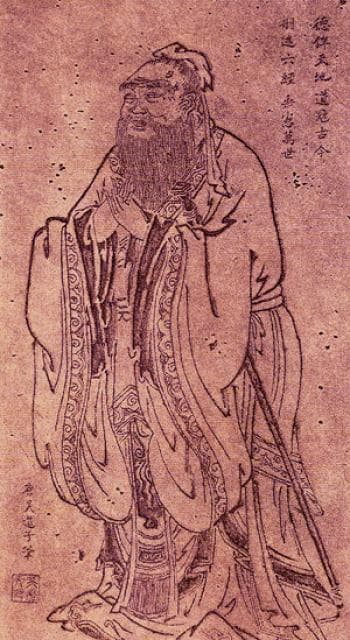
The master who would shape the moral architecture of East Asia did not see himself as an innovator, but as a preservationist.
In the twilight of the sixth century BCE, the broad, flat plains of northeastern China were a patchwork of warring fiefdoms, where the great, central house of Zhou ruled in name only. It was an age of brilliant, bloody chaos. The kings of Zhou, once the unquestioned masters of the world, had lost their grip on the scepter after a northern horde plundered their capital in 770 BCE, forcing them to flee eastward to Lo-yang. In their wake, the Chinese landscape fractured into a shifting constellation of semi-independent territories—at times numbering as many as one hundred and fifty, though only thirteen of them held real weight. This was the Spring and Autumn period, an era whose annals read like the pages of a dark, heroic epic: a chronic misrule of states contending with states, clans murdering within states, and sons murdering their fathers. In this world of deep social decay, where ministers routinely usurped their rulers and the common people suffered under constant warfare and frequent famine, a man named Kong Qiu was born. History would remember him as Kongfuzi, "Master Kong"—a name later Latinized by European Jesuits into Confucius.
Confucius did not view himself as an innovator, but rather as a transmitter of ancient truths. He was born in 551 BCE in Zou, a town in the state of Lu, a region that occupied what is now Shandong province. Though his father, Shuliang He, was an elderly garrison commandant renowned for feats of physical strength, he died when Confucius was only three. Raised in poverty by his young mother, Yan Zhengzai, Confucius grew up in a world of straitened circumstances, learning to perform the menial, practical tasks of commoners—experiences to which he later attributed his wide-ranging knowledge of the ordinary arts of life. His ancestry, though traced by tradition back through the dukes of Song to the imperial house of the fallen Shang dynasty, did him little practical good in his youth. Yet his hunger for the ancient ways was insatiable. He educated himself in the traditional schools, mastering the Six Arts, and spent his early twenties working in minor government roles as a bookkeeper and a caretaker of sheep and horses. When his mother died before she reached the age of forty, Confucius retired from public life to mourn her for three years, honoring the ancient rituals with a devotion that would define his entire philosophy.
To Confucius, the source of China’s current agony was clear: the people, and more importantly their rulers, had abandoned the rituals, the music, and the moral order of the early Zhou kings. He believed that the robust, harmonious family unit was the indispensable cornerstone of an ideal state. Within the family, a child learned filial piety, the deep-seated respect of children for their parents, wives for husbands, and the living for their ancestors. If a man could not govern his own household with virtue and respect, how could he hope to govern a state? Confucius championed what is known as the Silver Rule: "Do not do unto others what you do not want done to yourself." But his vision went far beyond mere personal kindness. He advocated for a society structured by clear, reciprocal obligations, where those in authority ruled not by brute force, but by the irresistible allure of their own virtue.
By the turn of the fifth century BCE, Confucius’s reputation as a teacher of righteousness had grown so great that the ruling families of Lu could no longer ignore him. In 501 BCE, he was appointed governor of a town, eventually rising to the post of Minister of Crime. The state of Lu was trapped in a political stranglehold, nominally ruled by a duke but effectively controlled by three powerful, hereditary aristocratic clans: the Ji, the Meng, and the Shu. Confucius, who possessed a keen and practical political mind, devised a bold, diplomatic plan to restore the legitimate authority of the duke. He sought to convince the three families to dismantle the formidable fortified walls of their stronghold cities, arguing that these private fortresses invited rebellion and undermined the central state.
For a brief, extraordinary moment, the plan seemed to work. Confucius and his disciples, including his close follower Zhong You, whom he had helped place in a high administrative post, navigated a series of volatile crises. They managed to suppress a dangerous rebellion by a military retainer named Gongshan Furao, using the chaos to force the hands of the aristocratic viscounts. The Shu family razed the walls of their city of Hou; the Ji family leveled the walls of Bi. Yet, when it came to the Meng family's stronghold of Cheng, the plan faltered. The governor of Cheng successfully convinced his lord that tearing down the walls would leave the family vulnerable to the neighboring state of Qi. The Duke of Lu laid siege to Cheng in 498 BCE to force the issue, but the city held. Confucius’s grand political experiment collapsed. Having alienated the most powerful families in Lu, and realizing that his idealistic reforms could not be realized under the current regime, Confucius departed his homeland in 497 BCE, entering a self-imposed exile that would last for more than a decade.
For thirteen years, Confucius wandered through the principalities of north-east and central China—Wey, Song, Zheng, Cao, Chu, Qi, Chen, and Cai. He was a philosopher in search of a prince, traveling from court to court with a retinue of devoted disciples, offering his services as an advisor. He sought a ruler who would govern through virtue and ritual rather than violence and fear. His ideas, however, were deemed too idealistic, too soft for an era defined by raw military ambition. He was frequently ignored, occasionally endangered, and always disappointed. Yet during these years of wandering, the core of his teachings was forged and refined. While he never saw his political beliefs implemented in his lifetime, his disciples meticulously preserved his sayings, eventually compiling them many years after his death into the text known as the Analects.
Confucius returned to Lu in his declining years, dying in 479 BCE at the age of seventy-two, believing his life's work to have been largely a failure. He could not have anticipated that the small school of disciples he left behind would shape the destiny of an empire. While his ideas suffered a brutal setback during the brief, legalist Qin dynasty, which sought to eradicate his teachings, they rose to spectacular prominence during the subsequent Han dynasty. Under Emperor Wu of Han, Confucianism received official imperial sanction. The ancient texts Confucius was said to have edited—the Five Classics—became the mandatory curriculum for any young man seeking a career in the imperial bureaucracy.
For over two millennia, the philosophy of Master Kong served as the intellectual and moral architecture of Chinese civilization. It survived the rise and fall of dynasties, evolved through the metaphysical debates of the Tang and Song periods into Neo-Confucianism, and was reinterpreted in the twentieth century to meet the demands of the modern world. What began as the frustrated plea of an exiled minister in a fractured, forgotten kingdom became the very fabric of East Asian social life, demonstrating the enduring power of an idea: that a society’s survival depends not on the height of its walls, but on the depth of its virtue.
Connected to
- religion · foundedConfucianism
+ 12 further connections to entries not yet ingested