Event · 1945 CE – 1991 CE · Modern Europe
Cold War
- Also known as
- Ady Mangatsiaka
- Akọn̄ Ofiik
- an Cogadh Fuar
- Aukstais karš
- Bellum frigidum
- Bresel Yeyn
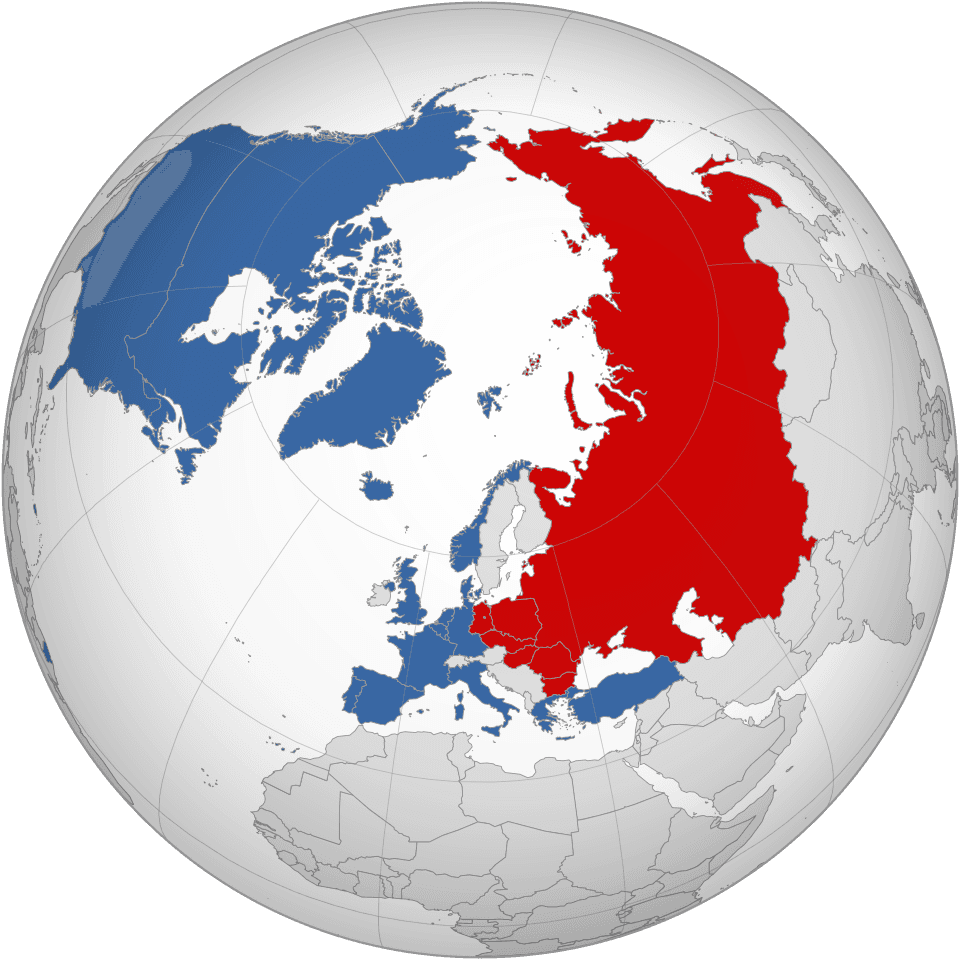
The global order of the late twentieth century was defined by a war that never officially broke out.
In October 1945, just weeks after the formal end of the Second World War, the English writer George Orwell published an essay contemplating a world living in the shadow of the newly unleashed atomic bomb. Looking ahead at a deeply polarized globe, he envisioned a permanent state of hostility between unconquerable super-states, warning of a looming, frozen peace that was, in essence, a "cold war." Within two years, the phrase was plucked from the realm of speculative essay and thrust into the center of international diplomacy. The term, popularized by American journalist Walter Lippmann and deployed by presidential advisor Bernard Baruch, perfectly captured a harrowing historical novelty: a total, global struggle between two rival systems that could never meet in open battle because doing so would mean the end of human civilization. The Cold War (1945–1991) was not merely a military standoff; it was a totalizing clash of ideologies, economics, and alternate visions of the future, fought in the shadow of absolute destruction.
The grand alliance that had defeated Nazi Germany and imperial Japan was a marriage of convenience, and it fractured almost before the ash had settled. By 1946, the physical and political geography of Europe was being violently redrawn. The Soviet Union, having borne the immense human cost of the war on the Eastern Front, sought security through expansion and control. In his famous 1946 "Iron Curtain" speech in Fulton, Missouri, Winston Churchill declared that an impenetrable barrier had descended across Europe, dividing the democratic West from a Soviet sphere of influence that extended through Poland, Hungary, and occupied Germany. Joseph Stalin struck back immediately, comparing Churchill’s rhetoric to that of Adolf Hitler and arguing that the Soviet Union, "anxious for its future safety," was fully justified in ensuring that loyal governments bordered its territory. This escalating war of words was accompanied by intense diplomatic maneuvering. In Washington, diplomat George F. Kennan dispatched his "Long Telegram" from Moscow, arguing that Soviet power was inherently expansionist and must be met with a long-term, patient, but firm "containment." In response, Soviet Ambassador Nikolai Novikov sent his own memo to Moscow, painting the United States as an aggressive capitalist monopoly bent on global supremacy.
By 1947, the lines of containment were formally drawn. President Harry S. Truman enunciated the Truman Doctrine, committing American resources to support "free peoples" resisting subjugation, specifically funding the Greek monarchy against communist insurgents and supporting Turkey against Soviet territorial demands in the Dardanelles. To secure the economic ruins of Western Europe—fertile ground for communist political parties—the United States launched the Marshall Plan in 1948, pouring over $13 billion into rebuilding Western European democratic and economic systems. Stalin viewed the plan as a capitalist conspiracy to buy European alignment. The division of Europe was soon institutionalized into hostile military alliances: the North Atlantic Treaty Organization (NATO) was established by the Western allies in 1949, and the Soviet Union countered in 1955 with the Warsaw Pact, designed to solidify its hegemony over its Eastern European satellite states. Germany itself was severed into two states, a division physically manifested in 1961 when East Germany constructed the Berlin Wall to stop its citizens from fleeing to the capitalist enclave of West Berlin.
As the European continent stabilized into a tense, militarized stalemate, the conflict spilled into the decolonizing world, turning Asia, Africa, and Latin America into surrogate battlefields. Because the United States and the Soviet Union possessed nuclear arsenals—the Soviets having successfully tested their first atomic bomb in 1949—direct confrontation was suicidal. Instead, the superpowers engaged in proxy wars, funding, training, and fighting alongside opposing sides in regional conflicts. The Korean War (1950–1953) ended in a bloody, permanent stalemate along the 38th parallel. In the 1950s and 1960s, the battle for influence expanded. The United States frequently intervened to support right-wing dictatorships and anti-communist uprisings, while the Soviet Union financed left-wing insurgencies, wars of independence, and revolutionary governments. No conflict demonstrated the agonizing cost of this proxy warfare more than the Vietnam War (1955–1975), which dragged the United States into a devastating, ultimately unsuccessful military intervention to prevent a communist takeover of the south.
Yet the most dangerous moment of the entire forty-six-year confrontation occurred not in the jungles of Southeast Asia, but just ninety miles off the coast of Florida. Following the Cuban Revolution of 1959, which established the first communist regime in the Western Hemisphere under Fidel Castro, the Soviet Union began deploying nuclear missiles to the island. This was partly a response to the United States placing its own nuclear missiles in Europe, near the Soviet border. The resulting Cuban Missile Crisis of October 1962 brought the world to the precipice of thermonuclear war. For thirteen days, the two superpowers stood eye-to-eye before Soviet Premier Nikita Khrushchev agreed to dismantle the Cuban launch sites in exchange for a public American promise not to invade Cuba and a secret agreement to remove US missiles from Turkey. The sheer terror of the crisis initiated a slow realization that the rivalry required rules, leading eventually to a period of "détente" in the 1970s, characterized by landmark treaties limiting nuclear arsenals and the historic opening of US diplomatic relations with the People's Republic of China, which had split from its Soviet ally in a bitter ideological and border rivalry by 1969.
The fragile stability of détente shattered at the end of the 1970s. The overthrow of US-allied regimes in Iran and Nicaragua, combined with the 1979 Soviet invasion of Afghanistan, reignited the global struggle. The Soviet-Afghan War became a grueling quagmire for Moscow, draining its treasury and military prestige, while the United States funneled resources to Afghan resistance fighters. By the mid-1980s, the structural contradictions of the Soviet system—stifled by economic stagnation, military overextension, and the crushing expense of the arms race—could no longer be ignored. When Mikhail Gorbachev assumed leadership of the Soviet Union in 1985, he introduced sweeping reforms designed to revitalize the nation by expanding political and social freedoms. Instead of saving the system, these reforms unleashed pent-up democratic aspirations. In 1989, a wave of peaceful revolutions swept through the Eastern Bloc, dismantling communist regimes and toppling the Berlin Wall. Two years later, in 1991, the Soviet Union itself dissolved into fifteen independent states. The Cold War ended not with a nuclear cataclysm, but with the quiet lowering of the Soviet flag over the Kremlin, leaving behind a world permanently reshaped by forty-five years of ideological division, nuclear anxiety, and a global network of alliances that continue to define modern geopolitics.
Connected to
- followsWorld War II1939 CE
+ 12 further connections to entries not yet ingested