Event · 900 CE – 1470 CE · Andean Civilizations
Chimor
- Also known as
- Chimon
- Chimu
- Chimú
- Chimú Empire
- Cultura chimú
- Imperio Chimú
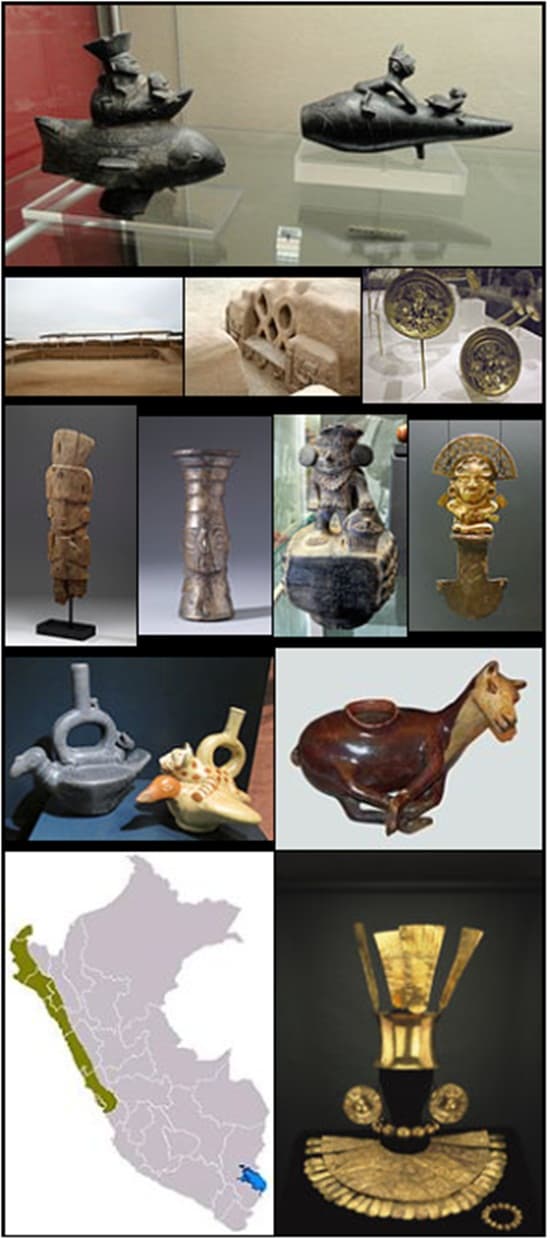
Out of the dry, coastal deserts of northern Peru, where rivers carved fertile plains through the sand, the Kingdom of Chimor built the largest empire of South America’s Late Intermediate Period.
To look upon the ruins of Chan Chan is to understand how a civilization can write its history in dried mud. On the hyper-arid Peruvian coastline, where the Pacific Ocean meets a strip of desolate sand, the capital of Chimor once stood as a sprawling monument to human will. Constructed entirely of sun-baked adobe, its monumental compounds—known today as ciudadelas—rise from the desert like labyrinthine, high-walled fortresses. Within these massive enclosures, which stretched over a thousand kilometers of coastline at the empire’s fifteenth-century peak, the Chimú kings did not merely rule; they orchestrated an environment. In a landscape where rain almost never falls, the survival of Chimor was an ongoing miracle of engineering, a highly regulated, bureaucratic defiance of the desert.
The origin of this coastal empire is preserved in a myth of arrival by water. According to Chimú oral history, a mysterious figure named Taycanamo arrived in the Moche Valley from the sea, riding on a balsa-wood raft. He was said to have founded the capital of Chan Chan, establishing a dynasty that would rule the northern coast of Peru from roughly 900 CE until 1470 CE. From this coastal seed, Taycanamo’s descendants expanded their domain. His son, Guacricur, consolidated Chimú control over the lower Moche Valley. His grandson, Ñançenpinco, pushed farther, conquering the upper valley and expanding the nascent kingdom's frontiers to the neighboring valleys of Saña, Pacasmayo, Chicama, Virú, Chao, and Santa. While early valley expansions may have been willing alliances, later conquests were aggressively imperial. The sophisticated Sicán culture to the north was violently assimilated, and the Chimú absorbed political and cultural influences from both the pre-Inca Cajamarca and the highland Wari civilizations.
At its zenith, the Kingdom of Chimor was the largest polity in the Late Intermediate Period, a vast coastal empire stretching from the Jequetepeque River valley in the north down to Carabayllo in the south, where its southward expansion was finally halted by the formidable military strength of the Lima valley. To manage this vast territory, the Chimú constructed a rigid, four-level administrative hierarchy. Chan Chan sat at the apex of this system, directing provincial administrative centers like Farfán in the Jequetepeque Valley. Local elites in conquered territories were not eliminated but were instead incorporated into the lower rungs of the imperial bureaucracy. These regional centers managed local land, water, and labor, funneling tribute and resources back to Chan Chan, while rural sites served as engineering headquarters for the maintenance of the empire’s lifeblood: its canals.
This empire was built on water and clay. The Chimú economy depended on sophisticated hydraulic engineering that linked separate river valleys into massive agricultural complexes, such as the Chicama-Moche and Lambayeque systems. To reclaim the arid soil, they utilized huachaques—sunken farms excavated deep into the earth to reach the moisture of the subterranean water table. Large-scale canals, built and maintained by draft labor, channeled Andean glacial runoff across miles of barren desert to irrigate vast, flat fields. The scale of this labor was immense. At sites like Quebrada del Oso, archaeologists have found vast quantities of broken bowls near ancient canal beds, suggesting that the state housed and fed thousands of canal workers at its own expense. This delicate agricultural network was highly vulnerable; scholars suggest that a catastrophic El Niño event around 1100 CE severely damaged the canal systems, forcing the Chimú state to aggressively conquer distant valleys to secure alternative food supplies and extract tribute.
Within the high adobe walls of Chan Chan, society was strictly segregated. The capital housed an estimated thirty thousand people, organized to emphasize social hierarchy. The ruling elite lived in exclusive, restricted palaces, heavily regulating access to administrative offices, bureaucratic roles, and sacred rituals. Below them was a massive, highly disciplined class of artisans. In the late Chimú period, approximately twelve thousand craft specialists lived and worked in Chan Chan alone. These artisans—men and women alike—were organized into specialized quarters within the ciudadelas and were legally forbidden to change their professions. They produced exquisite textiles from cotton and the wool of alpacas, llamas, and vicuñas, alongside highly distinctive, monochromatic black pottery. This iconic pottery, often modeled into the shapes of animals or human figures perched on cuboid vessels, achieved its metallic, dark finish through a specialized firing technique in closed kilns that prevented oxygen from reacting with the clay.
The Chimú were also master metallurgists, working with copper, gold, silver, bronze, and tumbaga—a delicate alloy of copper and gold. These luxury items were not merely decorative; they were the currency of prestige, controlled entirely by the state elite who monopolized their production, storage, and distribution. Alongside metal, the highly prized shell of the Spondylus shellfish served as a vital economic and religious currency. Harvested only in the warm, distant waters off the coast of modern-day Ecuador, these spiny, red shells were intimately associated with the sea, rainfall, and agricultural fertility. The acquisition and trade of Spondylus played a central role in both the diplomatic relations of the empire and its religious rituals.
While the highland Inca worshipped the sun, the coastal Chimú looked to the night sky, holding the moon to be far more powerful. The moon governed the tides, illuminated the desert night, and, unlike the sun, was visible during both day and night. Offerings of precious metals, fine textiles, and Spondylus shells were made to secure the moon's favor, ensuring the regular arrival of water and protection from the devastating ocean floods of El Niño.
For nearly six centuries, this coastal order endured. Chimor was a highly organized, wealthy, and stable state—the last great power in the Andes capable of resisting the expansionist ambitions of the Inca Empire. But by the 1470s, the highland conquerors arrived. The Inca general Topa Inca Yupanqui led an invasion that targeted the vulnerability of the coastal civilization. By seizing control of the highland heads of the river valleys, the Inca could threaten the vital canals that kept Chan Chan alive. Minchançaman, the final emperor of Chimor and a descendant of the legendary Taycanamo, was defeated.
The fall of Chimor was total. The victorious Inca did not destroy Chan Chan, but they stripped it of its purpose and its wealth. Minchançaman was taken as a captive to the Inca capital of Cusco, and the legendary stores of Chimú gold and silver were plundered and redirected to adorn the Qurikancha, the Inca temple of the sun. The great workshops of Chan Chan were emptied as thousands of highly skilled metalworkers and weavers were forcibly relocated to Cusco to serve their new imperial masters. By the time Huayna Capac assumed the Inca throne in 1493, the conquest of Chimor was complete. The desert kingdom, once the most formidable empire on the Peruvian coast, was reduced to a quiet province of the Inca state, leaving behind only its massive, empty clay palaces to be slowly eroded by the coastal winds.
Connected to
3 links to entries not yet ingested in the Library.