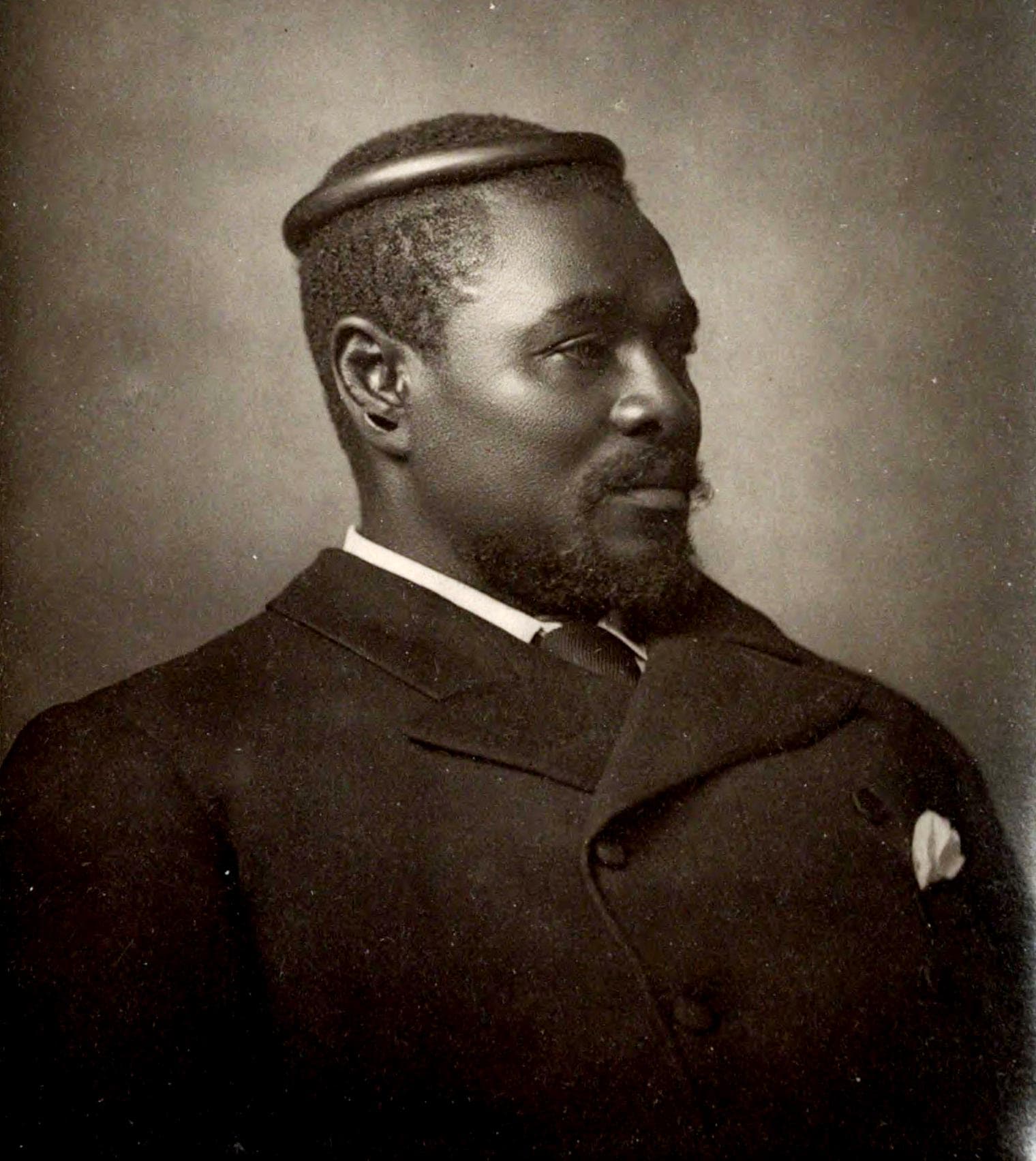
The sheer physical presence of Cetshwayo kaMpande, a man standing well over six feet tall and weighing some twenty-five stone, was matched only by the ruthless political calculations required to secure his path to the Zulu throne.
In the southern winter of 1873, a mountain of a man stood at the center of a newly built royal homestead named Ulundi—the high place. Cetshwayo kaMpande, standing well over six feet and weighing nearly twenty-five stone, had finally ascended to the Zulu throne after decades of waiting in the shadow of his long-lived father, Mpande. To mark the transition, Sir Theophilus Shepstone, the influential British administrator who annexed the Transvaal, traveled to Zululand to place a crown upon the new king’s head. It was a performance designed to project British patronage, but Cetshwayo understood the theater of power differently. He was a grandson of Senzangakhona, a nephew of the legendary Shaka, and the undisputed master of a highly organized state capable of fielding tens of thousands of disciplined warriors. For a brief moment, the British Empire and the Zulu Kingdom stood side by side, bound by a fragile diplomacy that both sides knew was slipping toward a reckoning.
The path to Ulundi had been carved through blood and absolute political resolve. Born around 1826, Cetshwayo spent his youth navigating the murderous court politics of a dynasty prone to fratricide. In 1856, at the Battle of Ndondakusuka, he secured his status as his father’s de facto successor by defeating and killing his younger brother, Mbuyazi, who had been Mpande’s favorite. The victory was total and ruthless; five of Cetshwayo's other brothers were killed, and almost all of Mbuyazi’s followers were massacred in the aftermath. For the next seventeen years, while his father remained the nominal king, Cetshwayo held the actual reins of Zulu authority. He aggressively policed his borders and his household, hunting down potential rivals. When his father took a new favorite wife, Nomantshali, Cetshwayo ordered her death along with her children; one young half-brother was murdered directly in front of the helpless, aging king. Rivals like his brother Umthonga fled across the borders to seek the protection of the Boers, forcing Cetshwayo into tense, calculated negotiations with the white pastoralists to secure their return. By the time Mpande died in 1872—a death initially kept secret to ensure a peaceful succession—Cetshwayo had already spent half a lifetime mastering the art of survival in a landscape of shifting alliances and sudden violence.
Upon taking the throne, Cetshwayo set about restoring the military luster of the Zulu state. He reconstituted the traditional impi regiments, expanded the army, and readopted many of the rigorous state-building methods pioneered by Shaka. Crucially, he recognized the changing technology of war and began equipping his forces with muskets, though their actual tactical utility would remain limited. He expelled European missionaries, whom he viewed as subverters of Zulu cultural cohesion, and was suspected by his white neighbors of inciting other African polities to resist Boer encroachment in the Transvaal. Yet, despite his formidable military preparations, Cetshwayo did not seek war with the white authorities. He viewed the British in Natal as natural allies against the expansionist Boers. This calculation seemed vindicated when a British boundary commission, appointed to investigate disputed territories, ruled in favor of the Zulu claims. But the report was promptly buried by British officials. Sir Theophilus Shepstone, feeling compromised by the encroaching Boers and outmaneuvered by Cetshwayo’s skillful land negotiations, withdrew his support for the Zulu king.
11 links to entries not yet ingested in the Library.
The true threat to Zulu independence, however, lay in the grand imperial designs of Sir Henry Bartle Frere, the British High Commissioner for the Cape Colony. Frere dreamed of a unified South African confederation modeled on the Dominion of Canada. In his eyes, a powerful, sovereign Zulu state boasting an independent army of forty thousand men was an intolerable obstacle to British hegemony. Frere systematically manufactured a crisis, seized upon minor border infractions to demand steep reparations, and ordered his subordinates to send provocative, insulting messages to Ulundi. Cetshwayo responded with remarkable restraint. Aware of the industrial and military might of the British Empire, he consistently sued for peace, reminding Frere that as sovereign rulers, they were equals: since Cetshwayo did not presume to tell Frere how to govern the Cape Colony, Frere should show him the same courtesy. The diplomatic high ground mattered little to Frere, who in late 1878 issued an ultimatum designed to be impossible to accept: Cetshwayo must effectively disband the Zulu army and dismantle his kingdom's social order.
When the deadline passed, British forces under Lord Chelmsford invaded Zululand in three columns, launching the Anglo-Zulu War of 1879. The initial British confidence was shattered almost immediately. At the Battle of Isandlwana, the Zulu army caught a major detachment of Chelmsford’s force in the open, completely overwhelming and annihilating them in one of the most catastrophic defeats ever suffered by a modern army at the hands of a non-Western power. In the weeks that followed, British columns were bogged down or defeated at Eshowe, Intombe, and Hlobane. Yet, Cetshwayo’s strategic vision was defensive, not expansionist. He explicitly forbade his commanders from launching a counter-invasion across the Buffalo River into the British colony of Natal, hoping instead to use his battlefield victories to negotiate a conditional peace. The British, desperate to salvage their military honor, refused to parley. Chelmsford returned with a massive, heavily reinforced army, while Cetshwayo’s own peace emissaries were undermined by Cornelius Vijn, a Dutch trader whom Cetshwayo had protected but who secretly fed intelligence about Zulu troop movements to the British. On July 4, 1879, at the second Battle of Ulundi, the British deployed artillery and Gatling guns in a massive infantry square on the open plain. The Zulu charges were torn apart by modern firepower, and within forty-five minutes, a cavalry charge routed the remaining defenders. Ulundi was put to the torch.
Captured in the wake of the defeat, Cetshwayo was deposed and sent into exile, first to Cape Town and later to London. In England, the deposed king became an object of intense public fascination. Supported by sympathetic figures like the writer and war correspondent Lady Florence Dixie, who campaigned tirelessly on his behalf, Cetshwayo won over the British public with his dignified, gentle demeanor. Visitors noted that he had been shoddily treated by imperial careerists like Frere and Chelmsford. The British government eventually capitulated to public sympathy and, in 1883, allowed him to return to a partitioned Zululand. But the kingdom he returned to had been deliberately fractured. The British had divided the territory into thirteen chiefdoms, sparking a brutal civil war between Cetshwayo's loyalists, the uSuthu, and rival factions led by Chief Zibhebhu. Supported by Boer mercenaries, Zibhebhu’s forces launched a devastating raid on Cetshwayo’s rebuilt kraal at Ulundi in July 1883. Wounded and defeated, the king fled into the dense, sacred forests of Nkandla.
The final months of the last independent Zulu king were spent as a refugee under British protection in Eshowe. There, on February 8, 1884, Cetshwayo died suddenly at the age of fifty-eight. The official cause was listed as a heart attack, though rumors of poison circulated widely among his followers. He was buried in a quiet field within sight of the Nkandla forest, the remains of the wagon that carried his body placed atop his grave as a final monument. His son Dinuzulu would claim the title of king, but the independent sovereignty of the Zulu state died with Cetshwayo. In the decades that followed, his memory was preserved in the novels of H. Rider Haggard and in the political consciousness of a changing South Africa, where his great-grandson, Mangosuthu Buthelezi, would play him in the classic 1964 film Zulu. Cetshwayo's legacy remains that of a leader caught in the gears of global empire—a man who sought to preserve his ancestors' sovereignty through the quiet art of diplomacy, only to be forced to defend it with the spear.