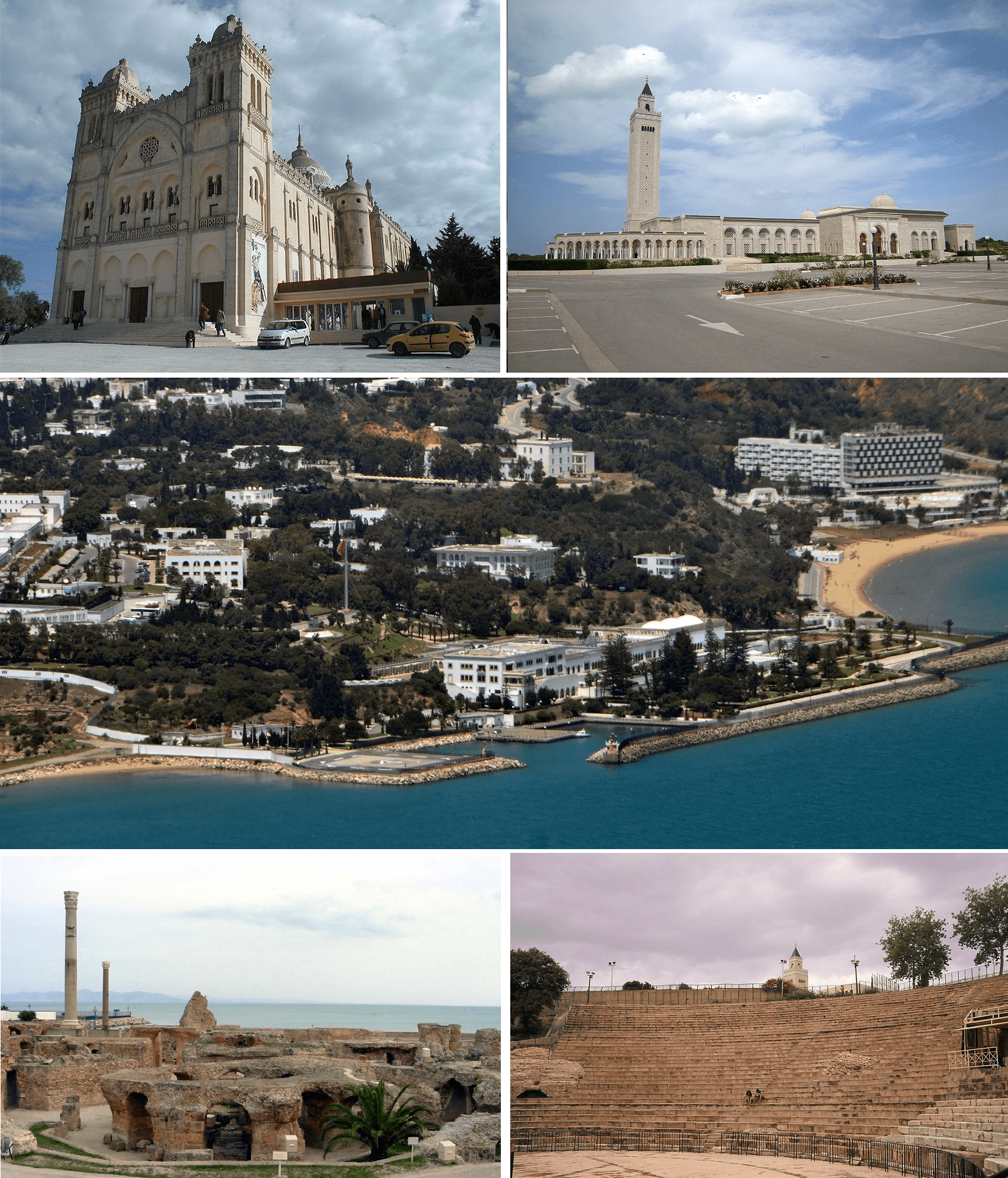
A city born of myth on the eastern edge of the Lake of Tunis, Carthage began as a Phoenician colony founded by the legendary Queen Dido, who secured her territory by the clever slicing of a single oxhide.
To cross the Mediterranean in the first millennium BCE was to navigate a network of ports, but all routes eventually converged on a single, strategic bottleneck. Where the Italian peninsula and the island of Sicily reach down toward the northern projection of Africa, the sea narrows. Here, on a peninsula jutting into the Gulf of Tunis, sat Carthage. It was a city positioned to act as a colossal lock on the commerce of the ancient world. From this vantage, Carthage grew from a Phoenician trading outpost into an empire that dominated the southwestern Mediterranean, establishing a maritime hegemony so complete that its navy of 220 warships operated from a specialized, circular military harbor hidden behind a massive outer commercial port. For centuries, Carthage was one of the wealthiest, most populous hubs of the classical world, a city built ex nihilo on virgin soil that eventually rivaled the greatest metropolises of antiquity. Yet its name remains inextricably bound to its spectacular, apocalyptic end—a three-year Roman siege in the second century BCE that concluded with the systematic demolition of its towering walls and the fiery collapse of its citadel.
The foundation of the city, dated by ancient tradition to around 822 BCE, is shrouded in a founding myth that captures the mercantile pragmatism and territorial negotiation of its early settlers. The legendary Queen Dido, or Elissa, fleeing her home city of Tyre in modern-day Lebanon, is said to have bargained with a local North African tribe for only as much land as could be encompassed by an oxhide. By cutting the hide into remarkably thin strips, she traced a boundary wide enough to secure the hill that would become the Byrsa, the fortified citadel of the new settlement. The Punic name for the city, Qart-ḥadašt, translated simply to "New City," signaling its status as a new Tyre. These eastern pioneers brought with them not only their language and their maritime expertise but also their industrial arts. Archaeological excavations of the earliest seventh-century layers reveal that almost immediately upon arrival, the settlers established fabric dyeing operations along the coast, utilizing crushed murex shells to produce the highly prized "Phoenician purple."
As the city grew, its geography dictated its defensive and commercial architecture. Carthage was built on a promontory with sea inlets to both the north and south, protected on the landward side by an isthmus. To shield this wealthy prize, the Carthaginians constructed 37 kilometers of walls to encircle the city. While the seaside defenses could afford to be less imposing because the Carthaginian navy dominated the waves, the three parallel walls guarding the western land approach were massive, stretching nearly ten meters thick and rising above thirteen meters in height. Within these fortifications, the city was organized into four residential quarters of uniform layout, interspersed with bustling marketplaces, metalworking and pottery workshops, religious shrines, and a sprawling necropolis. The houses, often whitewashed and presenting blank walls to the narrow, stepped streets, opened inward to private courtyards. As space became a premium, these homes rose to several stories, with some reaching six floors. Beneath the streets, a planned drainage system of soakaways leached waste into the sandy soil, a testament to the sophisticated urban planning of a preindustrial powerhouse.
At the heart of Carthaginian life was a stark spatial division between the civic, the maritime, and the sacred. Below the Byrsa citadel lay the agora, the central marketplace where merchants traded Greek-style earthenware, purple-dyed textiles, and agricultural yields from the fertile Chora—the surrounding farmlands of the Bagradas river valley and Cape Bon, where Punic farmers adapted Eastern agricultural sciences to African soil. In this open-air plaza, the civic life of the republic unfolded: the ruling magistrate suffets presided, the council of elders convened, and the tribunal of the 104 administered justice. Nearby, the famous cothon harbors functioned as the engine of Carthaginian power. The commercial outer harbor led via a canal into a circular military basin. At its center stood an islet where the Carthaginian admiral could monitor the entire fleet and overlook the surrounding docks.
In contrast to this highly organized civic machinery was the tophet of Salammbô, located south of the citadel near the harbor. This ancient, enclosed cemetery, dedicated to the queen goddess Tanit, has long been the focal point of historical fascination and horror. Filled with upright stone stelae carved for funerary purposes, the site also contained the skeletons of infants. For centuries, Greco-Roman and biblical accounts of Carthaginian child sacrifice were dismissed by many modern historians as wartime propaganda or cultural slander. While some twentieth-century archaeologists argued the tophet was merely a cemetery for infants who died of natural causes, modern scholarship and excavations have increasingly pointed to the conclusion that child sacrifice was indeed a real and structured religious practice among the Carthaginians, carried out to secure the favor of the gods in times of crisis.
This highly developed, affluent civilization was entirely dismantled during the Third Punic War in 146 BCE. After decades of bitter rivalry and two prior wars, the Roman Republic resolved to eliminate its greatest rival permanently. The Roman general Scipio Aemilianus led a grueling, three-year siege that culminated in a street-by-street battle of attrition. Carthaginian defenders made their final, desperate stand on the heights of the Byrsa, fighting from the rooftops of multi-story homes and on the sixty steps leading to the Temple of Eshmun, the god of healing. When the citadel finally fell, the Romans systematically put the city to the torch, demolished its massive stone walls, and dismantled its harbor works, leaving a landscape of ruins and ash.
Carthage, however, was too geographically valuable to remain vacant. A century after its destruction, the city was re-founded as Roman Carthage. It quickly rose from its ashes to become one of the premier cities of the Roman Empire, rivaling Alexandria in size and significance as the administrative capital of the province of Africa. The Romans built monumental public works, including the sprawling baths of Antoninus on the seafront and a colossal aqueduct stretching over ninety kilometers from the springs of Mount Zeugitanus to the massive reservoirs of La Malga. This Roman iteration of the city eventually became a crucible of early Christianity, boasting grand basilicas like the Damus-el-Karita, before shifting hands again during the Vandal and Byzantine eras.
The final eclipse of Carthage as a great urban center came in 698 CE. Following the Battle of Carthage, Umayyad Muslim forces captured and sacked the city. To prevent the Byzantine navy from ever using the site as a fortified base for reconquest, the conquerors dismantled its defenses and shifted regional political power inland to Kairouan and the nearby Medina of Tunis. For the next several centuries, Carthage existed largely as a quarry. Its marble columns, imperial statues, and dressed stones were systematically salvaged by Arab builders, and later by Crusaders, to construct the palaces and mosques of Tunis. By the time the Hafsid dynasty destroyed its remaining coastal defenses in the thirteenth century to deny their use to invading Crusaders, the ancient metropolis had been reduced to a quiet landscape of agricultural fields, cactus patches, and green lizards darting among mounds of structural rubbish. It was not until the nineteenth and twentieth centuries, through the pioneering surveys of Danish consul Christian Tuxen Falbe and French archaeologists, that the layers of Punic, Roman, and Byzantine civilizations were systematically uncovered, transforming this long-silent peninsula into an archaeological monument to the transience of imperial splendor.
+ 8 further connections to entries not yet ingested