Person · 155 CE – 220 CE · Early China
Cao Cao
- Also known as
- Ah Man
- Cao Mengde
- Cao Mengde
- Cao-Cao
- Car Wu od Weija
- Cchao
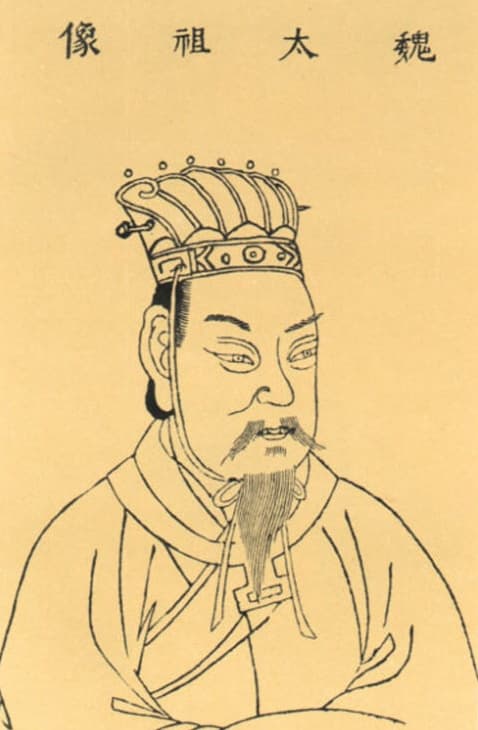
To understand the fractures that shattered the Han dynasty, one must look to Cao Cao, a man who built an empire in the shadow of a captive emperor.
In the late second century, as the Han dynasty entered its long, slow dissolution, the northern plains of China were ravaged by an invisible pestilence. Between the years 170 and 185 CE, widespread epidemic diseases swept through the empire on average once every three years. It was against this backdrop of mortality and institutional decay that a young man from Qiao County spent his youth. Cao Cao, born around 155 CE, was neither a traditional scholar nor a quiet rustic. He was a creature of kinetic energy: he hunted, he idled, he roamed the countryside playing the vigilante, and he manipulated those around him with a conspicuous, early-developed cunning. To the era’s arbiters of character, who made a trade of evaluating the potential of young elites, this behavior was both alarming and intoxicating. The famous commentator Xu Shao, looking upon the restless young man, delivered a verdict that would echo through Chinese history: "You will be a capable minister in times of peace, and a hero in times of chaos." Or, as another translation of the encounter ominously preserved it, "a treacherous villain in times of peace, and a hero in times of chaos."
The chaos arrived precisely on schedule, and Cao Cao was ready for it. Though his father, Cao Song, had bought his way to the prestigious post of Grand Commandant for an exorbitant sum, the family’s pedigree was slightly suspect; Cao Song was the adopted son of a powerful court eunuch, Cao Teng. In the status-conscious world of the late Han, this eunuch connection was a double-edged sword, offering immense wealth and influence but carrying a taint of court decadence. Cao Cao began his ascent through the standard imperial bureaucracy, nominated as a civil service cadet at nineteen and eventually serving as the security chief for the northern district of the capital, Luoyang. He was a young official who took his duties with a severity that bordered on the provocative, but he soon found himself caught in the factional gears of a dying empire. Implicated and briefly dismissed because a cousin had married into the family of a disgraced empress, Cao Cao returned to court as a Consultant, only to find the capital hollowed out by corruption. He watched the eunuchs destroy the reformist generals Dou Wu and Chen Fan. He wrote memorials to Emperor Ling protesting the greed of the high ministers who accepted bribes and protected incompetent provincial officials. But the emperor turned a deaf ear, and the young reformer, realizing the futility of his pen, fell silent.
When the political order finally splintered into open warfare in the 190s CE, Cao Cao abandoned the halls of Luoyang to build his own instrument of power. He retreated to Yan Province, a region covering parts of modern Henan and Shandong, where he recruited his own followers, organized a personal army, and began systematically extinguishing rival warlords. His true stroke of genius, however, was not military but political. In 196 CE, the figurehead Han sovereign, Emperor Xian, was a desperate fugitive, having escaped the clutches of various brutal military captors. While other warlords hesitated, viewing the boy-emperor as an expensive liability, Cao Cao moved swiftly to receive him. He established a new imperial capital at Xuchang, placing the emperor under his direct custody. From that moment on, though Cao Cao maintained a nominal allegiance to the Han throne, he held the reins of the state. He spoke with the voice of the emperor, drafted decrees in the imperial name, and used the legitimacy of the ancient dynasty to justify his own ruthless expansion.
What followed was a decade of relentless consolidation. One by one, the rivals of central China—the fearsome warrior Lü Bu, the pretender Yuan Shu, and the resilient Zhang Xiu—were eliminated. The turning point of Cao Cao's career came in 200 CE at the Battle of Guandu, where he faced his greatest rival, the aristocratic northern warlord Yuan Shao. Despite being outnumbered, Cao Cao’s superior tactical flexibility and decisive leadership broke Yuan's forces. For the next seven years, he pursued Yuan’s sons and allies across the north, eventually crushing them and unifying the vast, populous heartland of northern China under his singular authority. By 208 CE, he had been appointed Imperial Chancellor. He was the undisputed master of the Yellow River valley, a brilliant administrator who drafted military manuals—including an extant commentary on Sun Tzu’s The Art of War—and a poet of profound, melancholy power whose verse lamented the very ruins his wars had created.
Yet the southern half of the empire remained beyond his grasp. Late in 208 CE, seeking to finalize the unification of the realm, Cao Cao led a massive expeditionary force southward toward the Yangtze River. His ambition collided with the allied forces of the southern warlords Sun Quan and Liu Bei at the Battle of Red Cliffs. The decisive defeat he suffered there shattered his dream of an immediate, total conquest. The Yangtze became a permanent barrier, and his subsequent attempts to cross it and annex the southern territories over the following decade repeatedly faltered. Prevented from expanding south, Cao Cao turned his eyes back to the west and north. In 211 CE, he broke a coalition of northwestern warlords led by Ma Chao and Han Sui at the Battle of Tong Pass. Four years later, he seized the strategic region of Hanzhong from the warlord Zhang Lu, though this territory would ultimately slip into the hands of his persistent rival, Liu Bei, by 219 CE.
As his military expansion slowed, Cao Cao’s domestic authority grew to near-imperial proportions, eliciting deep anxiety among Han loyalists. The Emperor Xian, though still on the throne, was reduced to a ceremonial captive in a golden cage. In 213 CE, Cao Cao was created the Duke of Wei, receiving a vast fief in Hebei and Henan. Three years later, he was elevated to the status of "King of Wei," a vassal title of unprecedented authority that came with ceremonial privileges previously reserved exclusively for the sovereign. He was allowed to wear the imperial insignia, ride in imperial carriages, and act with the autonomy of an independent monarch. Yet, despite his absolute grip on the state, Cao Cao famously refused to take the final step of deposing the Han emperor, reportedly remarking that he was content to be King of Wei and let history decide his ultimate title.
That final step was left to his son and successor, Cao Pi. When Cao Cao died in the ancient capital of Luoyang in March of 220 CE, the fragile fiction of Han rule died with him. In November of that same year, Cao Pi formally accepted the abdication of Emperor Xian, ending the Eastern Han dynasty and establishing the state of Cao Wei. This act of transition, widely viewed by later historians as a classic usurpation, marked the official beginning of the Three Kingdoms period, a bloody division of China that would last for sixty years. Posthumously, Cao Pi elevated his father to the rank of "Emperor Wu"—the Martial Emperor—and granted him the temple name "Taizu," the Grand Ancestor.
History, however, has never quite agreed on who Cao Cao actually was. The earliest accounts of his life reveal a fractured mirror. Chen Shou’s third-century Records of the Three Kingdoms, written during the succeeding Jin dynasty, presents a statesman of immense administrative and military talent. Conversely, the Cao Man zhuan, an anonymous collection of anecdotes compiled in the rival southern kingdom of Eastern Wu, portrays him as a cartoon of cruelty and deceit—a piece of hostile wartime propaganda that nonetheless captured the imagination of the public. In the centuries that followed, especially as popularized in traditional theater and the monumental historical novel Romance of the Three Kingdoms, Cao Cao was cast as the ultimate archetype of the brilliant, treacherous villain. He was the white-faced, suspicious tyrant, the perfect foil to the virtuous Liu Bei, who was depicted as the righteous defender of the fallen Han.
To the world that inherited his legacy, Cao Cao was the architect of a new age. He took a fractured, bleeding empire and, through sheer administrative competence and military genius, rebuilt a stable state in the north that allowed agriculture, poetry, and law to survive the collapse of the ancient world. His poems, written in a spare, direct style, still evoke the desolate landscapes of his campaigns and the heavy burden of his ambitions. He remains one of the most polarizing figures in Chinese civilization: a man who saved the state from total anarchy, yet destroyed the dynasty he claimed to protect; a poet who wept for the dead, yet ordered the slaughter of entire cities; and a statesman who laid the foundations of an empire he never lived to rule.
Connected to
12 links to entries not yet ingested in the Library.