For more than a thousand years, the citizens of the state we now call the Byzantine Empire lived and died under the conviction that they were, simply and indisputably, Romans.
For more than a thousand years, the people who lived in the great stone-walled metropolis on the Bosporus did not know they were Byzantines. To themselves, they were simply Romaioi—Romans—and their realm was Rhomanía, the Roman land. When the early modern world later coined the word "Byzantine," deriving it from Byzantion, the ancient Greek transit town upon which Constantinople was built, it was often used with a note of dismissive prejudice, as if this Greek-speaking, Christian state of the Middle Ages was merely a decadent, pale imitation of the grand empire of Augustus and Caesar. Yet this state was the direct, unbroken continuation of Rome. When the Western Roman Empire splintered into Germanic kingdoms during the fifth century CE, the East did not merely survive; it thrived, preserving the Roman name, the Roman law, and the Roman administrative genius, all while translating them into a vibrant Greek culture that stood as the wealthiest and most sophisticated civilization in Europe.
The division of this vast Roman world had been born of administrative necessity. By the late third century CE, the empire had grown too sprawling, its frontiers too threatened, for any single ruler to govern from Rome. The emperor Diocletian instituted the Tetrarchy, dividing the realm into eastern and western halves. Though the political system of joint rulers soon collapsed, the geographical division endured. The pivot point came with Constantine I, who secured absolute power in 324 CE. Recognizing that the old capital on the Tiber was too far from the wealthy, populous eastern provinces and the strategically critical frontiers, Constantine rebuilt the city of Byzantium as a "New Rome." Dedicated in 330 CE and soon known as Constantinople, the new capital was a masterpiece of geography, perched on a peninsula commanding the trade lanes between Europe and Asia, the Black Sea and the Mediterranean. Here, Constantine legalized Christianity and introduced the gold solidus, a currency so stable it would anchor Mediterranean commerce for centuries.
When the last emperor to rule both halves, Theodosius I, died in 395 CE, the division became permanent. While the Western Roman Empire buckled under the weight of barbarian migrations, economic exhaustion, and military coups, the East possessed the resources to endure. It was a matter of fortune, geographical defense, and institutional resilience. While the West was carved up by Germanic warlords—culminating in the deposition of Romulus Augustulus in 476 CE—the Eastern emperors in Constantinople utilized their immense wealth to buy off invaders or redirect them westward. When Attila’s Huns ravaged the Balkans, demanding vast tributes, the East paid them, watching as the Hunnic confederation fractured after Attila’s death in 453 CE. Under the emperor Zeno, the troublesome Ostrogothic king Theodoric was cleverly persuaded to take his people and conquer Italy from the warlord Odoacer, removing a major threat from the imperial borders in a single diplomatic stroke. Protected by the massive, triple-layered Theodosian Walls, Constantinople became an impregnable vault.
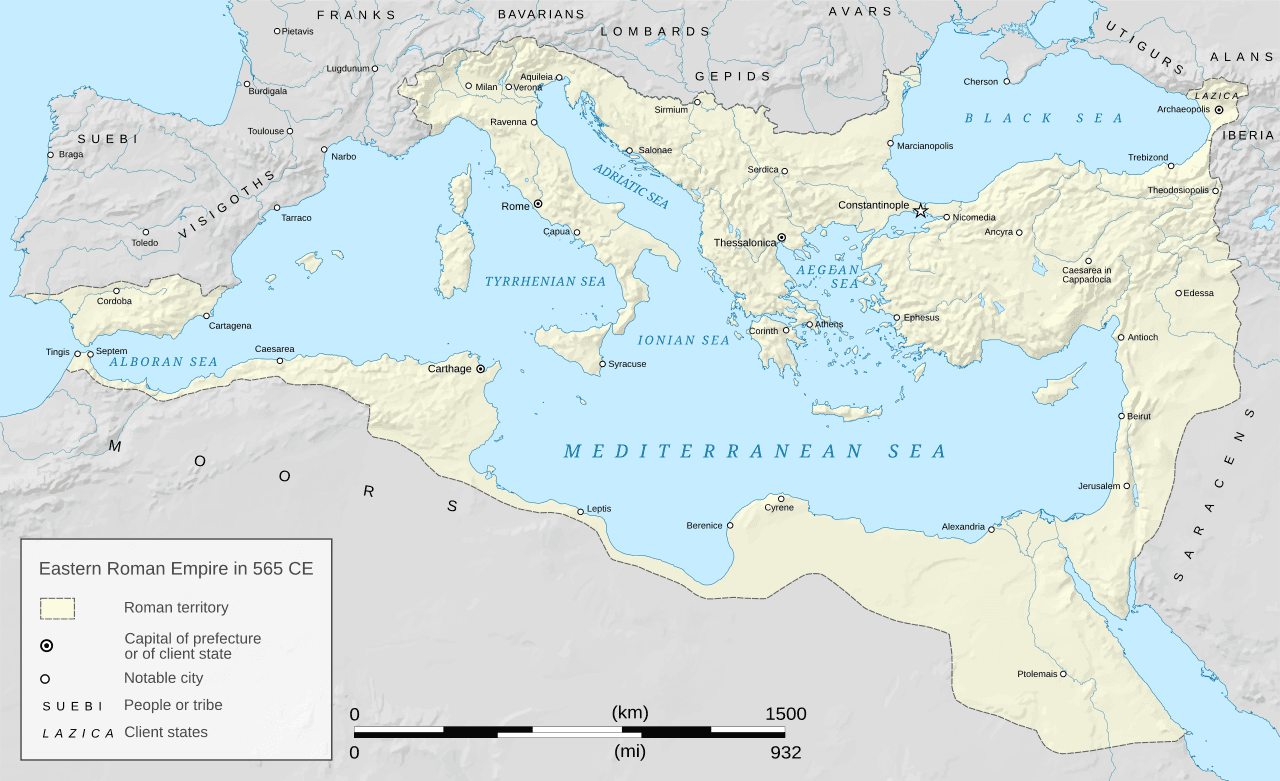
This survival set the stage for the sixth-century reign of Justinian I, an era that represents both the glittering summit and the exhausting limit of the East Roman state. Ascending the throne in 527 CE, Justinian sought to restore the ancient boundaries of the empire. His brilliant general Belisarius shattered the Vandal Kingdom of North Africa in 533 CE and then launched a grueling campaign to reclaim Italy from the Ostrogoths. But this grand reconquest came at a terrible price. In the 540s, fortune turned. A devastating pandemic, the Plague of Justinian, swept through the empire, decimating the population and crippling its tax base. Seizing upon Constantinople's distraction in the West, the Sasanian Persian king Khosrow I invaded from the east, sacking the great metropolis of Antioch in 540 CE. Though Justinian left behind enduring monuments—most notably the rewritten Roman legal code, the Corpus Juris Civilis, and the breathtaking, domed cathedral of Hagia Sophia—he left the treasury empty and the frontiers dangerously overextended.
The reckoning was swift and severe. By the early seventh century, the empire was fighting for its life. A mutiny in 602 CE led to the execution of the emperor Maurice, triggering a destructive civil war that allowed the Sasanian Persians to overrun the Levant and Egypt, while Avars and Slavs devastated the Balkans. The emperor Heraclius managed to save the state, leading a desperate, holy counter-offensive that culminated in a decisive victory over the Persians at Nineveh in 627 CE. Yet this triumph was instantly overshadowed by a new force emerging from the Arabian Peninsula. Exhausted by decades of total war, the Byzantine armies could not withstand the sudden, rapid expansion of the Arab Rashidun Caliphate in the 630s and 640s. In a matter of years, the empire permanently lost its wealthiest provinces: Syria, Palestine, and Egypt. The loss of Egypt alone stripped Constantinople of three-quarters of its imperial revenue and its primary source of grain.
Reduced to its core territories of Asia Minor, parts of Greece, and the southern Balkans, the empire underwent a profound metamorphosis. Latin, which had persisted as the language of the military and the law, was finally abandoned for Greek in official administration. The state stabilized, adapting to a defensive posture under the Isaurian dynasty and later experiencing a brilliant two-century renaissance under the Macedonian dynasty. During this medieval golden age, the empire expanded once more, pushing its borders back into the Balkans and northern Syria. Constantinople remained the largest, most opulent city in Europe, a beacon of classical learning, artistic mastery, and Orthodox Christian theology, unmatched by any Western capital until it was finally overtaken in size and wealth by Paris in the thirteenth century.
Yet the cycles of decline and recovery could not endure forever. The eleventh century brought new enemies, notably the Seljuk Turks, who began eroding the imperial hold on Asia Minor. Though the Komnenian dynasty initiated a major military and economic restoration, the fatal blow to the empire’s integrity came not from the East, but from the West. In 1204 CE, the soldiers of the Fourth Crusade, diverted from their original campaign by Venetian financial interests and Byzantine dynastic intrigue, breached the walls of Constantinople. The resulting sack of the city was a catastrophe of looting, fires, and destruction from which the capital never fully recovered. The empire was carved up into a patchwork of Latin crusader states and Greek successor realms.
Although the Greeks of the Empire of Nicaea managed to recapture Constantinople in 1261 CE and restore the empire, the reconstituted state was a shadow of its former self. No longer a great Mediterranean power, it was a regional actor, bankrupt and fractured, ruling over a dying capital and a handful of isolated territories. Over the fourteenth and fifteenth centuries, the rising Ottoman Empire systematically annexed the remaining Byzantine lands. By the mid-fifteenth century, the Roman Empire consisted of little more than the city of Constantinople itself, surrounded by Ottoman territory. When the Ottoman Sultan Mehmed II breached the ancient Theodosian Walls with modern gunpowder artillery on May 29, 1453 CE, the last Roman emperor, Constantine XI Palaiologos, died fighting on the ramparts. The fall of the city did not just signal the end of a medieval state; it closed the final, long chapter of classical Roman history, dispersing its scholars and manuscripts westward to help ignite the European Renaissance, while leaving its imperial legacy to be absorbed and adapted by the Islamic world that succeeded it.
+ 12 further connections to entries not yet ingested