Event · 1420 CE – 1966 CE · East African Civilizations
Buganda
- Also known as
- Baganda
- Baganda
- Baganda
- Baganda
- Baganda
- Boeganda
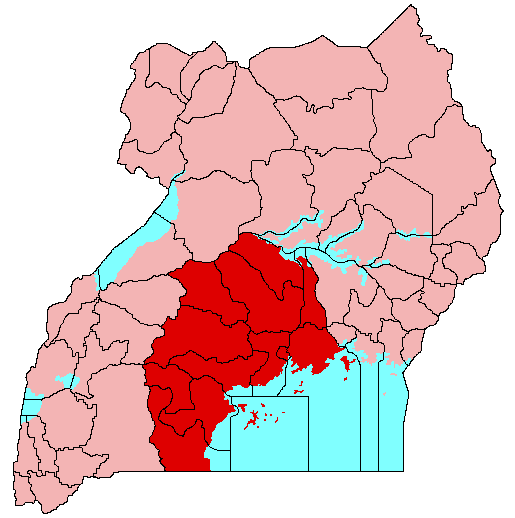
On the shores of the great inland sea of Nalubaale, the kingdom of Buganda took shape in a land of small green, flat-topped hills, nurtured by reliable equatorial rains and exceptionally fertile, resilient soils.
To look upon the kingdom of Buganda from the heights of its small, flat-topped hills is to understand how a civilization could believe itself favored by the gods. Rising two to four hundred feet above the valley floors of the East African Lakeland, these hills are carpeted in ten-foot-tall elephant grass and nourished by young, deep soils that resist erosion and cradle the roots of countless crops. Below them lies the vast, shimmering expanse of Lake Victoria—known to the Baganda as Nalubaale, the "Mother of the gods"—which sends up a reliable, near-constant supply of rain. Located directly on the Equator but elevated four thousand feet above sea level, the land escapes both the arid droughts of the surrounding plains and the oppressive heat of the lowlands. It was here, in this verdant sanctuary, that the Baganda people constructed what would become the most centralized, sophisticated, and formidable empire in the Great Lakes region of Africa, a state that would ultimately dictate the geography and name of modern Uganda.
The origins of this lacustrine power are shrouded in a mix of rich oral history and archaeological depth. While Bantu-speaking peoples crafting Urewe pottery had inhabited the region since the sixth century CE, Ganda tradition attributes the birth of the kingdom to Kato Kintu. Emerging from the northeastern slopes of Mount Elgon, Kintu is said to have led a migration of clans into the fertile territory of northern Busiro County, where he encountered and defeated Bemba Musota, the last of thirty indigenous kings. Through this victory, Kintu established the Kintu dynasty. Though tradition holds that Kintu mysteriously disappeared after founding his realm, his legacy was an unbroken line of thirty-six successive kings, known as the Kabaka, who transformed a minuscule territory of three counties—Kyadondo, Busiro, and Mawokota—into a regional colossus. Rivals from the neighboring kingdom of Bunyoro-Kitara would later claim that Buganda’s third king, Kimera, was actually a prince of their own Babiito dynasty who had traveled south to establish the state following the collapse of the ancient Chwezi empire. The Baganda, however, have long dismissed this as patriotic fiction. Their language is distinct, their traditions hold no memory of the Chwezi, and the marshy, banana-growing hills of Buganda were of little historical interest to the cattle-keeping dynasties of the drier west.
The true rise of Buganda began in the seventeenth and eighteenth centuries, as Bunyoro-Kitara entered a long decline and Buganda went on the offensive. Under the reigns of successive Kabakas—Kimbugwe, Katerega, and Mutebi—the kingdom expanded outward, swallowing up neighboring territories. When Buganda conquered Buddu, it replaced the defeated local rulers with loyal military governors, a administrative masterstroke that bound the newly acquired lands directly to the central authority of the Kabaka. To the Baganda, the people of Bunyoro-Kitara remained the ultimate enemy; indeed, the word Nyoro became their general shorthand for "foreigner," applied indiscriminately to all outsiders. By the mid-nineteenth century, Buganda had developed a highly organized, bureaucratic state. Ganda life was centered around hillside villages of forty to fifty homes clustered around the estate of a chief. These chiefs acted as the vital sinews of the state: they collected tribute, maintained local order, and channeled wealth upward to the Kabaka, who redistributed resources to reinforce social solidarity. But as the nineteenth century progressed, the Kabakas centralized their power even further, constructing great fleets of war canoes on Nalubaale from the 1840s onward to dominate the lake’s trade and coastlines.
With this military apparatus, Buganda established a sprawling sphere of influence characterized by systemic plunder, political manipulation, and calculated terror. Unlike Bunyoro, which claimed regional dominance through ancient myths, Buganda asserted its authority through the raw exercise of violence. To the west, the kingdom of Ankole paid a steady tribute of long-horned cattle simply to keep the peace and prevent the Ganda armies from devastating their pastures. Further south, the Haya kingdoms along the Kagera coast and the larger kingdom of Karagwe accepted the suzerainty of the Kabaka, helpless against Ganda attacks by both land and water. To the east, the Basoga people regularly sent goats, cattle, and slaves to the Kabaka's court, and whenever a major chief in Busoga died, rivals would travel to Buganda, bringing lavish gifts to have the Kabaka arbitrate their succession disputes.
Even when Buganda resorted to diplomacy, it did so with a devastating, cold-eyed pragmatism. In 1870, when the death of the king of Nkore triggered a succession crisis, Kabaka Mutesa sent a peace envoy to the border region of Kabula, ostensibly to forge a blood brotherhood with Makumbi, one of the prominent claimants to the Nkore throne. In truth, the envoy carried secret orders to support a rival pretender favored by Buganda. Once the Nkore delegation had been lured into the meeting, the Ganda forces launched a surprise assault, slaughtering over seventy leaders, including twenty royal princes. It was an act of political treachery that the Banyankole people would remember for generations, a testament to a state that would stop at nothing to secure pliant puppet rulers on its borders.
When the first British explorers, John Hanning Speke and Captain Sir Richard Francis Burton, arrived in 1862 in search of the source of the Nile, they did not find a decentralized tribal society, but a highly organized, sophisticated state. European visitors routinely marvelled at Buganda, describing it as the very pinnacle of native political evolution. Yet this administrative sophistication also made Buganda a prime target during the Scramble for Africa. Unable to preserve its complete independence against the rising tide of British imperialism, Buganda was integrated into the British Empire in 1884. Under the resulting protectorate, the British adopted the Swahili name for the kingdom—Uganda—to designate the entire colonial territory, placing Buganda at its very geographic and administrative heart.
Under colonial rule, the Baganda occupied a highly privileged, if complicated, position. Many Baganda were recruited as colonial administrators to govern other parts of the protectorate, spreading their language and administrative style across the territory. The region also became an economic powerhouse, transitioning rapidly into a major producer of cotton and coffee. Even into the modern era, coffee remained central to the region's identity and wealth; through ancestral agricultural campaigns like Emwaanyi Terimba, the Baganda actively drove the nation's coffee exports, producing over 3.1 million bags of Robusta coffee in the 2023/2024 financial year alone from the rich volcanic soils of the central hills.
Yet the very dominance of Buganda within the larger colony sowed the seeds of post-independence tragedy. When Uganda achieved independence, the tension between the historic, centralized kingdom of the Baganda and the broader, multi-ethnic nation-state proved irreconcilable. In 1966, this delicate balance collapsed. The following year, Uganda's first Prime Minister, Milton Obote, declared the nation a republic, abolished all traditional monarchies, and consolidated absolute power under the Uganda People's Congress. The ancient throne of Kintu was swept away, and Buganda was plunged into decades of political turmoil alongside the rest of the nation.
It was only in 1993, after years of civil war and unrest, that the ruling National Resistance Movement under President Yoweri Museveni officially restored the kingdom. Today, the Kabaka, Muwenda Mutebi II—the thirty-sixth of his line—reigns alongside Queen Sylvia Nagginda, occupying a largely ceremonial role. Though the absolute military power that once terrorized the Great Lakes has long since vanished, the kingdom’s cultural weight, its fertile hills, and its deep historical memory remain the anchor around which the modern state of Uganda continues to revolve.
Connected to
2 links to entries not yet ingested in the Library.