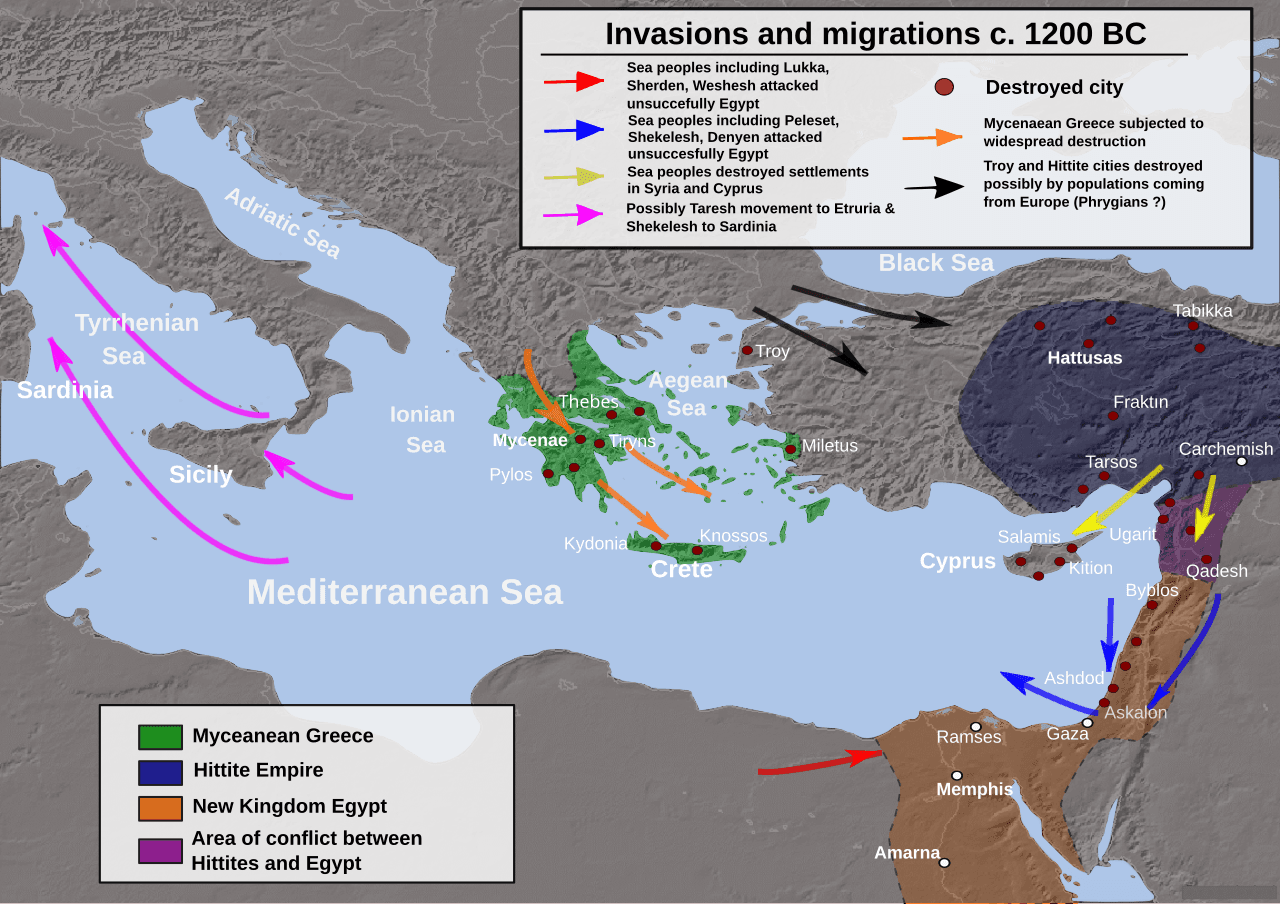
Between 1200 and 1150 BCE, a sudden and violent rupture fractured the ancient world, shattering the great, interconnected powers of the Eastern Mediterranean and the Near East.
In the dry clay of Ugarit, a coastal metropolis in what is now northern Syria, an unbaked tablet was found resting in the ashes of a ruined palace. Written in the urgent, wedge-shaped strokes of cuneiform, it was a letter from Ammurapi, the city’s last king, addressed to the king of Alasiya on the island of Cyprus. "My father," the tablet pleads, "behold, the enemy's ships came here; my cities were burned, and they did evil things in my country." Ammurapi explains that his own troops and chariots have been dispatched to the Hittite heartland in Anatolia, and his ships are stationed far away in Lukka. "Thus," he writes in a cadence of mounting desperation, "the country is abandoned to itself. May my father know it: the seven ships of the enemy that came here inflicted much damage upon us." The letter was never sent. It remained in the kiln where it was being fired for preservation, baked instead by the catastrophic conflagration that leveled Ugarit around 1180 BCE. Within a span of barely fifty years, between roughly 1200 and 1150 BCE, this scene of sudden, ruinous violence was repeated across the eastern Mediterranean. From the mountainous strongholds of Mycenaean Greece to the fertile river valleys of Syria and the Anatolian highlands, a vast, wealthy, and deeply interconnected web of civilizations did not merely decline; it shattered.
To understand the magnitude of this rupture, one must look to the nature of the world that preceded it. The Late Bronze Age was an era of unprecedented internationalism, characterized by a sophisticated, highly bureaucratic network of kingdoms that traded, fought, and negotiated with a level of diplomatic intimacy that would not be seen again in the region for centuries. This was a world dominated by great, sprawling empires: the New Kingdom of Egypt, the Hittites of Anatolia, the Middle Assyrian Empire of Mesopotamia, and the maritime, palace-centered kingdoms of Mycenaean Greece. These states were linked by a shared political economy. It was a palace-centric system where centralized administrations gathered the agricultural surpluses, timber, and wool of the hinterlands, concentrating wealth in royal storehouses before redistributing it according to the strategic needs of the ruling elite. Crucially, this system depended on a delicate, long-distance supply chain. To make bronze—the essential material for tools, armor, and the prestigious chariot divisions that dominated contemporary warfare—metallurgists needed both copper and tin. While copper was readily available on Cyprus and in the Levant, tin had to be imported from immense distances, with some of the closest mines located in modern-day Afghanistan, Kazakhstan, or perhaps even Cornwall. This absolute dependence on external trade meant that no kingdom was an island. The great powers were bound by an intricate web of dependencies; if one major gear in this international engine ground to a halt, the teeth of the others would inevitably shatter.
From the archives
Sea Peoples depicted in relief at Medinet Habu — Ramesses III's mortuary temple, c. 1175 BCE.
Public domain · via Wikimedia Commons
Major Bronze Age polities of the eastern Mediterranean before the collapse, c. 1300 BCE.
CC BY-SA · via Wikimedia Commons
The Lion Gate at Mycenae — one of the great Bronze Age centres that fell in the collapse.
CC BY-SA · via Wikimedia Commons
Connected to
4 links to entries not yet ingested in the Library.
For nearly two centuries, historians and archaeologists have debated what finally broke this world. In 1817, the German historian Arnold Hermann Ludwig Heeren first posited that a great historical barrier existed around 1200 BCE, dating the legendary fall of Troy to 1190 BCE and noting that the prehistoric period of Greece seemed to end abruptly at this threshold. In 1826, Heeren linked this Greek rupture to the end of the Nineteenth Dynasty of Egypt. In the decades that followed, as archaeologists began digging up the burnt ruins of ancient cities, a dramatic narrative took shape. Scholars like Robert Drews argued that within a single generation, almost every significant city between Pylos in southwestern Greece and Gaza in the southern Levant was violently destroyed, many never to be inhabited again. This "all-at-once" cataclysm became the orthodox view of the Late Bronze Age collapse. It was a compelling, cinematic vision of history: an entire civilized world put to the torch in a terrifying wave of invasions and disasters.
Yet, as archaeological techniques have grown more precise in the late twentieth and early twenty-first centuries, this monolithic picture of universal, instantaneous ruin has begun to splinter. Modern scholars, such as the archaeologist Jesse Millek, have systematically re-examined the excavation reports of the 148 sites traditionally associated with the collapse. The results of this revisionist work have revealed a far more complex, uneven, and localized process. Of the 153 destruction events ascribed to the years around 1200 BCE, over sixty percent show signs of being misdated, assumed on flimsy evidence, or, in some cases, never having occurred at all. Famous sites like Athens, Lefkandi, Knossos, Aleppo, Byblos, and Tyre were once placed on maps of total destruction, but closer inspection reveals that many of these settlements either experienced gradual, peaceful transitions, survived intact, or had already declined decades earlier. Jerusalem, for instance, was revealed by Ann Killebrew to have been a small, unfortified, and relatively insignificant settlement during this period, rather than a grand city sacked by invaders. Even on Cyprus, long thought to have been overrun by marauders, cities like Kition and Paphos did not collapse; instead, they flourished and saw major rebuilding projects without any sign of violent destruction, exhibiting what excavator Vassos Karageorghis called "cultural continuity." What emerges from the modern debate is not a single, tidy event, but a mosaic of localized crises, some violent and sudden, others slow and structural, occurring over several decades.
Where destruction did occur, however, it was absolute and transformative. This is most vividly seen in Mycenaean Greece. The palace economies of the Aegean did not merely decline; they completely disintegrated. The great fortresses of Mycenae, Tiryns, and Thebes were gutted by fire. At Mycenae, an earthquake had previously devastated parts of the city around 1250 BCE, leaving crushed bodies buried in the ruins, but the inhabitants had rebuilt. In 1190 BCE, however, a series of catastrophic fires swept through the site, destroying the palace administrative center for good. At Tiryns, a massive earthquake around 1200 BCE shook the foundations of the citadel, but while the population attempted to clear the rubble and continue living in the lower town, the central political authority of the palace was gone. In the Peloponnese, up to ninety percent of small rural settlements were abandoned, indicating a massive, desperate depopulation as people fled the fertile plains. These destructions brought about the Greek Dark Ages—a four-century-long period of deep isolation, cultural impoverishment, and a near-total loss of literacy, as the complex Linear B script used by the palace scribes was forgotten.
In Greece, as in Anatolia, the physical ruins speak of a pervasive, suffocating atmosphere of fear in the final years of the thirteenth century BCE. At Athens, though there is no evidence of a destroyed palace, archaeologists found that the inhabitants constructed elaborate, enclosed, and protected access points to their deep-water sources, suggesting they feared a siege or a prolonged disruption of their water supply. In the palace of Pylos, which was completely destroyed by an intensive fire around 1180 BCE, clay tablets baked in the final conflagration record the dispatching of military detachments: "Watchers guarding the coast." Though scholars like Eric Cline caution that these tablets do not specify who the watchers were looking for or why, the text captures a society standing on a knife-edge, scanning the horizon for an approaching threat.
That threat has long been identified in the historical imagination as the "Sea Peoples"—a mysterious coalition of seafaring raiders who swept across the Mediterranean, attacking the coasts of Anatolia, Cyprus, the Levant, and Egypt. The primary evidence for these invaders comes from Egyptian monumental inscriptions. On the walls of the temple of Medinet Habu, Pharaoh Ramesses III recorded his desperate defense of Egypt against a second wave of maritime invaders during his reign between 1186 and 1155 BCE. The inscriptions name these disparate groups: the Peleset, the Tjeker, the Shardana, the Denyen, and the Weshesh, depicting them in relief carvings with distinctive feathered headdresses and horned helmets, attacking with ships whose bows are carved in the shape of waterbirds. An earlier monument, the Merneptah Stele (c. 1200 BCE), also speaks of allied foreign groups—the Ekwesh, Shekelesh, Lukka, Shardana, and Teresh—allied with Libyan forces invading the Nile Delta.
For generations, historians treated the Sea Peoples as a singular, external engine of destruction, a massive barbarian migration that overwhelmed the civilized world like a tidal wave. But modern scholarship increasingly views them not as the cause of the collapse, but rather as one of its most visible symptoms. They were likely a highly diverse collection of displaced populations, mercenaries, pirates, and refugees from the Aegean and western Anatolia, driven from their homes by the very same crises—famine, drought, and political instability—that they would subsequently unleash upon others. In some regions, like the southern Levant, these groups were eventually absorbed; Ramesses III settled the defeated Peleset (the Philistines) along the coastal strip from Gaza to Joppa, where they rapidly assimilated and established independent city-states.
If the Sea Peoples were not the sole architects of this ruin, what was? Historians have increasingly turned to environmental data, seeking answers in the natural world. The late thirteenth and early twelfth centuries BCE appear to have been marked by a severe, prolonged climatic shift. Data gathered from Greenland ice cores, marine plankton variations, and sea surface temperature reconstructions point to a rapid regional drop of three to four degrees Celsius in the Mediterranean. This cooling was accompanied by a severe, persistent drought. In the Dead Sea region of the southern Levant, the subsurface water level plummeted by more than fifty meters at the end of the second millennium BCE, a drop that would have required a catastrophic reduction in rainfall over the surrounding mountains. Tree-ring analysis of ancient junipers in Anatolia reveals a particularly acute, multi-year dry spell between 1198 and 1196 BCE.
This drought would have struck at the very heart of the Bronze Age empires. The palace economies, with their top-heavy bureaucracies, were highly specialized and remarkably inflexible. They relied on steady, predictable agricultural yields to feed their urban populations and sustain their networks of dependents. When the rains failed, the system cracked. Nancy Demand suggests that in places like Mycenaean Greece, the palaces' vital role in managing and storing food imports meant that their failure to secure grain during persistent droughts would have triggered widespread famine, peasant revolts, and the rapid defection of mercenary forces. However, the environmental picture is not uniform. A recent study by Karakaya and Riehl analyzing ancient plant remains from Syria found little evidence that crops underwent severe water stress during the Late Bronze-to-Iron Age transition, warning against any simplistic, monocausal explanation that relies solely on widespread starvation.
Other natural disasters have been summoned to court. Some Egyptologists have pointed north, dating the massive Hekla 3 volcanic eruption in Iceland to approximately 1159 BCE. This eruption is thought to have triggered a "volcanic winter," throwing vast quantities of ash into the atmosphere, cooling the Northern Hemisphere, and disrupting the flow of the Nile, which in turn brought political chaos and treasury-depleting grain riots to Ramesses III's Egypt. (Other scientists, however, dispute this chronology, placing the Hekla eruption either earlier, around 1135 BCE, or much later, in 929 BCE). Meanwhile, biological evidence has introduced another terrifying variable: disease. Recent genomic studies suggest that an early, now-extinct strain of the bubonic plague (Yersinia pestis) may have arrived in the eastern Mediterranean from Central Asia during this period, carried along trade routes or by migrating groups, decimating urban centers that were already weakened by food shortages.
To explain how these various pressures—drought, plague, volcanic winter, pirate raids, and peasant uprisings—could have brought down an entire international system, scholars have turned to "systems collapse" theory. Pioneered by Joseph Tainter, this model proposes that as societies grow more complex, they require increasingly higher levels of energy, bureaucracy, and specialization to solve their problems, reaching a point of diminishing returns. The Late Bronze Age civilizations had become too complex, too specialized, and too deeply interdependent. When climate change disrupted agriculture, the trade routes that supplied tin and copper began to break down. The loss of trade undermined the wealth of the palace elites, who could no longer pay their administrative scribes or maintain their expensive chariot corps. As the central authority weakened, local populations defaulted on their obligations, mercenaries turned into raiders, and the defensive networks of the kingdoms crumbled. Once the delicate, specialized machinery of the Bronze Age world was seriously disrupted, it was simply too intricate to reestablish. The kingdoms did not recover; instead, they reverted to simpler, more localized, and more resilient forms of social organization.
Amidst this cascading failure, there was also a revolution in the nature of warfare itself. Robert Drews has argued that the collapse was accelerated by a sudden, drastic shift in military technology. For centuries, Bronze Age warfare had been dominated by the chariot, an incredibly expensive, highly specialized weapon system that only wealthy, centralized states could afford to build and maintain. Chariot battles were elite affairs, supported by small numbers of infantry. But around 1200 BCE, a new style of infantry warfare emerged. Soldiers began using long, heavy, cast-bronze swords designed for cutting and thrusting rather than slicing, along with light javelins and standardized bronze body armor. Suddenly, large groups of light, highly mobile "running skirmishers" could swarm, outmaneuver, and butcher an expensive chariot army on uneven terrain. This military democratization meant that small bands of raiders—such as the Sea Peoples, the Phrygians, or the Arameans—could defeat the grand imperial armies of the age. The expensive, specialized palace administrations that existed to support the chariot elite were rendered obsolete overnight.
The geographical reach of this collapse was vast, but its severity was highly uneven. In Anatolia, the Hittite Empire, which had dominated the peninsula for centuries, disintegrated completely. Its capital of Hattusa was burned to the ground, though evidence suggests it may have been largely abandoned before the final fire. Some sites, like Troy, were immediately rebuilt on a smaller scale, while others, like the massive fortress of Kaymakçı, were permanently abandoned. The vacuum left by the Hittites allowed new groups, such as the Phrygians, to migrate into Anatolia from the Balkans, while the remnants of the Hittite elite retreated to the south, fracturing into small, localized Syro-Hittite states.
In Syria and the Levant, the destruction was similarly selective. Great commercial hubs like Ugarit and Emar were obliterated. At Ugarit, the scattered arrowheads found in the streets of the southern residential quarter and around the city center leave no doubt that the city fell to a violent, desperate assault. At Emar on the Euphrates, only the temples and public buildings were burned, while the private homes were found empty and undamaged, suggesting a targeted, deliberate purging of the city's ruling institutions. Yet other nearby cities, such as Hama, Qatna, Kadesh, Aleppo, and Alalakh, bear no archaeological trace of destruction from this period, despite their frequent appearance on modern maps of disaster.
The two great imperial powers of the age, Egypt and Assyria, survived the cataclysm, but they did so in severely weakened, inward-looking forms. Egypt, under Ramesses III, successfully repelled the sea-borne invasions, but the effort nearly bankrupted the state. The pharaoh boasted of his victories, claiming that "no land can stand fast before my arms," but the reality was a protracted, agonizing retreat. Over the course of the twelfth century BCE, suffering from domestic political turmoil, dynastic assassinations, and economic exhaustion, Egypt withdrew its garrisons from the southern Levant, abandoning its governor's residences at sites like Deir al-Balah and Ashkelon. The New Kingdom collapsed into the fragmented, politically weak Third Intermediate Period.
To the east, the Middle Assyrian Empire managed to weather the storm with remarkable resilience. Unlike the other powers, Assyria maintained a stable monarchy, a highly efficient civil administration, and a continuous, detailed written record throughout the twelfth century BCE. Although Assyria was attacked by the Mushki in Anatolia and faced waves of migrating Arameans in the Levant, King Tiglath-Pileser I successfully repulsed these threats, mounting long-range military campaigns to protect Assyria’s vast territories. Yet even this military powerhouse could not escape the wider economic contraction of the region. Following the death of Ashur-bel-kala in 1056 BCE, Assyria withdrew from its far-flung colonies, shrinking back to its traditional heartland in northern Iraq and southeastern Turkey, where it would remain quiet for nearly a century before rising again to forge the Neo-Assyrian Empire.
The world that eventually emerged from the ashes of this collapse was unrecognizable to those who had lived through the Late Bronze Age. Robert Drews described the collapse as "arguably the worst disaster in ancient history," a ruin so profound that it lived on in the cultural memory of the survivors as the end of a legendary, heroic age. The Greek poet Hesiod, writing centuries later, conceptualized history as a descent from a golden age of heroes to a cruel, modern "Age of Iron." Similarly, scholars have suggested that memories of this sudden, watery destruction of an advanced maritime civilization may have inspired Solon and later Plato in his creation of the myth of Atlantis.
But the collapse was not merely an end; it was also a crucible of profound transformation. The destruction of the centralized palace economies, with their tight monopolies on wealth and trade, cleared the way for a more decentralized, democratic, and technologically innovative world. The most significant of these changes was the slow, steady transition from bronze to iron. While ironworking technology had been developing gradually in the Balkans and the Aegean since the thirteenth century BCE, it was the collapse of the Bronze Age trade routes—which cut off the supply of imported tin—that finally forced smiths to master the far more difficult process of smelting and forging iron. Iron, unlike tin and copper, was incredibly common and could be found locally in almost every region. Weapons and tools were no longer the exclusive privilege of wealthy kings who could afford international trade; they became cheap, accessible, and ubiquitous, transforming agriculture and warfare alike.
Politically, the collapse of the great empires allowed smaller, more flexible polities to emerge in the spaces between the old ruins. Along the coast of the Levant, the Phoenician city-states, freed from Egyptian and Assyrian domination, enjoyed a golden age of maritime commerce, setting up trading colonies across the Mediterranean. In the interior of the Levant, smaller, tribal-based kingdoms began to coalesce, including Israel, Moab, Edom, and Ammon. In Greece, the death of the Mycenaean palaces eventually gave rise to the polis—the independent city-state—which would define classical antiquity.
Perhaps the most enduring legacy of this transition was born of this new, decentralized internationalism. Seeking a simpler, more efficient way to keep track of their expanding trade networks than the complex cuneiform of Mesopotamia or the lost Linear B of the Mycenaeans, the Phoenicians developed a simplified, phonetic writing system. This writing system, consisting of just twenty-two characters representing consonantal sounds, bypassed the need for years of specialized scribal training. In the eighth century BCE, as Greece began to emerge from its long Dark Age, Greek merchants adapted this Phoenician alphabet, adding vowels to create the very first fully phonetic alphabet. It was a technology of memory born directly from the ruins of a forgotten literacy—a system designed not for palace bureaucrats, but for citizens, merchants, and poets.
In the end, the Late Bronze Age collapse poses a haunting question that continues to resonate in our own highly globalized, technologically complex, and ecologically fragile world: when a highly interconnected international system is subjected to multiple, simultaneous crises, does its very complexity make it impossible to save? Or is collapse simply the necessary, painful prelude to the next great leap forward in human history?