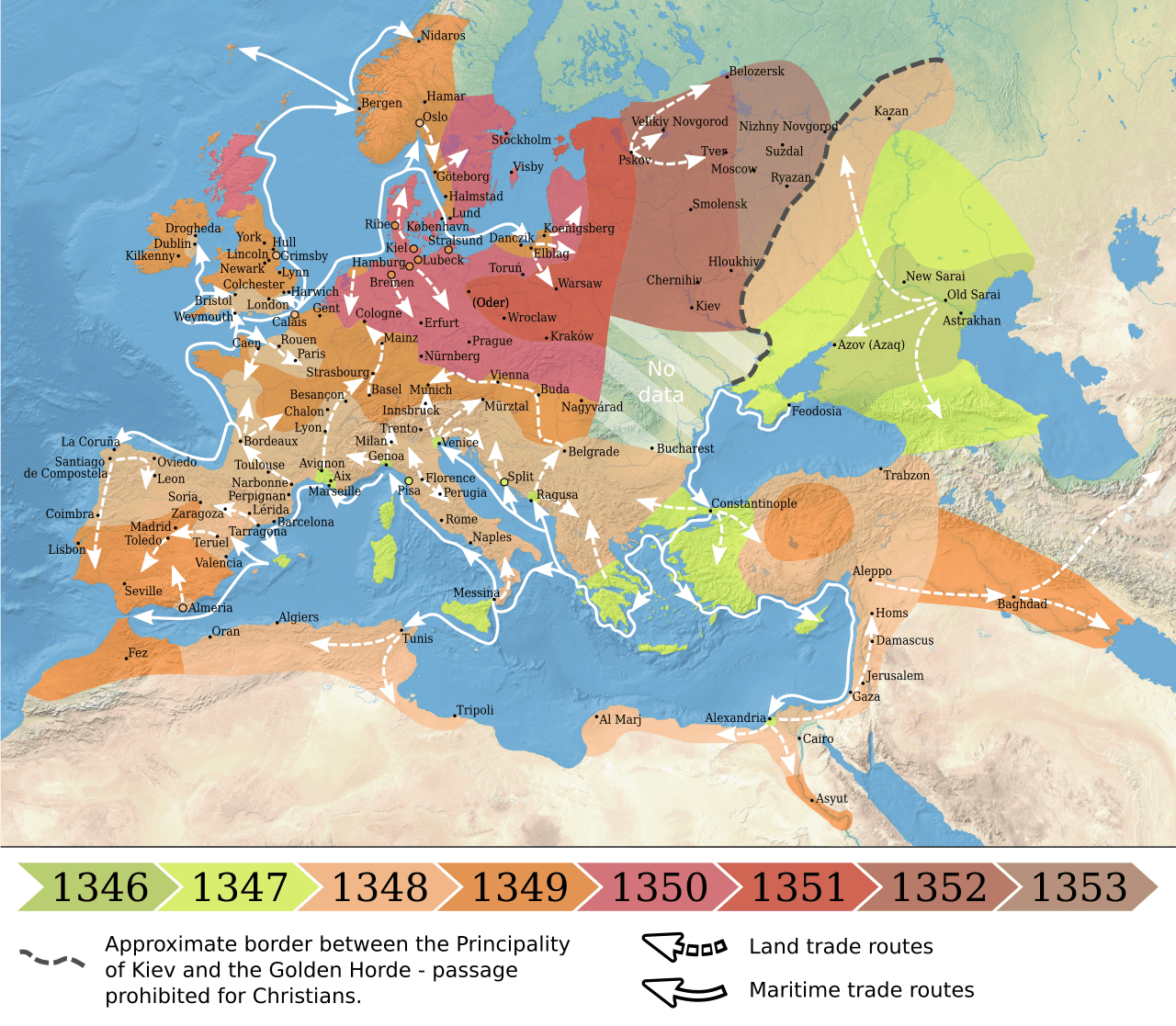
Sometime in 1347, during the siege of the Genoese trading port of Caffa in Crimea, the army of the Golden Horde under Jani Beg reportedly introduced a lethal pathogen to their European adversaries.
In the late 1330s, along the high-altitude trade corridors of the Chüy Valley near Lake Issyk-Kul in modern Kyrgyzstan, gravestones written in Syriac script began to record a sudden, terrifying spike in mortality. Where previous years had seen the quiet, expected rhythm of deaths in a remote Central Asian trading community, the years 1338 and 1339 saw stone after stone carved with a single, ominous cause of death: "pestilence." In the teeth of seven individuals buried in the cemeteries of Kara-Djigach and Burana, the genetic signature of this pestilence remained preserved for centuries. It was the bacterium Yersinia pestis, specifically the direct ancestor of a biological storm that was about to break across the hemisphere. The Chagatai Khanate, the geographic heart of the Mongol Empire’s vast trade network, served as the crucible. Here, where the high-speed postal stations of the Yam network connected East Asia to the West, and where heavily guarded merchant caravans traveled with unprecedented efficiency, a localized rodent-borne disease was quietly transformed into a transcontinental traveler.
The world that this pathogen was about to enter was highly connected yet completely defenseless. Since the conquests of Genghis Khan, the Eurasian continent had been knit together by trade routes that allowed goods, ideas, and people to move with a speed never before seen. But this infrastructure of exchange doubled as a superhighway for contagion. From its birthplace in Central Asia, the plague radiated outward in a "four-way split" that tracked the geographic fractures of the Mongol Empire. To the south and west, it followed the Silk Road toward the Ilkhanate in Persia. Scholars have long noted the suspicious timing of the Ilkhanate’s sudden collapse following the death of its ruler Abu Sa'id in 1335 CE. While direct archaeological evidence of mass graves in Persia from the early 1330s remains elusive, the catastrophic loss of military manpower and the immediate administrative paralysis suggest that the plague may have been quietly devouring the nomadic camps and trade hubs of the region long before urban chroniclers took notice.
To the north, the bacterium traveled along the Volga River into the territories of the Golden Horde, striking its capital of Sarai and rolling toward the Black Sea. In 1346, the plague arrived at the walls of Caffa, a strategic Genoese trading port on the Crimean peninsula. Here, the besieging army of the Mongol Khan Jani Beg was suddenly decimated by the sickness. In a desperate, early act of biological warfare recorded by the chronicler Gabriele de' Mussi, the Mongols catapulted the infected corpses of their own dead over the city walls. Whether this specific act caused the subsequent outbreak or whether rat-infested Genoese ships simply harbored the disease naturally, the result was the same. By 1347, ships fleeing the siege of Caffa had carried the infection into the Mediterranean Basin, introducing it to Constantinople, Sicily, and the Italian peninsula.
12 links to entries not yet ingested in the Library.
The speed with which the sickness swept inland from the ports puzzled contemporaries and continues to occupy modern researchers. While the disease was carried across the seas by fleas living on black rats aboard Genoese vessels, its rapid, devastating march across the European continent suggest that it did not rely on rodent vectors alone. Once ashore, the Black Death likely spread directly from person to person as pneumonic plague, an airborne variation that bypassed the slow cycle of rat-to-flea-to-human transmission. In Europe, where the memory of the Great Famine of 1315–1317 was still fresh in the minds of the elderly, this new horror was unmatched. Between 1346 and 1352, the pandemic tore through the continent, killing as many as 50 million people—perhaps half of Europe’s fourteenth-century population. Latin chroniclers of the era struggled for language to describe the scale of the loss, recording the catastrophe under the names pestis, epidemia, or simply magna mortalitas—the Great Death.
Further east, the pandemic shook the foundations of empires that had once seemed invincible. In China, the Yuan Dynasty struggled under a cascade of disasters: the plague was accompanied by widespread flooding and famine, a combination that shattered the administrative capability of the Mongol rulers and undermined their legitimacy. This triple crisis fueled the Red Turban Rebellion, which began around 1351 and ultimately led to the overthrow of the Mongols and the establishment of the Ming Dynasty in 1368. In the Golden Horde, the loss of the ruling elite and the sudden depopulation of the lucrative trade routes along the Volga triggered a prolonged domestic collapse. By 1359, the Horde descended into a chaotic period of civil war known as the "Great Troubles," weakening its grip on its Russian vassals and paving the way for the rise of the Grand Duchy of Moscow. Even India, under the Tughlaq Dynasty of Muhammad bin Tughlaq, recorded massive, sudden outbreaks of pestilence in 1334 and 1344. Though the traveler Ibn Battuta described an army decimated almost instantly by high fevers near Bidar and Warangal, the lack of distinct physical markers like buboes in his accounts leaves it unclear whether India suffered from Yersinia pestis or another tropical killer like cholera or malaria.
The term "Black Death" itself was not used by the people who lived through the fourteenth-century cataclysm. While the ancient Greek poet Homer had once described the monster Scylla as having mouths "full of black Death," and the medieval Belgian astronomer Simon de Covino had used mors nigra in a 1350 poem to describe the fatal end of the sickness, the name was not a contemporary label for the pandemic. Instead, it was popularized centuries later by Danish and Swedish chroniclers who spoke of den sorte død. The English language did not adopt the term until the 1750s, when writers translated the Scandinavian texts, forever fixing the dark moniker to the event.
The pandemic did not simply vanish after its initial fury subsided in 1352. It marked the beginning of the second plague pandemic, a centuries-long era of biological insecurity. Outbreaks recurred periodically across Europe, the Middle East, and the rest of the world, preventing populations from recovering. Due to the recurring visitations of the plague and the broader crises of the Late Middle Ages, Europe’s population did not return to its early fourteenth-century levels until the sixteenth century, while the global cycle of outbreaks persisted into the early nineteenth century. By the time the bacterium finally receded, it had permanently redrawn the political, social, and economic maps of Eurasia, bringing down dynasties, fracturing empires, and leaving behind a transformed world that had learned, at a terrible cost, just how small and interconnected it had become.