Event · 1170 CE – 1897 CE · West African Empires
Benin Empire
- Also known as
- A̱byintyok Bini
- Benin
- Benin
- Benin İmperiyası
- Benin Kingdom
- Benin Krallığı
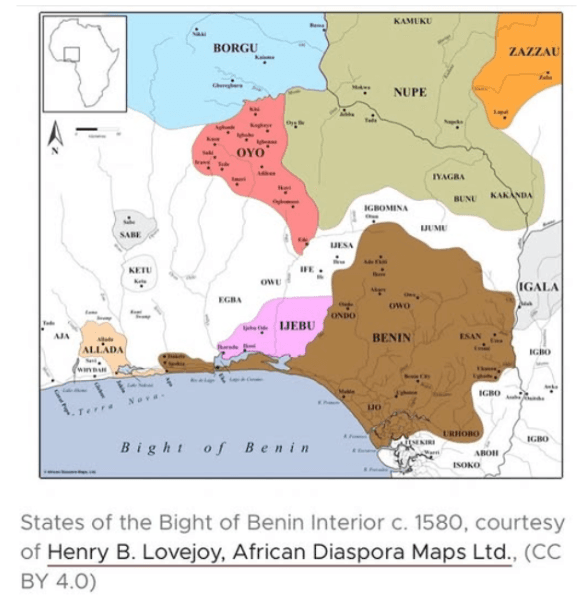
Deep within the protective canopy of the West African rainforest, a society took root by exploiting a dense landscape that was as much a natural fortress as it was a treasury of resources.
By the time the Portuguese explorer João Afonso de Aveiro rode through the forest-cleared gates of Great Benin in 1485, he found a metropolis of astonishing scale, organized with a geometric precision that rivaled the finest cities of Renaissance Europe. A labyrinth of earthen ramparts, constructed over centuries with an estimated one hundred and fifty million hours of labor, snaked across the landscape, delineating territories and enclosing a royal capital of vast avenues and deep, defensive moats. At the center of this world sat the Oba, a ruler whose authority was absolute and whose lineage stretched back to the twilight of the twelfth century. To the newcomers from the Iberian Peninsula, this was not merely a kingdom but a peerless trading partner—a sovereign power that would soon exchange pepper, ivory, and human lives for European brass, textiles, and firearms. Yet, the great city-state the Portuguese called Benin was already the product of several reinventions, its foundations sunk deep into the soil of a rainforest that was as much a defensive shield as it was a reservoir of wealth.
Before it was Benin, the land was Igodomigodo. Emerging from a cluster of autonomous communities in the dense forests of the southern Nigerian hinterland during the late first millennium CE, this early polity was governed by the Ogiso, or "rulers of the sky." The rainforest offered these early builders an ideal sanctuary. Its thick canopy and narrow, easily defended paths frustrated invaders, while its rivers and wood sustained a growing population of hunters, farmers, and artisans. By the fifth century CE, the inhabitants had mastered ironworking, forging the tools that cleared the heavy timber and the weapons that protected their settlements. Domesticated animals struggled to survive the tsetse-borne diseases of the wet forest, but over generations, local breeds of cattle and goats developed a hard-won resistance. The Ogiso period established the cultural and social blueprint of the region, but it ended in political ruin. By the late twelfth century, the incompetent rule of the last Ogiso, Owodo, provoked a popular revolt. The local chiefs attempted a republican experiment under a leader named Evian, but when Evian tried to pass his mantle to his son, Ogiamwen, the ruling council of chiefs—the Edionevbo—resisted. They sent emissaries north to the sacred Yoruba city of Ile-Ife, requesting a prince who could restore legitimacy to a fractured state.
What followed is a matter of enduring historical debate, where local memories diverge along political lines. The official court tradition asserts that Oranmiyan, a prince of Ife, accepted the invitation, arriving with a retinue to establish a new dynasty. A newer tradition, emerging in the late twentieth century, counters that the founding Oba was actually an exiled native Edo prince who had fled to Ife, meaning the Benin monarchy was indigenous from its inception. Whichever the case, Oranmiyan found the local politics of the city-state toxic. Opposed by Ogiamwen’s faction, he fought his way into the city but found himself unable to govern a population that viewed him as an outsider. Frustrated, he abdicated in favor of his young son, Eweka, born to the daughter of a local chief. Upon leaving, Oranmiyan reportedly cursed the kingdom as —the "land of vexation"—a phrase that would linger in the European ear centuries later as "Benin." It was Eweka, crowned around 1200 CE, who stabilized the realm, initiating a centralized system of governance supported by a newly organized council of chiefs.
Connected to
6 links to entries not yet ingested in the Library.