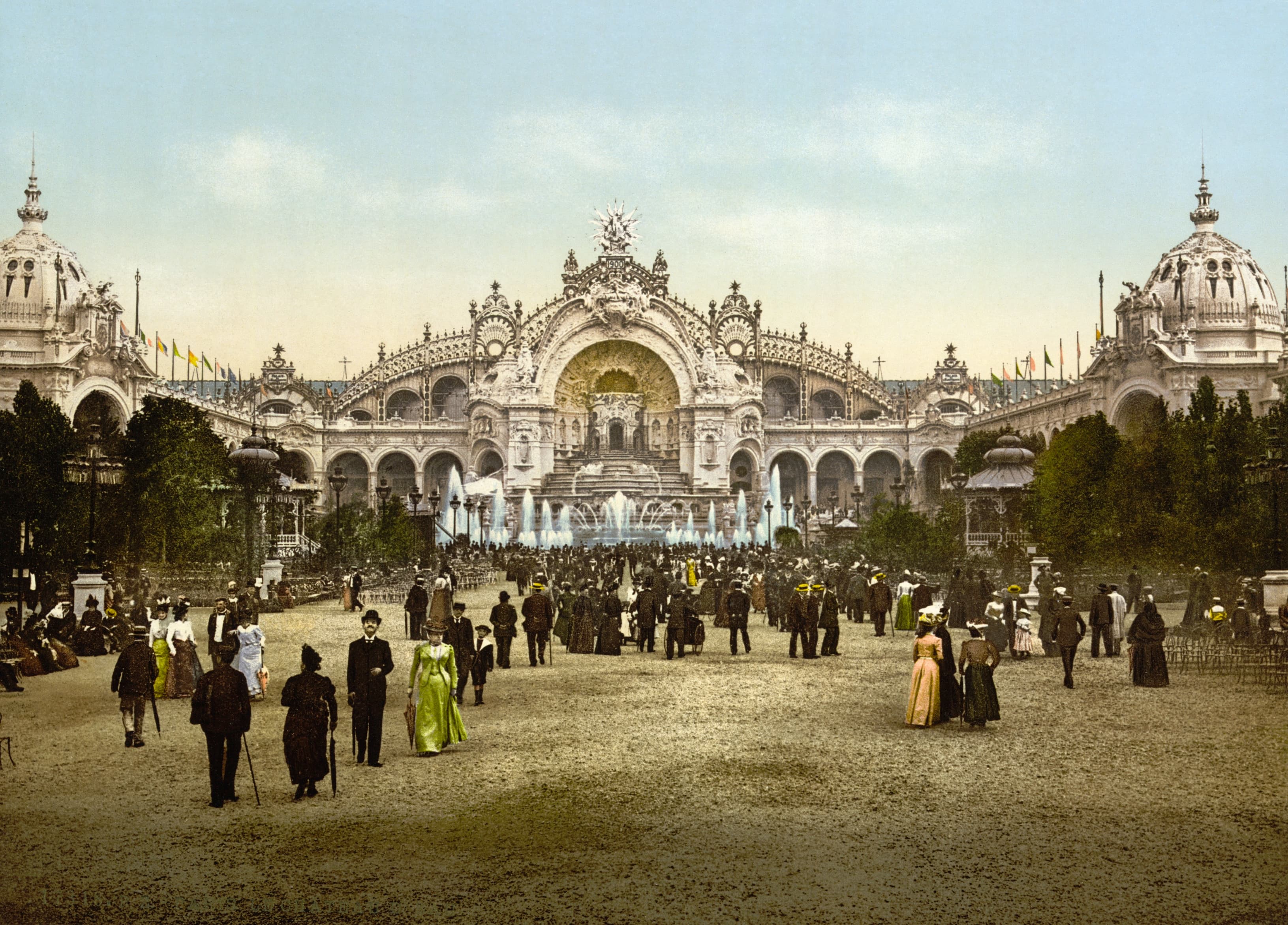
For more than forty years, sandwiched between the humiliation of the Franco-Prussian War in 1871 and the industrialized slaughter of 1914, Europe experienced a rare interval of regional peace and soaring optimism.
In the spring of 1889, a skeletal tower of puddle iron rose above the Paris skyline, slicing three hundred meters into the clouds. Built as the monumental gateway to the Exposition Universelle, Gustave Eiffel’s creation was initially decried by the city’s artistic elite as a giant, unsightly smokestack. Yet almost overnight, the Eiffel Tower became the defining emblem of a continent that believed it had permanently mastered gravity, distance, and time. To look out from its platforms was to survey a transformed world. Below stretched the wide, elegant boulevards carved through medieval slums by Baron Haussmann, clean, walkable avenues lit by the soft glow of gas lamps that were already giving way to the stark, brilliant hum of electricity. This was Paris at the threshold of what would later be called, with an intense and aching nostalgia, the Belle Époque—the Beautiful Era. It was a golden age of peace, prosperity, and unparalleled cultural confidence, suspended between the catastrophic humiliation of the Franco-Prussian War in 1871 and the industrialized slaughter of 1914.
This half-century of stability was born from a paradox. It was an era of profound regional peace in Western and Central Europe, maintained not by universal goodwill but by a delicate, shifting architecture of balance-of-power diplomacy. The wounds of 1871 remained unhealed; the French Third Republic nursed a quiet, enduring resentment over the loss of Alsace-Lorraine to the newly forged German Empire. Yet whenever local rivalries threatened to ignite a broader European conflagration, the Great Powers gathered in wood-paneled salons to partition the world instead of fighting each other. At the Congress of Berlin in 1878, the Berlin Conference in 1884, and the Algeciras Conference in 1906, diplomats redrew borders and negotiated colonial spheres of influence, fueling the competitive land grab of New Imperialism and the Scramble for Africa. For the European upper classes, this global dominance translated into an unprecedented sense of borderless freedom. A wealthy gentleman could board a train in Paris and travel across the length of Western Europe without once showing a passport, living and spending money with minimal bureaucratic interference.
For those with the means to enjoy it, the joie de vivre of the era was a tangible, sensory experience. The expansion of the railway network linked Europe's capitals to luxurious coastal resorts and inland spa towns—Biarritz, Deauville, Vichy, Arcachon, and the sun-drenched playground of the French Riviera. While ordinary citizens crowded into second-class compartments, the truly affluent commissioned private railway coaches that functioned as rolling palaces of mahogany and velvet. In Paris, the undisputed cultural capital of this globalized elite, the —wealthy industrialists and financiers—vied for acceptance into , the exclusive social circle of old aristocrats and trendsetters. They paraded their wealth at Maxim’s, the city’s most prestigious restaurant, where the air was thick with the scent of expensive cigars and hothouse orchids, cultivated at immense expense in private greenhouses using cheap coal and abundant labor. Fashion, too, became an ephemeral, yearly cycle with the birth of , demanding exotic furs and rare feathers to adorn women clad in elaborate, undulating Art Nouveau designs.
1 link to entries not yet ingested in the Library.
Below this glittering surface lay a massive economic underclass whose labor sustained the entire apparatus of luxury. The Belle Époque was built on cheap energy and even cheaper domestic labor. While the wealthy dined at Maxim’s or attended grand spectacles at the cavernous, opulent Opéra Garnier, the working population lived in dense, soot-choked urban slums or struggled against endemic poverty in the provinces. The physical separation of these worlds was accelerated by technological progress. The Paris Métro, alongside the omnibus and the electric streetcar, allowed the working class—including the legions of maids, cooks, and drivers who serviced wealthy estates—to commute from increasingly segregated suburbs into the affluent heart of the city. This sharp economic divide fueled a burgeoning international workers' movement. Transnational class solidarity grew through organizations like the Second International, while more radical anarchists sought to dismantle the capitalist state entirely. The era’s calm surface was occasionally shattered by political violence: a bomb exploded in the French Chamber of Deputies in 1893, and President Marie François Sadi Carnot was assassinated in 1894. That same year, anarchist Émile Henry detonated a bomb in a Parisian cafe, bringing terrorism directly into the spaces of bourgeois leisure.
Yet the dominant public mood remained stubbornly, almost aggressively optimistic, driven by a dizzying torrent of scientific and technological breakthroughs. The Second Industrial Revolution was fundamentally rewriting the conditions of daily life. The telegraph and telephone accelerated communication to near-instantaneous speeds, while Édouard Belin’s "Belinograph" allowed photograph transmissions over telephone lines. In the 1890s, Edouard Michelin invented removable pneumatic tires, transforming first the bicycle and then the early automobile from a rattling luxury experiment into a viable, smooth-riding mode of transport. The skies, too, were being conquered. Although aeroplanes remained the preserve of daring pioneers, France established the world’s first national air force in 1910, spurred by independent helicopter experiments conducted by Louis Breguet and Paul Cornu in 1907. Even the way humanity recorded its own existence changed. Léon Bouly patented the cinématographe, a technology refined by Auguste and Louis Lumière, who hosted the world’s first public film screenings in Paris, capturing the fleeting movement of crowds and steam trains on celluloid.
This celebration of modernity found its perfect stage in the entertainment culture of Paris. The bohemian counter-culture of Montmartre merged with the commercial desires of the bourgeoisie in the city's legendary cabarets and music halls. The Moulin Rouge, which opened its doors in 1889, and the Folies Bergère offered a sensual, uninhibited alternative to the more conservative entertainment of other European capitals. Here, dancers and singers like Polaire, Mistinguett, Paulus, and Eugénie Fougère became genuine celebrities. The wild, high-kicking energy of the Can-can, performed by stars like Jane Avril and La Goulue, was immortalized in the vibrant, lithographic poster art of Henri de Toulouse-Lautrec, which adorned the city's kiosks and walls. Courtesans and socialites like Liane de Pougy ruled the night, turning the demimonde into a space of theatrical self-invention where the boundaries of respectable society were playfully, if temporarily, transgressed.
But the Belle Époque was never a monolith of untroubled joy. It was haunted by deep structural anxieties, political scandals, and an undercurrent of cultural pessimism that some intellectuals termed the fin de siècle—the end-of-the-century malaise. The most explosive domestic crisis of the era was the Dreyfus affair, which began in 1894 when Captain Alfred Dreyfus, a Jewish French artillery officer, was falsely accused and convicted of passing military secrets to Germany. The affair exposed a deep, raw vein of antisemitism and militarism running through the French state, military, and general public. For years, the country was bitterly divided between Dreyfusards, who demanded justice and human rights, and anti-Dreyfusards, who prioritized the honor of the army and the preservation of national identity. The conflict reached a fever pitch when the novelist Émile Zola published his blistering open letter, J'Accuse…!, on the front page of a Paris newspaper, accusing the government and military high command of a systematic cover-up.
As the calendar turned into the twentieth century, the fragile geopolitical scaffolding that had preserved the general peace began to warp. A ferocious armaments race consumed Europe's major economies between 1897 and 1914. While the public marveled at the peaceful technologies displayed at the 1900 Exposition Universelle, factories across the continent were quietly churning out machine guns, heavy artillery, and dreadnought battleships. Diplomatic crises grew increasingly frequent and difficult to resolve, from the Fashoda Incident in 1898 to the Moroccan crises of 1905 and 1911. In the Balkans, regional wars in 1912 and 1913 acted as violent previews of a larger conflict, demonstrating the terrifying lethality of modern, industrial weaponry.
When the Archduke Franz Ferdinand was assassinated in Sarajevo in June 1914, the intricate system of alliances and imperial rivalries that had long stabilized the continent suddenly functioned as a trap. Within weeks, the transnational, borderless world of the European elite vanished. The luxury trains stopped running, the borders closed, and the young men who had spent their summers strolling the grand boulevards of Paris or Berlin marched off to the front lines. The Belle Époque was only named as such after the guns fell silent in 1918, viewed through the smoke of a devastated continent as a lost paradise—an era when humanity believed it was marching inexorably toward progress, unaware of the abyss waiting at the end of the avenue.