Event · Late Antique and Byzantine
Battle of Manzikert
- Also known as
- Bataille de Mantzikert
- bataille de Manzikert
- bataja de Manzicerta
- Batalha de Manzikert
- Batalha de Manzikert
- Batalha de Manziquerta
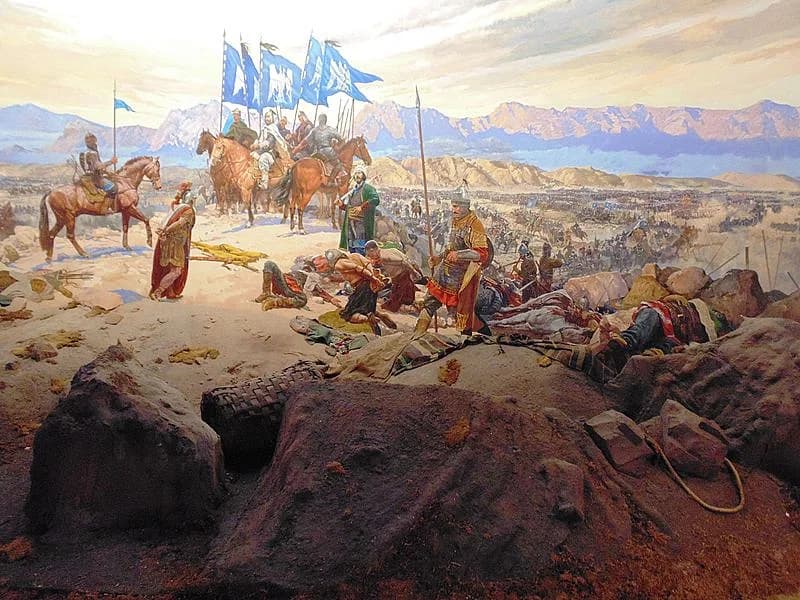
In the high summers of the eleventh century, the eastern borders of the Byzantine Empire were hollowed out by their own rulers.
On the morning of August 26, 1071, near the fortress town of Manzikert in the highlands of Armenia, Sultan Alp Arslan dressed himself in a white robe that resembled an Islamic funeral shroud. It was a deliberate, theatrical gesture designed to signal to his thirty thousand horsemen that their leader was prepared to die on the field. Across the undulating valley, Romanos IV Diogenes, Emperor of the Romans, surveyed the landscape from beneath the standards of Byzantium. He was a soldier-emperor who had seized the throne through marriage to address a single, burning crisis: the relentless, stinging incursions of Turkic nomads into the eastern provinces of his empire. Romanos believed he possessed the numbers and the professional iron to settle this eastern question once and for all. He did not know that his army had already been quietly halved by desertion and miscalculation, nor did he realize that the shadow of betrayal hung heavily over his rear guard. By nightfall, the emperor’s grand host would be scattered, and Romanos himself would lie in the dirt, a boot pressed firmly against his imperial neck.
The road to this catastrophe had been paved by decades of imperial complacency in Constantinople. During the middle of the eleventh century, under the militarily incompetent reigns of Constantine IX Monomachos and Constantine X Doukas, the Byzantine state had allowed its formidable military apparatus to decay. In a disastrous bid to save treasury funds, Constantine IX had disbanded the fifty-thousand-man "Iberian Army," catastrophically dismantling the defensive shield of the empire’s eastern border. The provincial themes, once populated by self-equipping soldier-farmers, were starved of resources. In their stead, the imperial court turned increasingly to foreign mercenaries—Franks, Normans, Pechenegs, Uz, Bulgarians, and Georgians—who could be hired for specific campaigns and disbanded afterward to prevent them from meddling in the cutthroat politics of the capital.
When Romanos Diogenes assumed the purple in 1068, he inherited an empire whose borders were fraying. The Seljuks, a rising powerhouse of steppe warriors under the brilliant leadership of Alp Arslan, had captured the crucial city of Ani in 1064 and were raiding deep into Anatolia. Romanos spent three years reforming what remained of the native army and launching aggressive, if indecisive, counter-campaigns. By the summer of 1071, seeing Alp Arslan occupied with a grueling siege of Aleppo, Romanos resolved to strike a massive, preemptive blow. He gathered a vast, polyglot host of approximately forty thousand men and began a long, difficult march across Asia Minor. The expedition was weighed down by the emperor’s luxurious baggage train, which alienated the rank-and-file, while his volatile Frankish mercenaries plundered the very Anatolian populations they were paid to protect.
The campaign began to unravel long before the two main armies clashed. Upon reaching the vicinity of Lake Van, Romanos made the fateful decision to split his force. Confident that Alp Arslan was either far away or retreating, the emperor sent General Joseph Tarchaniotes with nearly twenty thousand men—including his elite Varangian Guard, the Pechenegs, and the Franks—toward the fortress of Khliat. Meanwhile, Romanos marched on Manzikert with the remainder of the army, easily capturing the town on August 23. But Alp Arslan was not retreating. Guided by scouts who tracked every imperial movement, the Sultan was already in the area with thirty thousand cavalry from Aleppo and Mosul, reinforced by ten thousand Kurdish fighters. The army sent with Tarchaniotes vanished from the campaign entirely; whether they were secretly crushed by the Seljuks or simply fled the field in panic, as some contemporary chroniclers darkly hinted, they never returned to aid their emperor.
On August 24, Byzantine foraging parties under Nicephorus Bryennios stumbled into the vanguard of the Seljuk army. Romanos, still refusing to believe he was facing Alp Arslan’s main force, sent the Armenian general Basilakes with a contingent of cavalry to sweep them away. Basilakes was promptly routed and captured. The following day, a delegation of Seljuk peace emissaries arrived in the imperial camp. Romanos, knowing how difficult and expensive it would be to assemble another such army, and determined to end the nomadic incursions permanently, rejected the offer. He drew up his forces for a decisive, set-piece battle on August 26.
The Byzantine battle line was a study in fragile grandeur. Romanos commanded the center, flanked on the left by Bryennios and on the right by Theodore Alyates. The vital rear guard, tasked with covering any potential retreat, was placed under the command of Andronikos Doukas. It was a ruinous choice: Andronikos was the son of John Doukas, the emperor’s bitter political rival, and his loyalty to the crown was highly suspect. Four kilometers away, the Seljuks stood in a vast crescent formation.
As the Byzantines advanced, the Seljuks deployed the classic Parthian tactics of the Eurasian steppe. Swarms of horse archers hovered on the flanks, raining arrows upon the advancing infantry and cavalry. Whenever the Byzantine wings attempted to charge and force a pitched battle, the Seljuks simply melted away into the hills, only to wheel back and resume their missile attacks. Despite these stinging losses, the disciplined Byzantine center pressed forward, eventually capturing Alp Arslan’s camp by late afternoon. But as the sun began to set, Romanos realized his wings were becoming dangerously overextended and isolated. He ordered a withdrawal back to the safety of their camp.
It was in this moment of delicate maneuvering that the Byzantine army fractured. The right wing under Alyates misunderstood the withdrawal order, throwing their ranks into confusion. Sensing an opportunity, Andronikos Doukas committed an act of deliberate treachery: instead of deploying the rear guard to cover the retreating center, he abandoned the field entirely, marching his men directly back to the camp and spreading rumors that the emperor had already been defeated. The news triggered a panic. The right wing broke and fled, believing they had been betrayed by either the Armenian infantry or the Turkish auxiliaries.
In the chaotic dusk, the Byzantine center was surrounded. While many of the mercenary units fled, the emperor’s personal troops and the stout Armenian infantry stood their ground, suffering the heaviest casualties of the day. Romanos fought bravely, but he was wounded, his horse was killed beneath him, and he was ultimately taken prisoner by the surrounding Seljuk warriors.
The aftermath of the battle was defined by a surreal encounter. When the bloodied, dirt-caked Romanos was brought before Alp Arslan, the Sultan refused to believe that this tattered captive was the Emperor of the Romans. Once the prisoner’s identity was verified, Alp Arslan performed the ritual submission of the era, placing his boot on the fallen emperor’s neck and forcing him to kiss the ground. Yet, the humiliation was brief. Alp Arslan treated Romanos with remarkable magnanimity, hosting him at his table for a week and negotiating a surprisingly lenient peace treaty. In exchange for his freedom, Romanos agreed to surrender the border fortresses of Antioch, Edessa, Hierapolis, and Manzikert, leaving the rich heartland of central Anatolia untouched.
But the true disaster of Manzikert lay not on the battlefield, but in the political vacuum it created in Constantinople. Upon his release, Romanos returned to a capital that had already declared him deposed in favor of the Doukas faction. The resulting civil strife plunged the empire into a decade of ruinous economic and military paralysis. With the Byzantine defensive borders utterly shattered and the government consumed by internal warfare, the gates of Anatolia were thrown wide open. Waves of Turkic nomads migrated westward, settling the fertile Anatolian plateau almost unopposed. By 1080, the Seljuks had occupied some seventy-eight thousand square kilometers of former imperial territory, forever altering the demographic, linguistic, and religious landscape of Asia Minor. It would take three decades of agonizing civil war before Emperor Alexios I Komnenos could finally stabilize the state, but the loss of the Anatolian heartland would remain a permanent, aching wound, transforming Byzantium from a global superpower into a besieged regional empire.
Connected to
- participated inByzantine Empire395 CE
+ 4 further connections to entries not yet ingested