Event · Medieval Europe
Battle of Hastings
- Also known as
- bataille d'Hastings
- Bataille de Hastings
- Bataille d’Hastings
- Bataja dë Hastings
- Batalha d'Hastings
- Batalha de Hastings
The death of the childless English king Edward the Confessor in January 1066 set off a violent scramble for the crown that culminated on a single, bloody Saturday that autumn.
In the spring of 1066, a pale, ghostly streak burned its way across the night skies of Europe. To the peasants, priests, and kings who watched it for nearly a week, the celestial visitor—which modern astronomers would later catalog as Halley’s Comet—was an omen of terrifying clarity. It was a cosmic tear in the fabric of the status quo, signaling that a great throne was about to fall and a kingdom was about to be remade in blood. By autumn, that prophecy would find its fulfillment on a muddy, nondescript hillside in Sussex, seven miles northwest of Hastings, where the Anglo-Saxon world would meet its sudden, violent end.
The crisis of 1066 had been decades in the making. In January of that year, King Edward the Confessor had died childless. Edward’s life had been a bridge between two worlds: born of the ancient royal house of Wessex, he had spent decades of his youth exiled in Normandy, the duchy established in 911 when the Carolingian ruler Charles the Simple granted lands to the Viking chieftain Rollo and his followers. The Northmen had quickly adapted, shedding paganism for Christianity, adopting the local tongue, and marrying into the local population, yet they retained their formidable martial energy. Edward’s return to England to claim his crown in 1042 brought a strong Norman faction into English politics, sparking resentment among the native Anglo-Saxon nobility—chief among them Godwin, the powerful Earl of Wessex.
When Edward died, the Witenagemot—the council of English nobles and clerics—promptly elected Godwin’s son, Harold Godwinson, to the throne. Harold was the wealthiest, most capable aristocrat in the realm, but his coronation by Ealdred, the Archbishop of York, immediately drew challenges from across the seas. To the south, William, Duke of Normandy—a distant cousin of the late king—claimed that Edward had previously promised him the crown, and that Harold himself had once sworn a sacred oath to support that claim. To the northeast, Harald Hardrada, the towering King of Norway, laid his own claim based on an old agreement between his predecessor and a previous Danish king of England.
What followed was a frantic, three-way race of logistics and raw ambition. Throughout the summer of 1066, King Harold Godwinson held the southern coast of England with a massive militia army, anticipating William’s invasion. But the wind refused to blow for the Norman fleet, and by early September, Harold’s militia had run out of provisions; they were dismissed to harvest their crops. Just as the southern guard dissolved, Harald Hardrada’s Norwegian armada of over three hundred ships struck the north. Joining forces with Harold’s exiled, traitorous brother Tostig, the Norwegians crushed the northern English earls at Fulford on September 20 and occupied York.
Showing a blistering operational speed that would characterize his final weeks, King Harold rushed his elite housecarls—his professional, armored royal bodyguard—and what forces he could gather northwards, covering nearly two hundred miles in just days. On September 25, he caught the Norwegians entirely by surprise at Stamford Bridge. It was a slaughter. Both Harald Hardrada and Tostig were killed, and the Norwegian army was so utterly broken that of the three hundred ships that arrived, only twenty-four were needed to carry the survivors home.
But there was no time to celebrate. Even as the English army lay exhausted and bleeding in the north, the wind in the English Channel shifted. On September 28, Duke William’s fleet of hundreds of ships—carrying an army gathered from Normandy, Brittany, and Flanders—landed unopposed at Pevensey. William immediately threw up a wooden fortification at Hastings and began systematically raiding the surrounding Sussex countryside, deliberately baiting Harold to come south.
Harold received the news of the landing during his march back from York. He paused in London for only a week to gather what regional levies, or fyrd, he could, before pushing his exhausted men another eighty miles south. He intended to catch William by surprise, just as he had caught Hardrada. But William’s scouts detected the English approach, and on the morning of October 14, 1066, the Norman duke marched his army out to meet the King of England before the latter could fully deploy.
The battleground was a narrow ridge of high ground, bordered by dense woods, where the road from London to Hastings emerged. The English army, numbering perhaps seven to eight thousand men, took up a dense, compact defensive position at the top of the slope, their front ranks locked together shield-to-shield. It was an army composed almost entirely of infantry, dominated by the formidable housecarls clad in knee-length chainmail hauberks and carrying massive, two-handed Danish battleaxes.
William’s force, of comparable size, was far more varied. While the English relied on the traditional shield wall, the Normans deployed a sophisticated combined-arms force: archers and crossbowmen in the front, heavy infantry in the center, and a formidable rear line of heavy cavalry, armed with lances, swords, and kite-shaped shields.
At about nine o’clock in the morning, the battle began with a blare of trumpets. The Norman archers let fly a rain of arrows, but the English shield wall was so tightly packed, and the uphill angle so steep, that many of the missiles simply bounced off or flew harmlessly over the defenders’ heads. William then sent his infantry and cavalry charging up the slope. The physical exertion of rushing up a steep, muddy hillside, only to be met by a wall of interlocking wooden shields and the terrifying, downward arc of two-handed axes that could cleave a horse and rider in a single blow, broke the first Norman assaults.
The left wing of William’s army, largely made up of Breton allies, began to buckle and flee down the hill. Seeing this, parts of the English levy, defying Harold’s orders to hold the ridge, broke formation and surged down the slope in hot pursuit. A rumor swept through the Norman ranks that Duke William himself had been slain, threatening to turn the retreat into a general rout. In a pivotal moment of self-preservation and leadership, William tore off his conical helmet to reveal his face, riding along the lines and shouting to his men that he was still alive and that victory was still within their grasp. The Normans rallied, turned upon their disorganized English pursuers, and cut them to pieces.
Observing the devastating success of this accidental maneuver, the Normans adopted it as a deliberate tactic. Twice more over the grueling hours of the afternoon, Norman horsemen feigned panic, drew eager, disciplined-impoverished English defenders down from the safety of the ridge, and then wheeled around to slaughter them in the open.
Slowly, the English shield wall, thinned of its best fighters and structurally compromised, began to fray. The battle, which had lasted an unusually long time for a medieval engagement, dragged toward dusk. The decisive shift came late in the afternoon when William ordered his archers to alter their trajectory, firing high into the air so that their arrows rained down vertically behind the front line of shields.
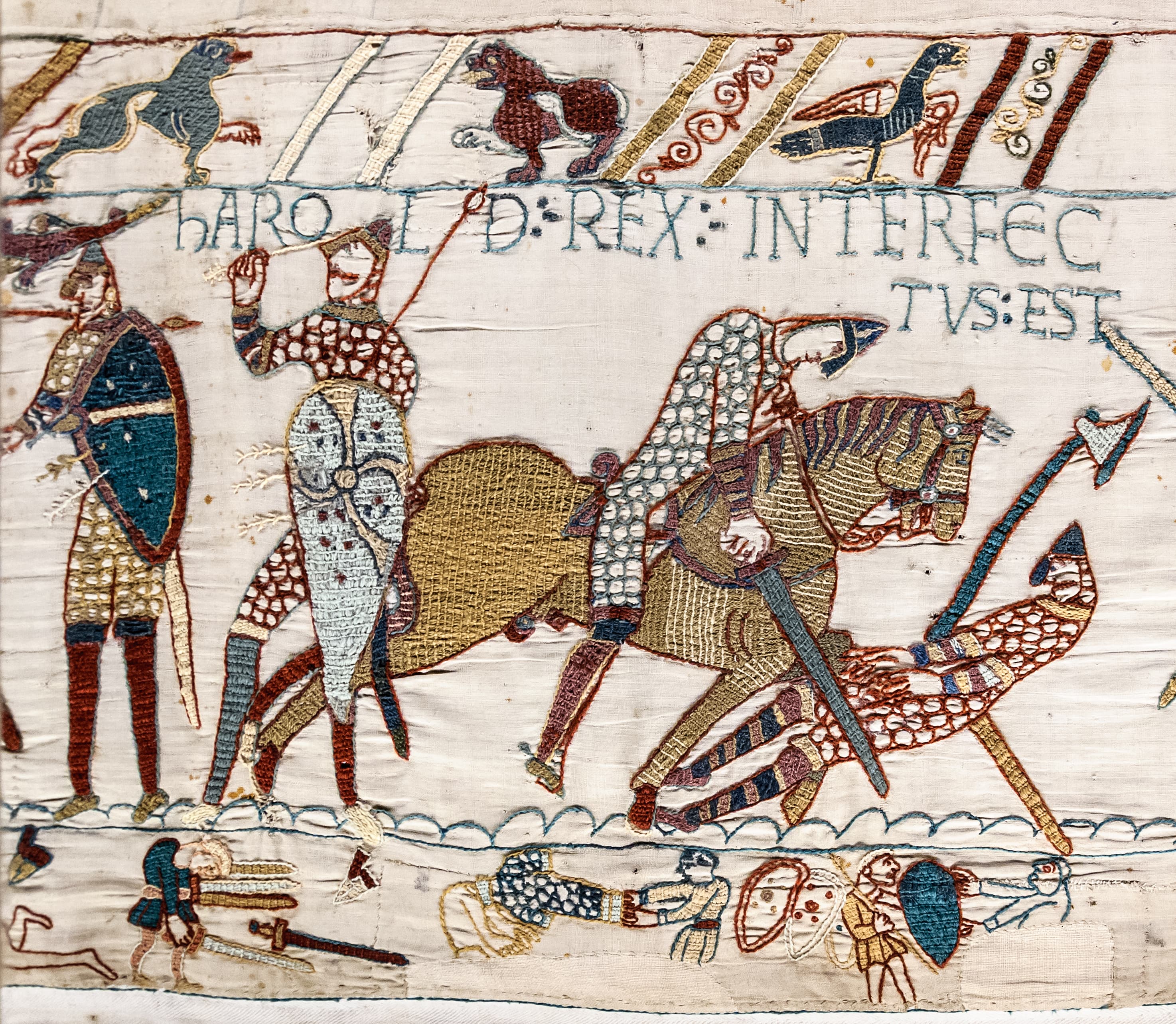
In this final, desperate melee, King Harold Godwinson was killed—legend, immortalized in the Bayeux Tapestry, holds that he was struck in the eye by an arrow, though he may also have been hacked down by Norman knights. With their king dead and his brothers fallen beside him, the shield wall shattered. The royal housecarls fought on to the last man around the body of their fallen lord, but the remaining local levies broke and fled into the dark, gathering forests of Sussex.
The butcher’s bill was staggering. Though exact figures remain elusive, some historians estimate that two thousand invaders died on that hillside, alongside four thousand Englishmen. To mark his victory and expiate the terrible slaughter of that day, William later founded a great stone abbey on the site of the battle, placing its high altar on the exact spot where Harold was said to have fallen.
Though local rebellions and bitter resistance would plague the new regime for years, the shield wall at Hastings had been the final barrier protecting Anglo-Saxon England. On Christmas Day 1066, William, Duke of Normandy, was crowned King of England in Westminster Abbey. The conquest was complete. The old Anglo-Saxon ruling class was systematically dismantled, their lands confiscated and redistributed to Norman barons.
The language, the architecture, the laws, and the very identity of the island were permanently redirected. By severing England's ancient ties to Scandinavia and binding its political destiny to the courts of continental Europe, the clash on the Sussex ridge did more than change a dynasty; it fundamentally rewrote the history of the Western world.
Connected to
7 links to entries not yet ingested in the Library.