When the envoys of the Mongol Empire arrived in Cairo demanding the submission of Egypt, Sultan Qutuz answered not with tribute, but by executing the messengers and hanging their severed heads from the city’s Bab Zuweila gate.
In the late summer of 1260, the severed heads of four Mongol envoys hung from the Bab Zuweila, one of the massive stone gates of Cairo. They were a gruesome, defiant answer to a demand for total submission. For a generation, the Mongol Empire had behaved not as a state engaged in diplomacy, but as an unavoidable force of nature. Under Hulegu Khan, the grandson of Genghis, the Mongol war machine had rolled westward out of the Eurasian steppe, systematically dismantling the ancient centers of Islamic power. The Assassins of Persia had been crushed in their mountain fortresses; Baghdad, the five-century-old seat of the Abbasid Caliphate, had been sacked and its caliph rolled in a rug and trampled to death; Damascus, the pride of the Ayyubid dynasty, had fallen shortly thereafter. Now, the letter brought by the executed envoys to the Mamluk Sultan Saif ad-Din Qutuz issued a chillingly simple ultimatum: "You cannot escape the terror of our armies... whither can you flee?"
To all appearances, the Mamluks of Egypt were next on the path to extinction. Yet a sudden, distant stroke of mortality shattered the Mongol momentum. Far to the east, in the depths of China, the Great Khan Möngke died while campaigning against the Southern Song. According to Mongol custom, the death of the supreme ruler required a kurultai—a grand assembly of the royal princes—to elect his successor. Hulegu, eyeing the imperial throne, immediately turned back toward Mongolia, taking the vast bulk of his conquering army with him. He left behind a skeleton force of roughly ten thousand men west of the Euphrates under the command of Kitbuqa, a seasoned general of the Naiman tribe and a Nestorian Christian. To Qutuz in Cairo, this sudden withdrawal was not merely a reprieve; it was an invitation.
The Mamluks were uniquely suited to meet this threat. Nominally slave-soldiers, they were overwhelmingly Kipchak Turks who had been purchased as youths from the Black Sea steppes, converted to Islam, and subjected to a monastic, hyper-rigorous military education in Egypt. Ironically, they shared a common steppe heritage, riding style, and equestrian combat philosophy with the very Mongols who now threatened them. When Qutuz mobilized his forces, many of his amirs balked, terrified by the myth of Mongol invincibility. Qutuz rallied them with a fiery speech at the camp of al-Salihiyya, shaming his commanders into action. He then dispatched his most brilliant vanguard commander, Rukn al-Din Baibars—a giant of a man who had once been a fugitive in the Levant—to clear the Mongol outpost at Gaza.
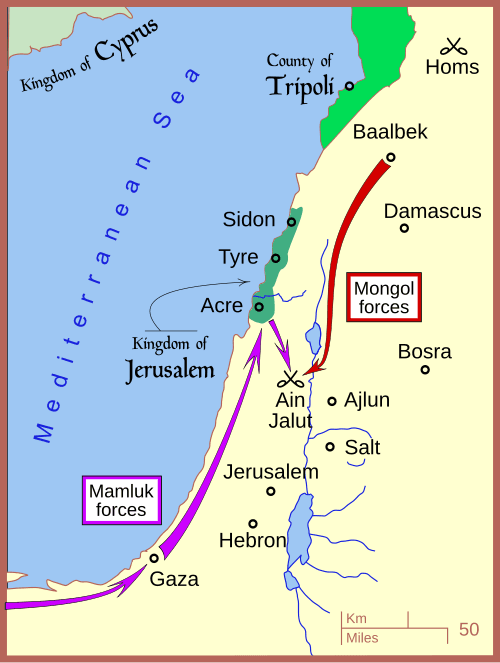
To confront Kitbuqa, the Mamluk army had to march north along the Palestinian coast, a route that required passing through the territories of the Crusader Kingdom of Jerusalem, centered at Acre. The political landscape was fraught. While some Christian lords, such as Bohemond VI of Antioch, had actively allied with the Mongols, the barons of Acre viewed the newcomers as unpredictable barbarians. They had recently watched with horror as the Mongols sacked the Christian city of Sidon over a minor dispute. Though the Franks of Acre resolved to remain officially neutral, they chose to view the Mamluks as the lesser of two evils. They granted Qutuz free passage through their territory and even permitted his army to camp and buy provisions under the safety of Acre's walls. This diplomatic concession secured Qutuz’s rear, allowing him to plunge inland toward the Jezreel Valley without fear of a Christian betrayal.
+ 7 further connections to entries not yet ingested
On September 3, 1260, the two armies converged near a perennial spring known as Ain Jalut—the "Spring of Goliath"—nestled at the northwestern foot of Mount Gilboa. Kitbuqa, who had marched south from his base in Ba'labakk, arrived first and occupied the favorable ground. The valley of the Wadi Jalut offered ample water and pasture for his horses, with the steep slopes of Mount Gilboa securing his flank. His forces included not only his Mongol cavalry but also contingents from the Kingdom of Georgia, five hundred Armenian knights from Cilicia, and local Syrian levies. Qutuz, possessing superior numbers and a profound knowledge of the local topography, devised a classic trap. He hid the heavy bulk of his army in the forested highlands surrounding the valley, leaving only his vanguard under Baibars visible in the basin below.
The battle began with a thunderous Mongol charge. Baibars, playing his role in the deception, engaged the Mongols in a series of fierce, exhausting skirmishes. Using classic steppe hit-and-run tactics, the Mamluk vanguard fought and fell back, fought and fell back, gradually drawing the overconfident Kitbuqa deeper into the valley. Believing he had the Egyptians on the run, the Mongol general committed his entire force to the pursuit. As the Mongols pressed up into the higher ground, the trap snapped shut. From the wooded ridges, the main Mamluk army emerged, surrounding the invaders on all sides. To complicate Kitbuqa’s position, Timothy May has noted that a critical turning point occurred when several Syrian Ayyubid allies, who had been conscripted into the Mongol ranks, defected mid-battle, shattering the Mongol lines.
Despite the ambush, the Mongols fought with legendary ferocity, concentrating their power to break through the Mamluk left wing. The pressure was so intense that the Mamluk line began to buckle and dissolve. From his command post, Qutuz saw his left wing on the verge of ruin. In a moment of sheer desperation and theater, the Sultan tore off his combat helmet so his men could see his face, throwing it to the ground. He cried out three times into the din of battle: "O Islam! O Allah grant your servant Qutuz a victory against these Mongols!" Spurring his horse, he charged directly into the collapsing flank, screaming wa islamah! ("Oh my Islam!"). Inspired by their ruler's suicidal bravery, the Mamluks rallied, stabilizing the line and turning the tide.
The Mongol ranks shattered under the weight of the counter-offensive. Kitbuqa refused to flee; he was killed on the field, and his surviving troops retreated toward the nearby town of Bisan. Though they managed to briefly reorganize and launch a desperate counterattack, the Mamluks hunted them down. Nearly the entire Mongol occupying force in the Levant was annihilated.
The victory at Ain Jalut reverberated across the medieval world, shattering the aura of Mongol invincibility. When Hulegu, still in the east, received word of the disaster, his fury was absolute; he immediately executed the captive Ayyubid sultan of Damascus, An-Nasir Yusuf, in retaliation. Yet Hulegu could never marshal the full, undivided strength of the Ilkhanate to avenge the defeat. His cousin Berke Khan, the ruler of the Golden Horde to the north, had converted to Islam. Berke had watched the sack of Baghdad and the execution of the Caliph with mounting horror, reportedly declaring, "He has sacked all the cities of the Muslims... With the help of God I will call him to account." The resulting civil war between the Ilkhanate and the Golden Horde kept the Mongol frontiers locked in internecine conflict, permanently blunting their westward momentum.
For Egypt, the triumph was absolute, though its architect did not live to enjoy it. On the journey back to Cairo, a group of conspirators led by the ambitious Baibars assassinated Sultan Qutuz. Baibars seized the throne, initiating the golden age of the Bahri Mamluk Sultanate. Under his long reign, the Mamluks would systematically dismantle the remaining Crusader states of the Levant, securing Cairo’s position as the uncontested capital of the Islamic world. Ain Jalut had drawn a hard, permanent boundary in the sand of the Galilee. For the first time, a Mongol advance was not merely paused, but permanently thrown back, ensuring that the Nile Valley, the holy sanctuaries of Arabia, and the Mediterranean basin would remain beyond the reach of the steppe conquerors.