Organization · Bantu Expansion
Bantu people
- Also known as
- A-Bantu
- Babantu
- Bafoun
- Banta
- Bantai
- Bantas
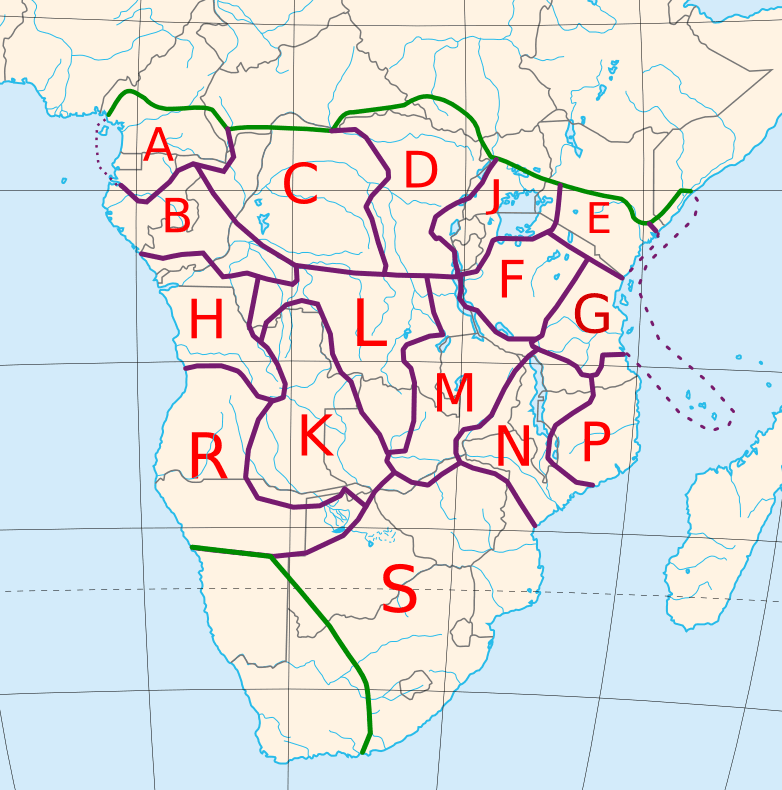
To find the common thread that unites some 350 million people across the southern half of the African continent, one must look to the architecture of their speech.
To the ear of nineteenth-century European philologists, there was a persistent, resonant echo vibrating across the southern half of the African continent. From the Atlantic shores of the Congo to the Indian Ocean ports of the Swahili coast, and down into the windswept hills of the Drakensberg, hundreds of seemingly distinct communities shared a common phonetic architecture for the most fundamental of concepts: themselves. In Kikongo, they were the bantu; in Swahili, watu; in Chichewa, anthu; in Zulu and Xhosa, abantu; and in Sesotho, batho. In 1862, the German linguist Wilhelm Bleek formalized this linguistic thread, coining the term "Bantu" to classify a massive family of languages. Yet, as modern scholarship has come to understand, the term describes a vast, intricate network of shared speech and history rather than a single, static ethnic group. To speak of the Bantu is to speak of one of the most monumental, slow-burning human migrations in global history—an epic expansion that reshaped the ecology, technology, and demographics of an entire continent over the course of millennia.
The deep roots of this expansion reach back to a dramatic ecological transformation. Deep-tissue genetic analysis suggests that the ancestors of Proto-Bantu speakers originally emerged from Northeast Africa. During the African Neolithic period, as the lush "Green Sahara" began to desiccate and turn to dust around 3500 BCE, populations were forced to move. Some dental evidence points to an ancient migration from the western Sahara during the Kiffian period, southward into the fertile, river-laced forests of West-Central Africa. By roughly 4,000 to 3,000 years ago, in the highlands and river valleys spanning modern-day Cameroon and Nigeria, the Proto-Bantu language had coalesced. These early communities possessed a powerful ecological toolkit: they were agriculturalists, cultivating crops suited to the forest edges and, crucially, they would soon master the secrets of ironworking. Armed with these technologies, small pioneer groups began to filter out of their West-Central African homeland, embarking on a migration that was not an organized military conquest, but a gradual, generational drift along river systems and forest clearings.
For decades, the precise geography of this ancient movement remained a subject of fierce debate. Early scholars split into two camps: some argued for a single, radiating dispersal from a central Congolese hub, while others championed an early split that sent one wave eastward toward the Great Lakes and another southward along the Atlantic coast. Modern genomic studies, analyzing thousands of DNA samples from dozens of distinct sub-Saharan populations, have revealed a more complex, interwoven reality. One major branch of pioneering farmers pushed eastward through the formidable Congo Basin, reaching the fertile, high-yielding environment of the African Great Lakes by approximately 1000 BCE. Here, the rich soils and abundant water supported dense, booming populations. Another branch moved south, tracing the Congo River system and the Atlantic coast toward Angola, arriving in the southern savannas by 500 BCE. By the early centuries of the Common Era, coastal pioneer groups had pushed all the way to modern KwaZulu-Natal in South Africa, while others reached the Northern Cape by 500 CE.
This expansion was not a journey into an empty wilderness. The expanding Bantu farmers encountered long-established, highly specialized populations of hunter-gatherers and pastoralists. The genetic legacy of these encounters remains etched in the DNA of modern Bantu-speaking peoples, showing significant regional variations that reflect centuries of intermarriage and cultural assimilation. In Central Africa, they met Pygmy groups; in the south and east, they encountered ancestral Khoisan populations. Geneticists have noted that before the Bantu expansion, the Khoisan of the Kalahari were remnants of what may have been the most populous human group on the planet. As Bantu agriculture spread, the Khoisan population underwent a drastic, centuries-long decline, leaving only a few modern populations, alongside Tanzania’s Hadza people, as keepers of those ancient lineages into the modern era.
Yet, this was an exchange of ideas as much as a displacement of people. The Bantu-speaking migrants who pushed into East and Southern Africa interacted intimately with Afro-Asiatic Cushitic speakers, as well as Nilotic and Central Sudanic groups. It was from these neighbors that the Bantu acquired their relationship with cattle. Because the vocabulary for cattle and the specific cultural practices of milking among southern Bantu pastoralists differ from those of their northern linguistic cousins, historical linguists believe the early southern migrants learned pastoralism directly from Cushitic-influenced Khwe-speaking peoples. In the process, several Southeast Bantu populations, such as the Xhosa and Zulu, incorporated not only Khoisan maternal ancestry but also the distinctive click consonants of the Khoisan languages into their own phonetic systems, transforming the very sound of their speech.
By the turn of the first millennium CE, the agricultural and metallurgical foundations of these communities gave rise to a new political era. Between the ninth and fifteenth centuries, the landscape of Central, East, and Southern Africa began to crystallize into complex, centralized states. No longer organized merely around localized clans, these societies experienced rapid population growth, which catalyzed specialized divisions of labor, professional standing armies, and sophisticated spiritual ideologies of divine kingship. In the Great Lakes region, empires like Buganda, Bunyoro, Rwanda, and Burundi emerged, while the savannas south of the rainforests saw the rise of the Kingdom of Kongo, the Luba and Lunda Empires, and the Kuba Kingdom. Along the Indian Ocean, a vibrant, cosmopolitan Swahili civilization blossomed through the fusion of Bantu coastal communities with Arab and Persian maritime traders.
Deep in the southern interior, this state-building impulse produced stone monuments that still stun the modern eye. The Monomotapa kings constructed the Great Zimbabwe complex, a massive, mortarless stone city that served as the nerve center of a wealthy trading empire ancestral to the Shona people. Similar stone-walled complexes arose at Bumbusi in Zimbabwe, Manyikeni in Mozambique, and Mapungubwe in South Africa. Centuries later, these traditions of political consolidation culminated in the rise of powerful military states, such as the Zulu Kingdom under Shaka and the Ndebele and Sotho kingdoms, which dominated the southern African landscape on the eve of European colonial intrusion.
Today, the linguistic descendants of those early Cameroonian farmers number roughly 350 million people, accounting for about 30 percent of the African continent’s population. The sheer demographic weight of this family is staggering: the Luba of the Democratic Republic of the Congo number nearly 29 million; the Shona of Zimbabwe, over 17 million; the Zulu of South Africa, over 14 million; and the Kikuyu of Kenya, some 8 million. Though divided into hundreds of distinct ethnic groups and speaking anywhere between 440 and 680 different languages, they remain bound by a shared ancestral heritage.
But perhaps the most enduring legacy of this ancient migration is not found in stone walls or genetic markers, but in a philosophy. The Proto-Bantu root -ntʊ́ did not merely signify a biological human being; it carried a profound ethical weight. Across the southern half of Africa, this root evolved into the concept of ubuntu (or hunhu in Shona, botho* in Sesotho). It is a worldview that defines humanity not through individual isolation, but through relational connection: the belief that a person is only a person through their relationship with other people. In this philosophical thread, the ancient travelers who walked across the continent did not just carry iron and seed; they carried a defining vision of the human collective that continues to shape global ethics today.
Connected to
- religionChristianity33 CE
- religionIslam631 CE
- is a superset ofKongo people
+ 3 further connections to entries not yet ingested