Event · 18 BCE – 660 CE · Korean Kingdoms
Baekje
- Also known as
- Baekje Kingdom
- Baekje Krallığı
- Bekdže
- Bekçe krallığı
- Bách Tế
- Báik-cá̤
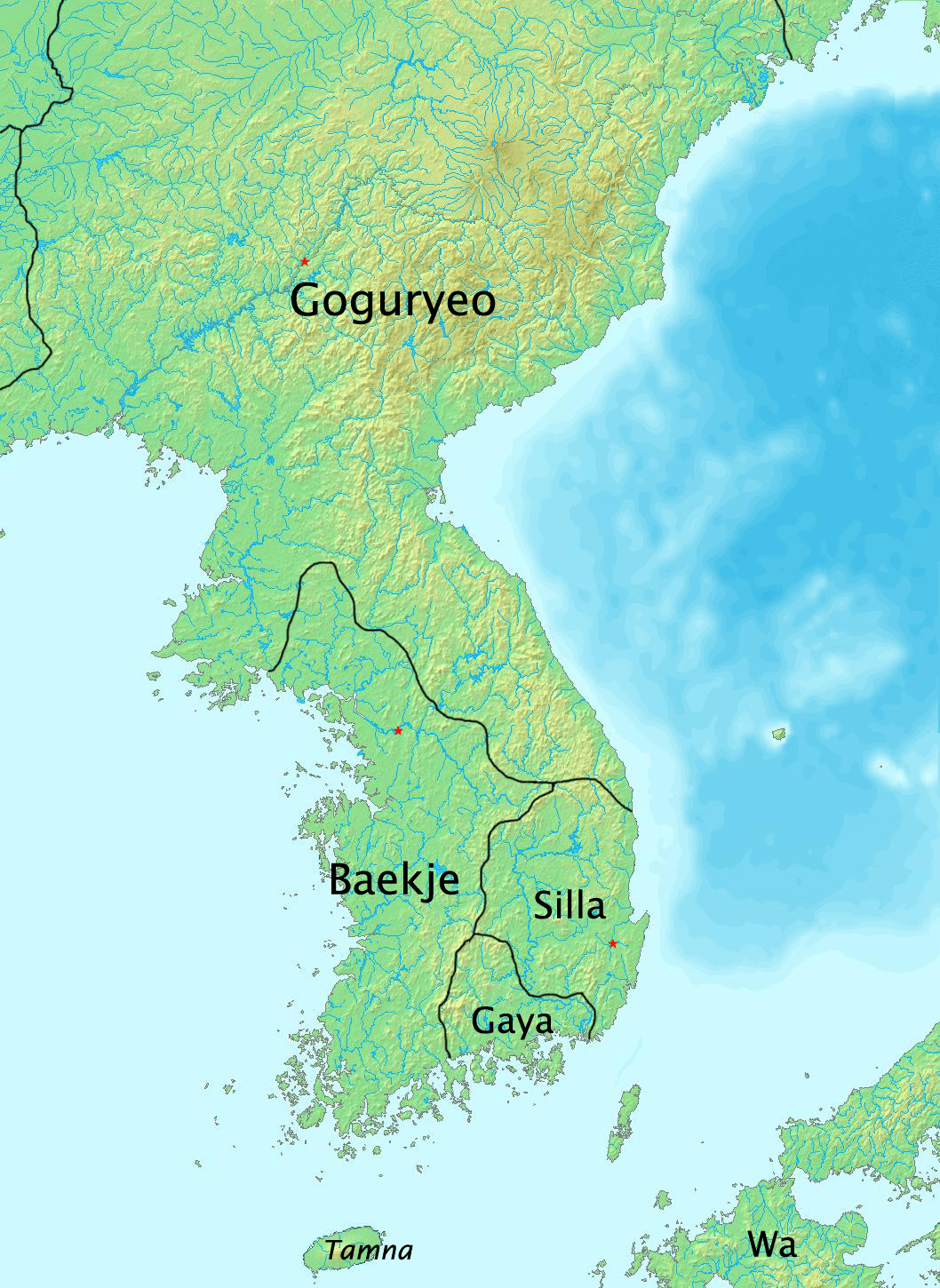
In 18 BCE, a queen named Soseono left the northern kingdom of Goguryeo, taking her sons Biryu and Onjo south to the Han River basin to carve out a new destiny.
In the middle of the seventh century, on a sheer cliff overlooking the waters of the Geum River, a tragedy unfolded that would endure as one of the founding elegies of Korean memory. As the combined armies of Silla and Tang China breached the gates of the capital city of Sabi, hundreds of court ladies, concubines, and noblewomen of the kingdom of Baekje fled to the precipice. Rather than submit to the conquering alliance, they cast themselves into the gorge. Later generations would name this promontory the Rock of the Falling Flowers, imagining the tumbling silk of their robes as petals scattered by a sudden autumn wind. Their leap was not merely a gesture of desperate honor; it was the final, violent punctuation mark on the history of an empire that had, for nearly seven centuries, served as the cultural hinge and maritime powerhouse of East Asia.
Baekje was born in migration and fraternal strife. Its official history, preserved in the Samguk sagi, attributes the kingdom’s founding in 18 BCE to King Onjo, a prince of northern stock. His father was Jumong, the legendary founder of Goguryeo, but when a half-brother arrived from the north to claim the Goguryeo throne, Onjo and his brother Biryu chose exile over subjugation. Led by their mother, the formidable Queen Soseono—remembered as a foundational matriarch of two distinct empires—they journeyed south with ten vassals into the fertile basin of the Han River. While Biryu chose to settle on the brackish, salt-bitten marshes of Michuhol near modern Incheon, Onjo established his stronghold at Wiryeseong in the verdant soils of southern Seoul, naming his fledgling state Shipje, or "Ten Vassals." Biryu’s settlement faltered, poisoned by the sea. Defeated in an ensuing war against his brother and dying by his own hand, Biryu’s people eventually migrated to Wiryeseong. Welcoming them, Onjo renamed the unified realm Baekje, meaning "Hundred Vassals" or "hundred counties"—a name that signaled a new, grander destiny of collective survival.
This origin story mirrored a complex archaeological reality: the early Baekje state was a cultural mosaic. It was forged from the indigenous Han River populations of the Mahan confederacy, integrated with incoming Yemaek peoples migrating south from the fallen Manchurian state of Buyeo and the northern kingdom of Goguryeo. Through the early centuries of the Common Era, Baekje gradually transformed from a regional chiefdom into a highly centralized kingdom. This transformation accelerated dramatically during the third-century reign of King Goi, who established a system of patrilineal succession and organized a sophisticated, sixteen-tier bureaucratic hierarchy. At the summit of this structure stood the king, referred to by commoners as k(j)ə-n kici and by the nobility as eraγa, alongside his queen, or oluk. Beneath the crown, power was brokered by a proud aristocracy, dominated in the early centuries by the Hae and Jin clans, and later by the "Great Eight Families"—the Sa, Yeon, Hyeop, Hae, Jin, Guk, Mok, and Baek. To balance noble ambitions, a unique system of consensus emerged: at the sacred site of Cheonjeongdae near Hoamsa temple, the names of candidates for the office of chief minister were placed beneath a rock. After several days, the stone was lifted, and the candidate whose name bore a mysterious mark was elevated to the office, blending aristocratic compromise with the mandate of the divine.
The zenith of Baekje’s military and territorial ambition arrived in the fourth century under King Geunchogo. Reining from 346 to 375, Geunchogo subjugated the remaining Mahan polities in the south and turned his armies northward against his ancestral rival, Goguryeo. In 371, Baekje forces marched as far north as Pyongyang, defeating the Goguryeo army on their own soil. With the Han River basin as its secure heartland, Baekje became a formidable regional sea power. It was the Phoenicia of East Asia, its sailors navigating the treacherous waters of the Yellow Sea to establish diplomatic and trade networks that stretched into the Liaoxi region of China and across the strait to the Kofun-period courts of Japan.
With this maritime supremacy came a profound cultural mission. Baekje was the great transmitter of continental civilization. In 384, Buddhism arrived on its shores, eventually becoming the official state religion in 528 under King Seong. Rather than merely adopting these ideas, Baekje intellectualized and exported them. Scholars, monks, weavers, potters, and administrative experts crossed the seas to Japan, introducing the Chinese writing system, sophisticated ceramic techniques, monumental tomb construction, and the sutras of the Buddha. The Japanese court, recognizing this cultural debt, referred to the kingdom as Kudara—the "great place."
Yet, Baekje's geopolitical position was as fragile as it was brilliant. Pressed by the relentless southward expansion of Goguryeo, the kingdom suffered a catastrophic blow in 475 when the Han River basin and the capital at Wiryeseong fell to northern invaders. Forced to retreat into the southern mountains, Baekje established a new capital at Ungjin, modern-day Gongju. While the mountainous terrain offered safety, it isolated the kingdom from its maritime networks. In response, Baekje forged a defensive alliance with its eastern neighbor, Silla, to hold Goguryeo at bay.
The kingdom’s final renaissance occurred in 538, when King Seong moved the capital once more, this time to Sabi, situated on the navigable waters of the Geum River. Renaming the kingdom Nambuyeo ("Southern Buyeo") to emphasize its prestigious northern lineage, Seong rebuilt Sabi into a cosmopolitan center of trade, art, and Buddhist devotion. The river once again connected Baekje to the dynasties of China, allowing high culture to flourish even as the geopolitical sands shifted beneath the kingdom's feet.
The end came not from the north, but from the east. By the seventh century, Silla had grown into an aggressive, highly organized power, and its alliance with Baekje dissolved into bitter rivalry. Silla formed a grand strategic coalition with the Tang Dynasty of China, creating an unstoppable pincer movement. In 660, a massive Tang fleet crossed the Yellow Sea while Silla forces marched from the east. At the Battle of Hwangsanbeol, a vastly outnumbered Baekje army commanded by the legendary General Gyebaek made a heroic but doomed stand. Gyebaek’s defeat cleared the path to Sabi. The capital fell, King Uija and his heir Buyeo Yung were carried away in chains to exile in China, and the Tang established the Ungjin Commandery to govern the conquered lands.
Even in defeat, the ghost of Baekje refused to rest. A fierce restoration movement arose from the countryside, led by the monk Dochim and the general Buyeo Boksin. Operating from their stronghold at Juryu, they recalled Prince Buyeo Pung from Japan to assume the throne and besieged the Tang garrison at Sabi. Responding to desperate pleas, the Japanese court dispatched a massive expeditionary force of over ten thousand soldiers to aid their old ally. The climax of this final struggle took place in August 663 at the Battle of Baekgang, where the lower reaches of the river became a graveyard. In five successive naval engagements, the superior coordination of the Silla-Tang fleet shattered the combined Baekje and Japanese forces. Prince Pung fled into the northern wilderness of Goguryeo, and the last embers of Baekje independence were extinguished.
In the aftermath of the conquest, the physical traces of Baekje were largely absorbed into the realm of Unified Silla, but its cultural DNA survived. Some of the displaced Baekje aristocracy fled across the sea to Japan, where the son of the last king established the Kudara no Konikishi clan, serving the Japanese emperors for generations as living relics of a lost golden age. Though its cities were burned and its borders erased, Baekje’s legacy remained etched in the artistic traditions, the Buddhist temples, and the early administrative foundations of the Japanese archipelago, leaving an indelible imprint on the cultural landscape of East Asia long after the waters of the Geum River had washed away the blood of its final defenders.
Connected to
- religionBuddhism
+ 3 further connections to entries not yet ingested