Person · 1483 CE – 1530 CE · Delhi Sultanate and Mughal
Babur
- Also known as
- Babar
- Baber
- Baber
- Baber
- Baber
- Baber
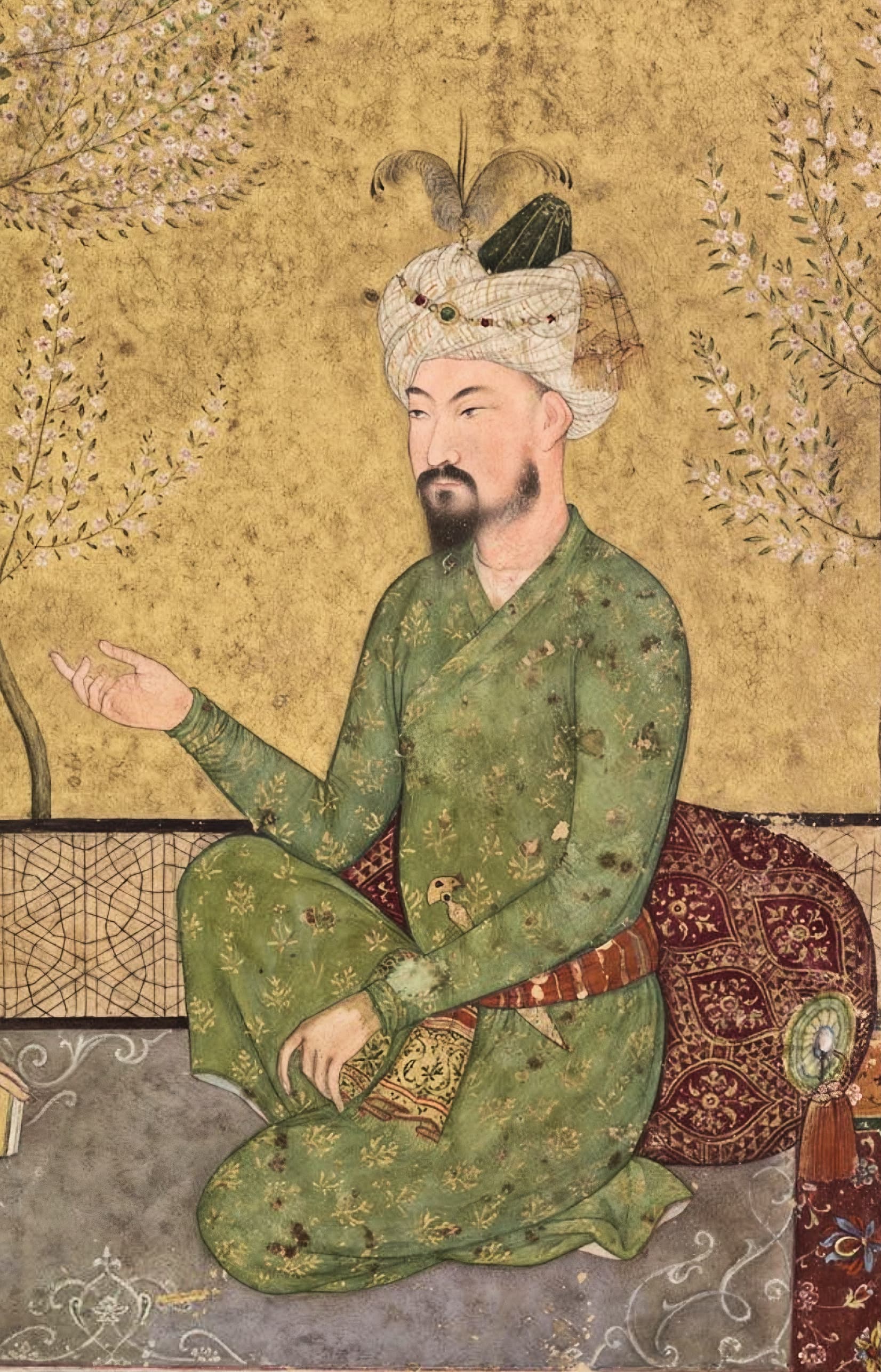
To carry the blood of both Timur and Genghis Khan was to inherit a legacy of relentless ambition, but Zahir ud-Din Muhammad, known to history as Babur, spent his youth as a king without a kingdom.
In the summer of 1494, an eleven-year-old boy named Zahir-ud-Din Muhammad inherited a small, mountainous valley in Central Asia when his father died in a highly unusual accident. Umar Sheikh Mirza II, the Timurid ruler of the Fergana Valley in what is now Uzbekistan, had been tending his pigeons in a poorly constructed palace dovecote when the structure suddenly toppled over, sending both ruler and birds plunging into the deep ravine below. The young prince who succeeded him faced an immediate, hostile ring of relatives—uncles, cousins, and local rivals—who saw his youth as an invitation to conquest. This boy, whom his soldiers preferred to call Babur, a nickname derived from the Persian word for tiger because his Arabic name proved too difficult for his Turco-Mongol troops to pronounce, spent the next three decades losing almost everything he had been born to inherit. Yet in losing his ancestral world of high mountain passes and walled oasis cities, he would eventually forge one of the wealthiest and most enduring empires in human history.
Babur was a man caught between two worlds, carrying the blood of history’s most formidable conquerors. Through his father, he was a great-great-great-grandson of Timur, the legendary Turco-Mongol conqueror; through his mother, Qutlugh Nigar Khanum, he was a direct descendant of Genghis Khan. His family belonged to the Barlas tribe, a group of Mongol origin that had fully integrated into the Persianized, Islamic culture of Central Asia. Babur spoke and wrote in Chagatai Turkic, but he was equally fluent in Classical Persian, the language of high administration and literature. This double inheritance of nomadic martial prowess and refined Persianate aestheticism defined his life. He was a man who could spend the morning directing a bloody siege and the evening composing delicate Persian ghazals or cataloging the flora of a newly conquered valley.
For the first decade of his rule, Babur’s life was a dizzying sequence of sudden triumphs and catastrophic reversals. His eyes were fixed on Samarkand, the legendary capital of his ancestor Timur, which lay some 350 kilometers west of his native Fergana. In 1497, at the age of fifteen, he successfully besieged the city for seven months and captured it, a triumph that seemed to secure his status as a true Timurid heir. But the victory was brief. Desertions thinned his ranks, and while Babur lay desperately ill inside Samarkand, a faction of nobles back in Fergana rebelled in favor of his younger brother, Jahangir. Babur abandoned Samarkand to march home and reclaim his birthplace, only to lose both cities in the process. He had held Timur’s capital for just one hundred days, a loss that would obsess him for the rest of his life.
In the years that followed, Babur became a royal vagabond, wandering the cold peaks of the Hindu Kush and the Pamirs with a dwindling band of loyal followers. He recruited soldiers among the Tajiks of Badakhshan and made alliances with his Mongol uncles, Mahmud and Ahmad Khan. In 1500, he managed to take Samarkand a second time, only to be besieged and trapped by his most formidable nemesis, Muhammad Shaybani, the leader of the rising Uzbek confederation. Desperate and starving, Babur was forced to buy his freedom by agreeing to a humiliating peace treaty that included giving his eldest sister, Khanzada, to Shaybani in marriage. He fled into the mountains, finding temporary shelter among rural hill tribes and peasants. During his stay in Tashkent with his maternal uncle, he sank into deep poverty, later writing in his memoirs of the humiliation of having "no country, or hope of one!"
The turning point came in 1504. Crossing the snowy Hindu Kush with his ragtag band of followers, Babur descended upon Kabul, which had fallen into political chaos after the death of his paternal uncle, Ulugh Beg II. Capitalizing on the unpopularity of a local usurper, Babur seized the city and established a new base of operations. Kabul was a poor mountain kingdom, generating little revenue, but it gave Babur a secure stronghold. It was here, in 1505, that he first looked southward. "My desire for Hindustan had been constant," he wrote, describing his first brief, exploratory raid across the Khyber Pass. Still, he could not let go of his Central Asian ambitions. When his great rival Shaybani was killed in battle in 1510 by the Safavid Shah of Persia, Ismail I, Babur seized the moment. He formed a strategic partnership with the Shia Safavids, accepting their nominal suzerainty in exchange for military support. With their help, he entered Samarkand for a third time in 1513. But the alliance with the Shia Persians alienated his staunchly Sunni Central Asian subjects, and within a short time, the Uzbeks drove him out once more.
By 1514, having lost Samarkand for the third and final time, Babur returned to Kabul and turned his gaze permanently toward the fertile, wealthy plains of northern India. The Delhi Sultanate, which had dominated the region for centuries, was currently ruled by Ibrahim Lodi, but it was a spent force, weakened by internal rebellions and administrative decay. Recognizing that his horse archers alone could not guarantee victory against the massive armies of India, Babur adapted. He actively sought military innovations, integrating Ottoman gunpowder technology, musketeers, and field artillery into his army alongside traditional Central Asian cavalry tactics.
On April 21, 1526, Babur met Ibrahim Lodi’s vast army on the dusty plains of Panipat, north of Delhi. Though heavily outnumbered, Babur used his artillery and his highly disciplined, mobile cavalry to encircle Lodi's forces, achieving a devastating victory. Lodi was killed on the field, and Babur marched triumphantly into Delhi and Agra, establishing the foundation of what would become the Mughal Empire—a name derived from the Persian word for "Mongol." The conquest, however, was far from secure. The powerful Rajput ruler of Mewar, Rana Sanga, quickly assembled a formidable coalition of Rajput clans and disgruntled Afghan warlords to drive the Central Asian invader out of India. The two armies met at the Battle of Khanwa in 1527. Facing an immense force and a demoralized army, Babur gave a stirring speech, famously renounced alcohol, broke his gold and silver drinking vessels, and commanded his troops to fight a holy war. Once again, his masterful positioning of troops, combined with the devastating use of gunpowder and artillery, broke the enemy coalition. Khanwa proved to be the decisive watershed of the campaign, shattering organized resistance to his rule in northern India.
Unlike many conquerors of his era, Babur left behind an extraordinarily intimate record of his life. His memoirs, the Baburnama, represent the first true autobiography in the Islamic world. Written in Chaghatai Turkic, the prose is remarkably candid, observant, and free of the dry, self-aggrandizing hyperbole common to court histories of the period. He writes of his deep grief over lost battles, his love of melons and gardens, the beauty of the literary salons of Herat, and his struggles with alcoholism and subsequent repentance. He was a product of the Timurid Renaissance, a period characterized by a flourishing of the arts, poetry, and sciences. His court reflected these humanistic values; over his lifetime, his religious outlook evolved from that of a rigid Sunni warrior into a more tolerant, pragmatic ruler who allowed diverse religious traditions to coexist peacefully within his expanding realm.
Babur’s reign in India was brief. He died in Agra in December 1530 at the age of forty-seven, leaving his newly won, fragile empire to his eldest son, Humayun. Though he died in the humid heat of the Gangetic plains, his heart remained in the cool highlands of Central Asia. He was initially buried in Agra, but according to his explicit, final wishes, his remains were later moved back to his beloved Kabul, where they were laid to rest in a terraced garden open to the sky.
Babur’s legacy extends far beyond the borders of the empire he founded. In modern Uzbekistan and Kyrgyzstan, he is celebrated as a national hero, his poetry still sung as popular folk songs. In India, the empire he initiated would go on to shape the subcontinent’s architecture, language, cuisine, and administrative structures for more than three centuries, fundamentally altering the cultural landscape of South Asia and bridging the worlds of the Central Asian steppe and the Indian ocean.
Connected to
- child · father ofHumayun1508 CE
- religionIslam631 CE
+ 12 further connections to entries not yet ingested