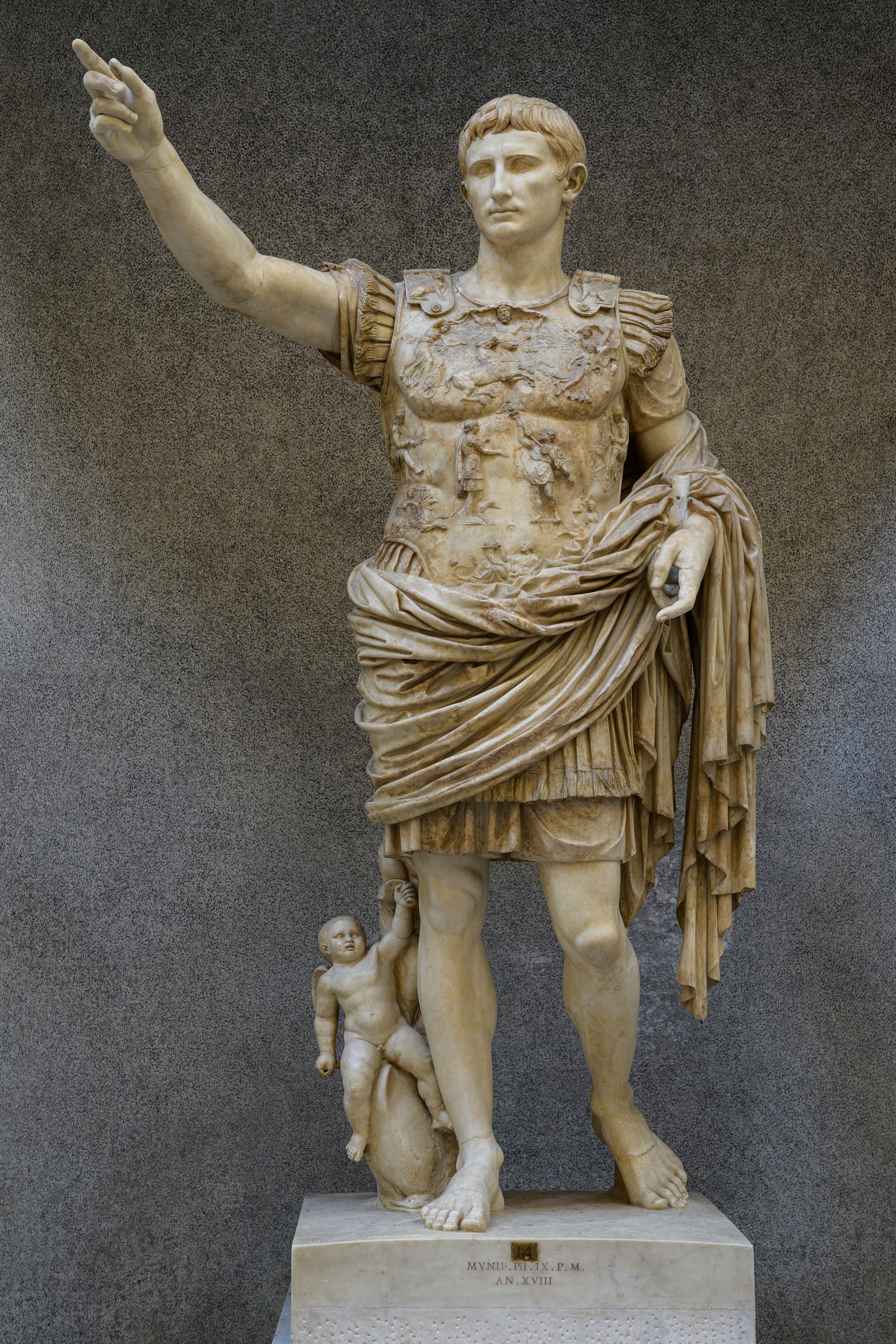
To understand the birth of the Roman Empire, one must look to a young man born Gaius Octavius, who inherited a name and a bloodline that would rewrite the destiny of the Mediterranean.
In the late summer of 44 BCE, a nineteen-year-old youth from a respectable but unremarkable equestrian family from Velitrae arrived in Rome to claim a hazardous inheritance. He was small, frequently ill, and so obscure that his political rivals scarcely took him seriously. His name was Gaius Octavius, but by the testament of his maternal great-uncle, the recently assassinated dictator Julius Caesar, he had been adopted as Caesar’s primary heir. Against the urgent warnings of his mother Atia and his stepfather Lucius Marcius Philippus, the young man accepted the bequest, renamed himself Gaius Julius Caesar, and set about collecting his inheritance. Because the consul Mark Antony—Caesar’s formidable former lieutenant—refused to hand over the dictator’s liquid assets, the youth took matters into his own hands. Landing at Brundisium, he illegally intercepted 700 million sesterces destined for the Parthian war, appropriated the annual tribute of the province of Asia, and raised a private army of 3,000 veterans by offering bonuses twice the size of a soldier’s annual salary. It was a cold, astonishingly bold opening gambit. Within fifteen years, this delicate youth would dismantle the five-hundred-year-old Roman Republic, systematically eliminate his rivals, and construct a system of autocracy so subtly veiled in ancient tradition that it would endure for centuries.
The path to absolute power was paved with blood and framed by uneasy alliances. To survive his initial vulnerability, the young Caesar played a consummate game of political opportunism. He allowed the Republican orator Cicero to flatter him and pit him against Antony, only to discard the alliance when it served him. By November of 43 BCE, he had formed the Second Triumvirate with Antony and Marcus Lepidus, a legally sanctioned dictatorship of three. Their first act was the purge of their domestic enemies: a series of brutal proscriptions that resulted in the state-sanctioned murder of three hundred senators—including Cicero, sacrificed to Antony’s vengeance—and two thousand knights. After crushing the Republican assassins Marcus Junius Brutus and Gaius Cassius Longinus at Philippi in 42 BCE, the triumvirs carved up the Roman world. The young Caesar took the West; Antony took the wealthy, Hellenized East; Lepidus was marginalized in Africa. During these years of fracturing peace, the future emperor worked systematically to establish himself as the sole guarantor of Italian order. When Sextus Pompeius, the son of Pompey the Great, blocked the grain fleets from reaching Rome, the young Caesar—aided by the brilliant naval tactics of his lifelong friend and commander Marcus Vipsanius Agrippa—annihilated Pompeius’s fleet in 36 BCE. That same year, he stripped Lepidus of his triumviral power and sent him into exile.
+ 12 further connections to entries not yet ingested
By the late thirties BCE, only two men remained. While Antony lingered in Egypt, entangled both politically and romantically with Queen Cleopatra VII, the young Caesar waged a masterful propaganda campaign in Italy. He painted Antony not merely as a rival, but as a man who had surrendered his Roman heritage to a foreign queen, seeking to establish a Greco-Oriental empire. In 32 BCE, after Antony repudiated his Roman wife Octavia—the young Caesar's sister—the Senate declared war, pointedly directing its wrath at Cleopatra rather than Antony. The denouement came on September 2, 31 BCE, off the coast of Greece. At the naval Battle of Actium, Agrippa’s ships decisively routed the combined fleets of Antony and Cleopatra. Within a year, the lovers had committed suicide in Alexandria, Egypt was reduced to the personal property of the young Caesar, and the Roman world lay exhausted at his feet. Returning to Italy in 29 BCE, he celebrated a three-day triumph and ordered the doors of the Temple of Janus closed, signaling to a war-weary populace that, for the first time in two centuries, Rome was at peace.
The true genius of the man who would become Augustus lay not in his military victories, which were largely won by Agrippa, but in his political engineering. He understood that Julius Caesar’s fatal mistake had been his open embrace of the title "dictator in perpetuity," which insulted the deeply ingrained Republican sensibilities of the Roman elite. On January 17, 27 BCE, the victor performed a masterstroke of political theater: he formally returned all state powers to the Senate and the Roman people, declaring the Republic restored. In gratitude, the Senate bestowed upon him the title Augustus—meaning "the revered" or "majestic"—and granted him proconsular command over the critical frontier provinces where the majority of Rome's legions were stationed. Rather than adopting the hated title of king or dictator, he styled himself princeps, or "first citizen." The Principate was born: an absolute autocracy disguised as a free republic. Augustus preserved the Senate, the consuls, and the assemblies, allowing the aristocracy to retain their prestige while he quietly maintained absolute control over the treasury, foreign policy, and the military.
Under the canopy of this Pax Romana, Augustus radically reorganized the Roman world. He turned his attention to the physical fabric of the capital, famously boasting that he found Rome a city of brick and left it a city of marble. With the assistance of Agrippa, who served as aedile, he renovated aqueducts, built monumental temples, and established the city’s first professional fire-fighting and police forces, alongside his personal elite bodyguard, the Praetorian Guard. He standardized the empire's taxation and currency, built an extensive network of military roads equipped with an official courier system, and established Rome's first permanent, professional standing army. He was also a shrewd patron of the arts, funding poets like Virgil, whose epic Aeneid provided a mythical pedigree for the new Julian dynasty. Beyond Italy, Augustus pushed Rome's borders further than any predecessor, annexing Egypt, Dalmatia, Pannonia, Noricum, and Raetia, and completing the bloody conquest of Hispania. Yet his expansionism met its limits in the dense forests of Germania, where three Roman legions were annihilated in 9 CE—a disaster that halted Roman expansion at the Rhine. Elsewhere, he secured the frontiers through diplomacy, negotiating a peace treaty with the Parthian Empire and establishing client states to serve as buffers.
Augustus died of natural causes on August 19, 14 CE, at the age of seventy-five, though persistent rumors whispered that his formidable third wife, Livia, had poisoned him to secure the succession for her son Tiberius. In his final days, he reportedly asked his friends if he had played his part well in the comedy of life. The Senate posthumously deified him, cementing the imperial cult he had cultivated to bind the provinces to the person of the emperor. By the time of his death, Augustus had ruled Rome for over forty years. He had taken a fractured, self-consuming oligarchy and replaced it with a durable, centralized bureaucracy. His reign was the pivot upon which classical antiquity turned; he did not merely end a century of civil war, but transformed the very definition of Rome, leaving behind an empire that would shape the laws, languages, and boundaries of Europe and the Mediterranean for the next half-millennium.