Person · 1500 CE – 1533 CE · Andean Civilizations
Atahualpa
- Also known as
- Ata-w wallpa
- Atabahipa
- Atabalipa
- Atabálipa
- ATAHUELPA
- Atahuelpa
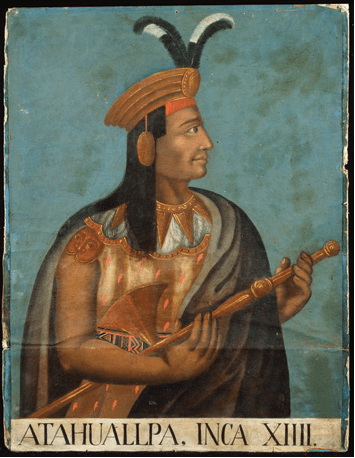
The sovereignty of the Inca Empire unraveled not from a lack of strength, but from the bitter friction of sibling rivalry.
The bird we call the chicken was, to the people of the sixteenth-century Andes, a strange and novel beast. When the Spanish first brought the animal to the shores of western South America, the local populations struggled to name it, eventually settling on a word that double-bonded the creature to their own tragic history: atawallpa. For centuries, philologists debated whether the final sovereign of the Inca Empire had been named after a bird—translating his name as "happy rooster" or "bird of fortune"—before modern scholarship inverted the etymology. The bird was named after the man. It was a linguistic monument to the last effective ruler of Tahuantinsuyo, the "Land of the Four Quarters," whose name likely derived from older, half-forgotten Puquina roots meaning "the chosen" or "the courageous."
To understand the world that produced him, one must understand that the Inca Empire was not an ancient monolith, but a young, aggressively expanding state that had only recently consolidated its hold on the massive spine of the Andes. When Atahualpa was born, around 1502, the empire was still digesting its northern conquests. His father, the Sapa Inca Huayna Cápac, spent the latter part of his reign in the north, putting down rebellions by the Caranquis and Cayambis with a violence so absolute that one battlefield lake, Yahuarcocha, was said to have run red with blood. Chroniclers disputed where Atahualpa first drew breath; some, like Pedro Cieza de León and Juan de Betanzos, insisted he was born in the imperial capital of Cusco to a princess of the noble Inca bloodline. Others, writing later, suggested he was born in Quito, the son of a conquered northern queen. Whether this northern origin was historical reality or a political smear invented by his rivals to brand him a usurper, it was in the north that Atahualpa came of age.
At thirteen, having passed through the Warachikuy rites of manhood in Cusco, the young prince joined his father’s northern campaigns. He spent more than a decade in the military camps of Quito, learning the complex machinery of Inca statecraft and warfare under the tutelage of seasoned generals like Quizquiz and Chalcuchímac. He grew into a young man whom contemporaries described as possessing "lively reasoning and with great authority." But the stability of the empire was fragile, resting entirely on the divine person of the Sapa Inca. Around 1525, that stability shattered. Smallpox, traveling down the continent faster than any European explorer, struck the imperial court. Huayna Cápac died of the scourge, and his designated successor, Ninan Cuyochi, perished alongside him.
The double vacancy plunged the empire into a constitutional crisis. In Cusco, the nobility crowned Huáscar, one of Huayna Cápac’s sons who had remained in the capital. In Quito, Atahualpa initially accepted his half-brother’s elevation, receiving in turn an appointment as governor of the northern territories. For five years, an uneasy, suspicious peace held. Huáscar, sensing the threat posed by his brother’s battle-tested northern legions, used the time to court the Cañari, a powerful ethnic group in the north who nursed bitter grudges against the Inca conquerors. By 1529, the tension broke into open civil war.
The conflict was characterized by a scale of violence that shocked even the war-hardened populations of the Andes. Early in the war, Huáscar’s forces managed to ambush and capture Atahualpa at Tumebamba. Imprisoned in a roadside tambo, Atahualpa managed a daring escape, though not without cost: he lost an ear during the ordeal, a mutilation he hid for the rest of his life beneath a headpiece fastened under his chin. He returned to Quito, mobilized his veterans, and unleashed a campaign of devastating retribution. He leveled Tumebamba, slaughtering the Cañari who had betrayed him.
The tide of the war surged back and forth across the mountainous spine of the empire. While Huáscar’s general, Atoc, won an initial victory at Chillopampa, Atahualpa’s veteran commanders, Quizquiz and Chalcuchímac, quickly turned the tables. They routed Atoc’s forces at Mulliambato, capturing the general before torturing and killing him. From that moment, the northern armies began a relentless, slow-motion advance toward Cusco. Atahualpa, traveling in the rear of his victorious armies, paused at Marcahuamachuco to consult the famous oracle of the god Catequil. When the resident priest prophesied that the prince’s advance would end in disaster, Atahualpa did not hesitate. He marched to the sanctuary, personally executed the priest, and ordered the temple razed to the ground.
It was during this southward march, flush with the news that his generals had finally defeated and captured Huáscar outside Cusco, that Atahualpa received word of another phenomenon. A small band of pale, bearded strangers had landed on the coast, carrying weapons of iron and riding monstrous, four-legged beasts.
Francisco Pizarro and his roughly 168 conquistadors entered an empire that had just spent three years tearing itself apart. When Atahualpa agreed to meet the Spaniards in the highland basin of Cajamarca in November 1532, he did so not as a frightened native, but as the unchallenged master of the Andean world, surrounded by tens of thousands of loyal, victorious troops. The encounter that followed remains one of the most famous and misunderstood collisions in human history. Expecting a diplomatic audience with strange travelers, Atahualpa entered the plaza of Cajamarca on a splendid litter, his retinue unarmed as a gesture of imperial confidence.
The Spanish, hiding in the dark stone buildings surrounding the plaza, watched the emperor arrive. When a Dominican friar approached the imperial litter, carrying a breviary and demanding that the Sapa Inca accept the Christian god and the suzerainty of the King of Spain, Atahualpa examined the book, found it silent, and threw it to the ground. The gesture was the signal Pizarro’s men had waited for. Gunfire and steel erupted from the buildings. The unarmored Inca nobility, horrified by the sound of artillery and the shock of cavalry, threw themselves in front of the emperor’s litter to shield him, but they were cut down. Within minutes, the plaza was a slaughterhouse, and Atahualpa was a prisoner of the Spanish Crown.
In captivity, the fallen emperor quickly grasped that his captors were driven by an insatiable hunger for yellow metal. He offered them a bargain: in exchange for his freedom, he would fill a room measuring twenty-two feet long by seventeen feet wide once with gold, and twice over with silver, as high as his arm could reach. Pizarro accepted the terms. As the treasure of the empire began to arrive in Cajamarca—beautifully worked vessels, plates, and icons stripped from temples across the Andes—Atahualpa continued to govern his empire from his cell. Fearing that the Spanish might use his captive brother Huáscar as a puppet ruler, Atahualpa secretly sent orders to his loyalists to have the former emperor executed.
The ransom was paid, but the promised release never came. The arrival of the gold only heightened Spanish paranoia; they found themselves a tiny garrison in a vast, hostile empire, holding a god-king who could raise an army with a whisper. Rumors of an imminent native uprising, led by Atahualpa’s undefeated general Rumiñawi, began to circulate through the Spanish camp.
In July 1533, Pizarro and his officers staged a mock trial. They accused Atahualpa of treason against the Spanish Crown, conspiracy to launch an rebellion, and the murder of his brother Huáscar. Found guilty, the emperor was sentenced to death by burning at the stake—a prospect that terrified Atahualpa, as Inca religious belief held that the destruction of the physical body prevented the soul from journeying to the afterlife. In his final hours, the Spanish offered him a compromise: if he accepted Christian baptism, he would be spared the fire. Atahualpa consented. He was baptized, and on August 29, 1533, the last effective Sapa Inca was executed by garrote.
Though the Spanish would install puppet rulers to maintain the illusion of continuity, and a rump Inca state would survive in the remote mountains of Vilcabamba for another forty years, the death of Atahualpa marked the definitive collapse of the indigenous Andean world order. The sophisticated state machinery of Tahuantinsuyo was rapidly dismantled, replaced by a colonial economy designed to extract silver from the deep veins of the Andes. For the people of the Andes, the memory of Atahualpa became a haunting symbol of a lost age, his name preserved not in the stone monuments of Cusco or Quito, but in the everyday name of the strange domestic bird that walked the patios of their conquerors.
Connected to
- citizen ofInca Empire1438 CE
+ 12 further connections to entries not yet ingested