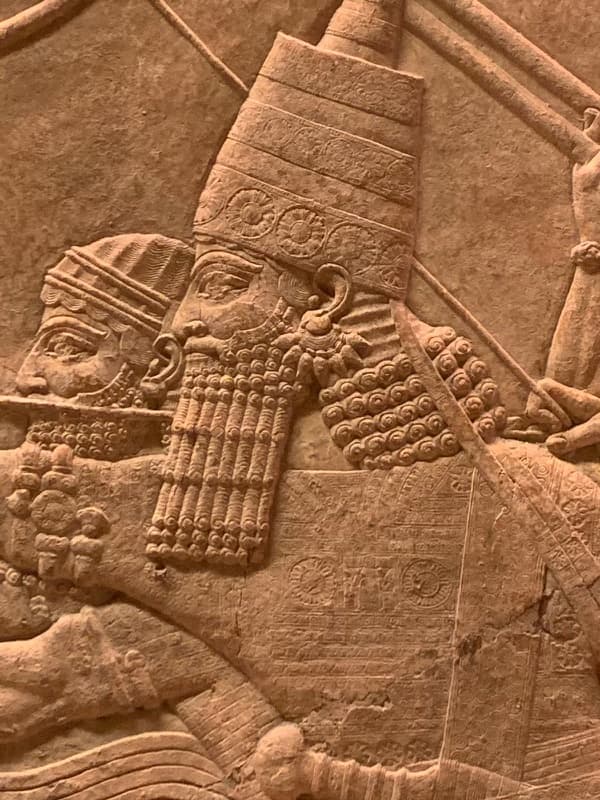
In the final, brilliant decades of the Neo-Assyrian Empire, dominion was maintained through a deliberate policy of terror and an unprecedented obsession with the written word.
In May of 672 BCE, the grand plazas of Nineveh filled with an uneasy crowd of foreign emissaries, provincial governors, and heavily armored military commanders. They had been summoned by the ailing Assyrian emperor, Esarhaddon, to witness a political experiment that violated centuries of imperial tradition. Standing before them were two brothers. The elder, Shamash-shum-ukin, was designated as the future king of Babylon, the ancient and volatile cultural capital of the south. The younger, a youth of about thirteen named Ashurbanipal, was presented as the primary heir to the throne of Assyria—the supreme commander of the most lethal military machine in the ancient world. The name given to him for the occasion, Aššur-bāni-apli, carried a weight of divine selection: "Ashur is the creator of the heir." To secure this fragile arrangement, Esarhaddon’s mother, the formidable dowager queen Naqi'a, would later force the entire court and royal family to sign the Zakutu Treaty, binding them by terrible oaths to accept the younger brother's supremacy. It was an arrangement designed to prevent a civil war of succession, yet by dividing the world’s greatest empire between two brothers, Esarhaddon sowed the very wind that his favored younger son would spend a lifetime reaping.
When Esarhaddon died in 669 BCE while marching to suppress a rebellion in Egypt, Ashurbanipal ascended the throne in Nineveh, while his older brother was crowned in Babylon the following spring. To soften the blow of vassalage, Ashurbanipal returned the sacred Statue of Marduk, which their grandfather Sennacherib had stolen from Babylon twenty years prior, allowing Shamash-shum-ukin to lead the deity back to his southern temple. Yet, the younger brother made sure the boundaries of power were unmistakably clear. Though Esarhaddon's decrees warned against interfering in Babylonian affairs, Ashurbanipal systematically stripped his brother of genuine independence, monitoring his court through an extensive intelligence network and keeping the southern king in a state of closely watched vassalage. Ashurbanipal himself had been trained in the "House of Succession" not just in the arts of archery, riding, and chariotry, but in the administration of statecraft. During his father's final years of illness, it was Ashurbanipal who had run the empire's vast spy network, receiving strategic dispatches from foreign frontiers and compiling intelligence reports. He knew that security in the Near East was an illusion maintained only by swift, preemptive violence.
The early decades of Ashurbanipal’s thirty-eight-year reign were defined by an endless, grinding effort to hold together the far-flung territories his father had conquered. Foremost among these was Egypt, a land whose local elites chafed under the Assyrian garrisons established by Esarhaddon. The Kushite Pharaoh Taharqa, having retreated south into Nubia, continuously instigated revolts among the delta's vassal rulers, including the local lord Necho I. Ashurbanipal’s response was a demonstration of the cold, calculated pragmatism that characterized his early rule. His armies marched south, gathering tribute and auxiliary troops from Levantine vassals—including Manasseh of Judah—and crushed the rebellion at Kar-Banitu. When Necho I and other conspirators were brought back to Nineveh in chains, Ashurbanipal did not execute them; instead, he extracted new oaths of fealty and sent Necho back to govern Egypt as a loyal client. The peace was short-lived. In 664 BCE, Taharqa's nephew Tantamani invaded from the south, seizing Thebes and marching on Memphis. The Assyrian retributive strike was merciless. Though Tantamani fled into the Nubian desert, the Assyrian army descended upon Thebes, the historic and religious heart of Upper Egypt. The city was systematically and thoroughly plundered, its historic temples stripped of gold, its obelisks hauled back to Nineveh to be melted down or re-erected as monuments to Assyrian triumph. It was a cataclysm from which the ancient city would never fully recover.
+ 12 further connections to entries not yet ingested
Yet the true nemesis of Ashurbanipal’s reign lay not in the African desert, but across the eastern marshes: the kingdom of Elam. For decades, Elam had served as the chief instigator of anti-Assyrian unrest in Babylonia. When the Elamite king Urtak launched a surprise raid into Babylonia in 665 BCE, Ashurbanipal drove him back, but the subsequent power vacuum in Elam brought the usurper Teumman to the throne. Teumman immediately sought to purge his rivals, forcing three of Urtak’s sons to flee to Nineveh, where Ashurbanipal granted them political asylum. This lingering diplomatic wound festered until 653 BCE, when Teumman invaded Babylonia. The campaign ended in a crushing Assyrian victory, but it merely set the stage for the great tragedy of Ashurbanipal’s life: the rebellion of his brother.
For sixteen years, Shamash-shum-ukin had quietly endured the humiliation of his brother's overbearing guardianship. By 652 BCE, the resentment boiled over. The Babylonian king assembled a vast, covert coalition of Assyria’s enemies, uniting Elamites, Aramean tribes like the Gambulians, and Arabian rulers in a desperate bid for independence. The resulting civil war tore the empire apart. Ashurbanipal reacted with a terrifying, single-minded focus. He besieged Babylon for two grueling years, cutting off the city until starvation forced the defenders to capitulate in 648 BCE. Shamash-shum-ukin died amidst the chaos of the siege, perhaps choosing the flames of his burning palace over his brother’s wrath. Ashurbanipal's vengeance on the surviving population was brutal and deliberate. He ordered massacres of rebellious civilians, boasting openly in his royal inscriptions of his cruelty—a departure from the more sanitized victory records of his predecessors. He then turned his full fury upon Elam, the coalition's primary backer. In a series of scorched-earth campaigns between 647 and 646 BCE, Assyrian forces systematically dismantled the Elamite state. They leveled its cities, salted its fields, desecrated the tombs of its kings, and dragged its population into exile. It was a campaign of such total eradication that modern historians have characterized it as a state-sponsored genocide.
Yet, this dark, blood-drenched monarch possessed a parallel life that would define his legacy far longer than his conquests. Ashurbanipal was a highly educated king, a rare literate ruler in an age when kings relied entirely on scribes. He boasted of his ability to read the complex, archaic cuneiform tablets of Sumer and Akkad, and of his mastery of mathematics and oil divination. To preserve and project this intellectual supremacy, he built the Library of Ashurbanipal within his palace at Nineveh. He dispatched scribes across Mesopotamia to seize, copy, and catalog every significant tablet they could find, collecting works of medicine, astronomy, religion, and literature. Here, the great Epic of Gilgamesh and the Mesopotamian creation myth, the Enuma Elish, were preserved on thousands of clay tablets. At its height, the library contained over 100,000 texts—a monument of human knowledge that would not be surpassed until the construction of the Library of Alexandria centuries later. The artwork produced under his patronage reflected this sophisticated, dramatic worldview. The palace reliefs of his reign, particularly the famed scenes of Ashurbanipal hunting lions, possessed an epic, fluid quality, capturing the agony of the beasts and the cold majesty of the king with a raw, innovative realism unseen in earlier Assyrian art.
This juxtaposition of refined intellectualism and industrial-scale violence is the central paradox of Ashurbanipal. In Greco-Roman legend, he was remembered under the name Sardanapalus, a distorted, mythical figure of decadent, effeminate luxury whose vices supposedly caused the sudden collapse of his empire. The historical reality was far more complex. Though Ashurbanipal pushed the empire to its absolute zenith, campaigning further than any Assyrian king before him, the strategic foundations of his victories were rotten. His brutal sack of Babylon alienated the southern Aramean and Chaldean populations permanently, sowing a deep, generational hatred that would find its outlet just five years after his death in 631 BCE with the rise of the Neo-Babylonian Empire. His wars in Arabia and his campaign in Egypt ultimately drained the treasury and stretched Assyrian military resources to their breaking point, yielding no long-term imperial control.
When Ashurbanipal died, he left behind a capital of unparalleled architectural and intellectual splendor, but an empire hollowed out by its own fury. The destruction of Elam had removed a buffer state, leaving Assyria's eastern flank exposed to the rising power of the Medes, while the scarred ruins of Babylonia awaited a liberator. Within two decades of his death, Nineveh itself would be besieged, breached, and burned to the ground by an alliance of Medes and Babylonians. The great library collapsed into the flames, baking and preserving the clay tablets beneath the rubble of the palace. In the end, the very violence Ashurbanipal used to secure his eternal glory ensured the swift, catastrophic ruin of his world, leaving only his buried clay tablets to tell the story of the last great king of Assyria.