Event · 1670 CE – 1902 CE · West African Empires
Ashanti Empire
- Also known as
- Asante
- Asante Empire
- Asante Empire
- Asanteman
- Aschanti-Föderation
- Aschanti-Königreich
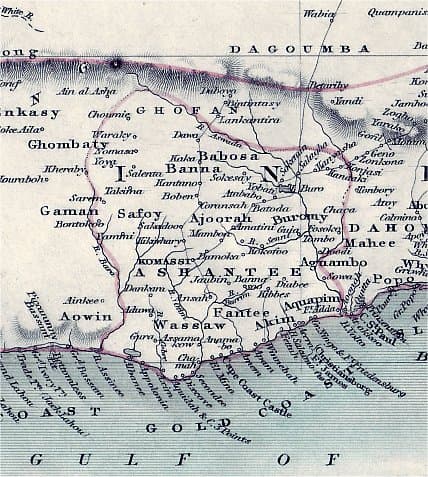
To understand the Asante Empire, one must understand that its very name, derived from the Twi words for war and because of, translates to because of war.
In the dense, shadowed canopy of the West African forest, where the Ofin and Pra rivers snake through earth rich with alluvial gold, the people of the forest did not measure their beginnings by maps, but by stools. To the Akan, the primordial homeland was Amansie—the "Origin of the Nations." In their oldest narratives, the adomankomasem, a golden chain once descended from the sky, carrying a stool and a herald woman named Ankyewea Nyame. She settled at Asantemanso, where the ancestors of the Oyoko clan first emerged from the earth to join her. Archaeological excavations at this sacred site reveal that beneath the myth lies a deep history: continuous human habitation stretching back to at least the ninth century BCE, with evidence of iron smelting, pottery, and an urban complexity that linked the forest-dwellers to the great trans-Saharan gold trade of the Middle Niger Valley long before the first European sails appeared on the Gulf of Guinea.
For centuries, this forest world was a constellation of independent, decentralized aman—states governed by ruling lineages whose authority was anchored in the akonnwa, the sacred wooden stools of the ancestors. Chief among the early polities was Adanse, remembered as the seat of the first organized kingship and the place where God began creation. But by the seventeenth century, this ancestral heartland began to fracture under the weight of succession disputes, migration, and fierce competition over the lucrative trade routes that carried gold and kola nuts north to the savanna and south to the European fortresses on the coast. Portuguese, Dutch, and English merchants wrote of the legendary "Accanists"—shrewd inland gold traders from the kingdoms of Arcania who dominated the coastal markets. As these clans migrated, pushed by regional wars and the search for new territories, they established a network of rising towns: Dwaben, Kokofu, Kumawu, and a settlement destined to eclipse them all, Kumase.
The catalyst for this transformation was a collective trauma and a brilliant act of political imagination. For decades, the rising forest states had been dominated by the powerful kingdom of Denkyira, which demanded heavy tribute and restricted access to the coast. In the late seventeenth century, a military leader of the Oyoko clan, Osei Tutu, assumed the leadership of Kumase. Alongside his chief priest and adviser, Okomfo Anokye, Osei Tutu realized that the scattered, warring Akan clans could never defeat Denkyira while divided. They needed a symbol that transcended individual lineage, a spiritual anchor that could bind the independent states into a single, indivisible union.
The moment of transformation occurred at a grand assembly of chiefs. According to tradition, Okomfo Anokye conjured a vessel from the heavens: a wooden stool encased in pure gold, which floated down through the forest mist to land gently on the lap of Osei Tutu. This was the Golden Stool (Sika Dwa Kofi). Anokye declared that the stool contained the sunsum—the collective soul, power, and destiny—of the entire nation. It was not the throne of the king, but the embodiment of the state itself, so sacred that it was never allowed to touch the bare earth. Bound by this shared spiritual covenant, the newly united clans took the name Asante, meaning "because of war"—a name forged in the crucible of their collective rebellion against their overlords.
In 1701, the newly unified Asante army marched against Denkyira. They did not fight as a loose coalition, but as a disciplined, highly organized military machine. Osei Tutu introduced a sophisticated paramilitary structure, organizing the state’s forces into wings—a vanguard, a main body, left and right flanks, and a rear guard—that could move through the dense forest with lethal coordination. The Asante victory over Denkyira was total. It shattered the old order of the forest and, crucially, secured the new empire direct access to the Atlantic Ocean. For the first time, the Asante could bypass middleman kingdoms to trade directly with European merchants, particularly the Dutch, exchanging gold, agricultural goods, and enslaved captives for firearms, textiles, and manufactured goods.
Over the next two centuries, the Asante Empire (Asanteman) expanded aggressively from its heartland around Lake Bosumtwi—the region's only natural lake—to encompass most of modern-day Ghana, as well as parts of the Ivory Coast and Togo. The capital, Kumasi, grew into a sophisticated metropolitan center characterized by grand courtyards, whitewashed clay architecture, and an intricate, highly structured administrative hierarchy. The empire’s wealth was legendary, built upon a diversified economy of gold mining, agricultural exports, the trade of kola nuts to the north, and a dominant position in the regional slave trade.
This immense wealth and military sophistication brought the Asante into direct, protracted conflict with the expanding British Empire, which sought to establish a protectorate over the coastal Fante states and secure unchallenged control of the Gold Coast. The resulting Anglo-Asante Wars, spanning the nineteenth century, became some of the most fiercely contested colonial conflicts in African history. The Asante proved to be formidable adversaries. During the early campaigns, their armies repeatedly outmaneuvered British forces. In 1824, at the Battle of Nsamankow, the Asante defeated a British force and killed the British colonial governor, Sir Charles MacCarthy, keeping his skull as a gold-rimmed drinking cup in Kumasi—a potent symbol of their defiance.
But the sheer material resources of the British Empire, combined with internal divisions among the Asante's tributary states, eventually turned the tide. British forces launched successive expeditions into the forest interior, utilizing modern repeating rifles and rockets. In subsequent campaigns, British troops managed to breach the forest defenses, burning and sacking the grand capital of Kumasi. The fifth and final Anglo-Asante War broke out at the dawn of the twentieth century, sparked by a British governor's demand to sit upon the sacred Golden Stool—a profound insult that demonstrated a complete ignorance of its spiritual significance. The uprising, led by the queen mother Yaa Asantewaa, was a fierce final act of resistance, but it ultimately ended in defeat. On January 1, 1902, the Asante Empire was formally annexed, becoming part of the British Gold Coast colony.
Though the sovereign empire was dismantled by colonial rule, the spirit of Asanteman proved remarkably resilient. The British could conquer the territory, but they could never destroy the sunsum embodied in the Golden Stool, which the Asante successfully hid from colonial authorities. When modern Ghana achieved independence in 1957, the historic Asante Kingdom was integrated into the new republic, where it survives today as a constitutionally protected, sub-national traditional state. Led by the current king, Otumfuo Osei Tutu II, the modern kingdom remains an influential cultural and political force, its economy still anchored in the historic trade of gold, cocoa, and kola nuts. The empire that began "because of war" under the shade of the forest canopy remains one of the defining pillars of West African civilization, its identity preserved not in borders on a map, but in the golden symbol that once descended from the sky.
Connected to
2 links to entries not yet ingested in the Library.