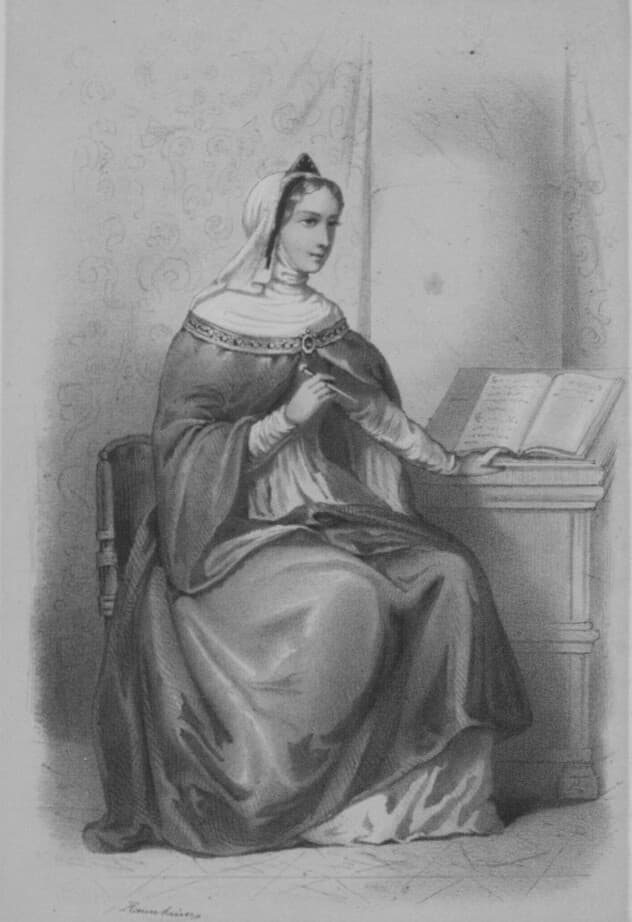
Born in the Porphyra Chamber of the imperial palace in Constantinople, Anna Komnene was literally "born in the purple." As the eldest daughter of Emperor Alexios I Komnenos and Irene Doukaina, her birth on 1 December 1083 carried immense geopolitical weight.
On a December night in 1083, inside the Porphyra—the imperial, purple-marble chamber of the Great Palace of Constantinople—a child was born whose very arrival was choreographed as an act of imperial obedience. Her mother, the Empress Irene Doukaina, had felt the pangs of labor days earlier but had pressed a hand to her belly, making the sign of the cross, demanding that the child wait until her husband, the usurper-emperor Alexios I Komnenos, returned from the wars. The baby girl complied, entering the world only when her father was back in the capital. This child, Anna Komnene, would spend the rest of her life obsessed with this concept of birthright, duty, and the literal and symbolic purple of her origin. She was a porphyrogenita—born in the purple—and from her first breath, she was wrapped in the dynastic calculations of an empire that lived in the shadow of its own collapse.
At her birth, Anna was presented with a crown and an imperial diadem. She was betrothed to Constantine Doukas, the young son of a deposed emperor, in a political matchmaking designed to legitimize her father’s newly seized throne. For the first decade of her life, Anna was the designated heir to the Roman Empire, raised in the household of her future mother-in-law, Maria of Alania, and surrounded by the formidable women who anchored the Komnenian court. But the Byzantine world was a shifting mosaic of alliances. In 1087, Anna’s brother John was born; by 1092, the boy was designated emperor, displacing Anna and her betrothed. Two years later, Constantine Doukas was dead. The crown that had hovered over Anna's cradle vanished, replaced by the reality of a younger brother who would inherit the earth she believed was hers.
Though she was married in 1097 to Caesar Nikephoros Bryennios—a soldier, historian, and member of a formerly reigning family—Anna’s gaze remained fixed on the lost inheritance of her childhood. The marriage was highly intellectual; Bryennios was a man who tolerated, and perhaps even nurtured, his wife’s staggering academic ambitions. Byzantine women of high status were expected to be pious and domestic, and Anna’s parents reportedly disapproved of her reading ancient poetry due to its pagan themes. Yet, as her contemporary Georgios Tornikes later recalled, Anna studied the classics in secret, hiding her texts to "brace the weakness of her soul" against intellectual deprivation. She mastered rhetoric, philosophy, geometry, astronomy, and medicine. She grew so adept in the medical arts that she administered a massive hospital in Constantinople, wrote authoritatively on gout, and eventually stood over her father’s deathbed, debating diagnoses with the finest imperial physicians.
+ 12 further connections to entries not yet ingested
The true crisis of Anna’s life arrived in August 1118, as her father lay dying of rheumatism. The palace became a silent battlefield. Empress Irene, who favored Anna and her husband Bryennios, pleaded with the dying Alexios to alter the succession. But John, the younger brother, was swift. While their father gasped for breath, John slipped into the imperial bedchamber, embraced the dying emperor, and secretly slid the imperial signet ring from his father’s finger. Before the death was even announced, John had been acclaimed emperor in the Hagia Sophia.
History, written nearly a century later by the chronicler Niketas Choniates, records that Anna did not surrender quietly. Driven by ambition and revenge, she allegedly organized a military plot to assassinate her brother during their father's funeral. The conspiracy fell apart because her husband, Bryennios, refused to cooperate. In a fit of fury that Choniates preserved for posterity, Anna supposedly lamented that nature had mistaken their sexes, declaring that she should have been the man and he the woman. Modern historians, however, suggest a more complex reality. Choniates wrote long after the fall of Constantinople in 1204, searching for the moral rot that had doomed the empire, and may have painted Anna as the archetypal ambitious schemer. Other contemporary sources suggest that John’s behavior at his father's deathbed was widely seen as inappropriate, and that Anna’s "rebellion" may have been a later fabrication.
Whether guilty of treason or merely politically inconvenient, Anna was stripped of her estates and retired to the Kecharitomene Monastery, a convent founded by her mother. It was here, in the quiet of her confinement, that the princess reinvented herself as the architect of her family’s memory. When her husband died in 1137, leaving behind an unfinished history of the empire, Anna took up the pen.
Between the 1140s and 1150s, she composed the Alexiad, a monumental fifteen-volume epic of her father’s reign and the defining primary source of the late eleventh and early twelfth centuries. Writing from her monastic cell, Anna convened intellectual circles and gathered materials with the precision of a modern researcher. She combed through the imperial archives, cross-referenced official treaties, and interviewed aging veterans who had served under her father. She quoted from Homer and the Bible, often from memory, weaving a narrative that was as much a classical epic as it was a historical chronicle.
Through the Alexiad, Anna gave the world its most vivid, first-hand account of the first encounter between the Byzantine East and the Latin West during the First Crusade. She described the Western crusaders not as holy liberators, but as unstable, greedy barbarians—unpredictable forces of nature that her father had to manipulate and contain. Her writing was cinematic, filled with precise descriptions of military tactics, weaponry, and the physical toll of medieval warfare. Yet underneath the grand geopolitical narrative ran a deeply personal current. The Alexiad was Anna’s ultimate act of political defiance: a masterful literary monument designed to prove her own intellectual superiority, defend her father’s controversial legacy, and subtly assert that she, not her brother John, was the true intellectual heir to the Komnenian dynasty.
Anna Komnene died around 1153, having spent her final decades in the shadow of the convent, far from the halls of the Great Palace where she had been born in the purple. She never regained her political power, and her name was largely erased from the active statecraft of her brother's reign. Yet, while the emperors of her line crumbled into dust and the borders they fought to protect eventually vanished, her voice survived. By translating her thwarted political ambition into historical prose, she ensured that the story of Byzantium’s great survival would be told entirely on her terms, securing a legacy far more permanent than the crown she was denied.