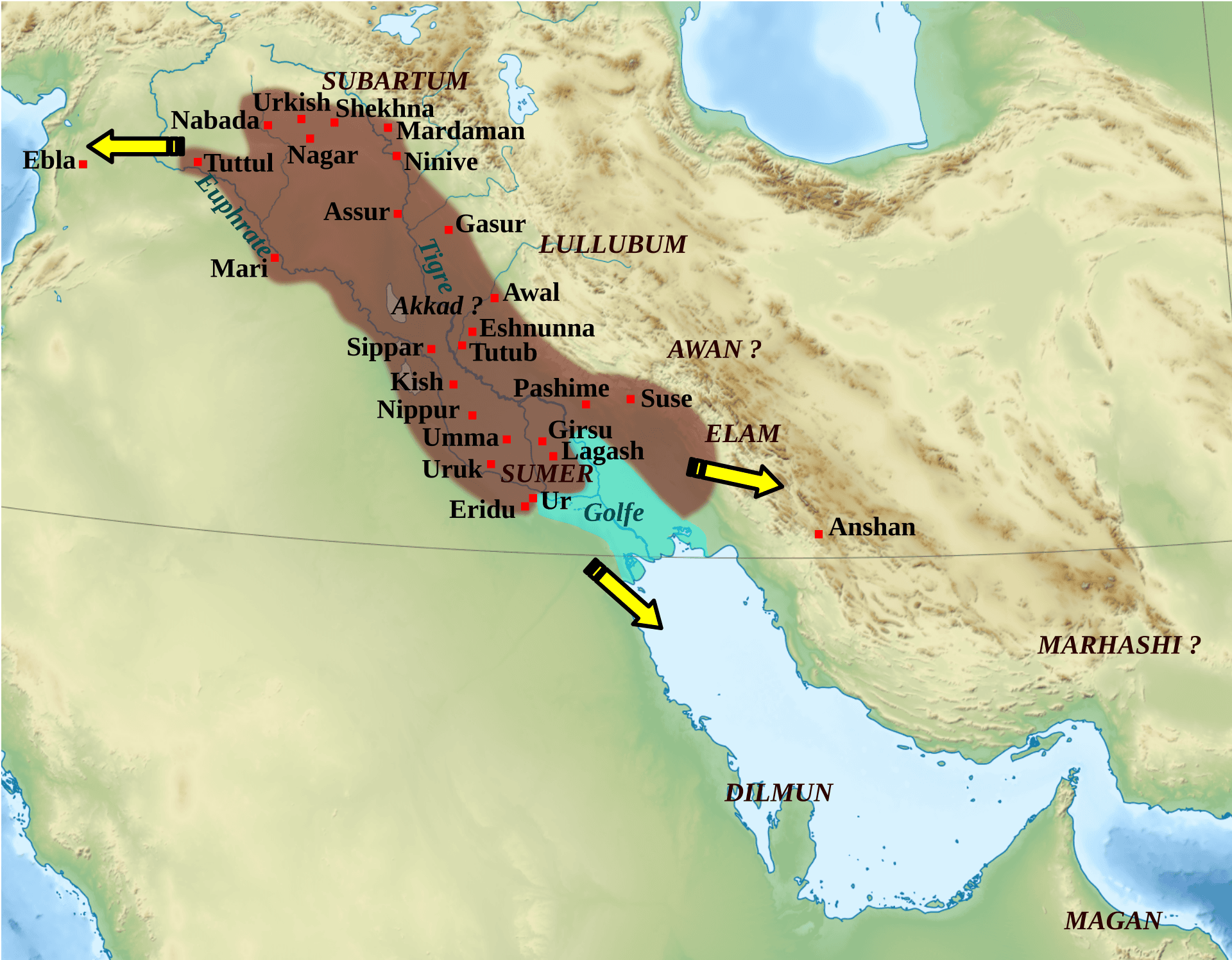
Before the twenty-fourth century BCE, the Mesopotamian world was a fractured mosaic of rival city-states, each guarding its own temples and sovereignty.
Before there was an empire, there was a system of walls, irrigation canals, and intensely jealous gods. For centuries, the landscape of southern Mesopotamia was a patchwork of sovereign city-states—Ur, Lagash, Umma, Kish—each operating as a closed universe. These cities spoke Sumerian, shared a pantheon, and periodically slaughtered one another over border ditches. It was a world of deep localism, where a king’s ambition was bounded by the horizon of his own fields and the defensive reach of his bronze-tipped phalanxes. Then, around 2334 BCE, the system was shattered by a man who did not belong to it.
He was not Sumerian, but a speaker of Akkadian, a Semitic tongue that had long drifted through the northern reaches of the alluvial plain. He did not claim royal lineage; later legends whispered he was the abandoned son of a priestess, set adrift in a reed basket on the Euphrates and raised by a gardener. History knows him as Sargon, a name that translates, with a touch of defensive irony, to "the legitimate king." Sargon did not merely conquer his neighbors; he dissolved the conceptual borders of their world. After defeating the formidable Sumerian king Lugal-zage-si, Sargon marched his troops to the Persian Gulf and symbolically washed his weapons in the sea, declaring that he had united the world from the "Lower Sea" to the "Upper Sea" of the Mediterranean. To anchor this sprawling new reality, he built a capital from scratch: Akkad, or Agade, a city so thoroughly erased by time and soil that its ruins have never been found, though its name would define the first true empire in human history.
To govern a territory stretching from modern-day Iran and the Persian Gulf across Syria and Anatolia, the Akkadians had to invent the machinery of centralized rule. Sargon and his successors replaced the hereditary rulers of conquered cities with loyal Akkadian governors, imposing a planned economy that coordinated agriculture, trade, and taxation on an unprecedented scale. They introduced a system of year-names—naming each calendar year after a major royal achievement, such as the construction of a temple or a great military victory—to synchronize the administrative heartbeat of the empire. Standardized weights and measures regulated trade, which now flowed along secured routes linking the silver mines of Anatolia to the ports of the south, where merchants traded with the far-off Indus Valley. The Akkadian language, written in cuneiform, became the empire’s administrative lingua franca. Yet, this was not a simple campaign of cultural erasure. The Akkadians respected the ancient prestige of Sumerian religion and literature, weaving the two cultures together. Sargon’s own daughter, Enheduanna, was appointed as the high priestess of the moon god Nanna at Ur. Her existence, confirmed by surviving clay seals, marks her as the first named author in human history, her hymns to the goddess Inanna serving as both sublime theology and sophisticated political glue for the young state.
+ 3 further connections to entries not yet ingested
For all its administrative sophistication, the Akkadian peace was a fragile thing, bought with blood and maintained by terror. Sargon’s sons, Rimush and Manishtushu, spent their brief reigns putting down savage rebellions from the old Sumerian city-states, both eventually dying violent deaths in palace coups. It was Sargon’s grandson, Naram-Sin, who elevated the empire to its artistic and political zenith, while simultaneously sowing the seeds of its mythological doom. Reigning for decades, Naram-Sin was a military commander of terrifying energy. He crushed a massive, coordinated uprising of seventeen kings in a single year—an event immortalized on the copper base of the Bassetki Statue—and pushed the empire’s borders deep into the Zagros Mountains and northern Syria.
Naram-Sin did not merely claim to rule by divine right; he claimed divinity itself. He adopted the title "King of the Four Quarters" of the world, prefixed his name with the cuneiform sign for a god, and had himself depicted in monumental stone reliefs wearing the horned helmet reserved exclusively for deities. A contemporary inscription on the Bassetki Statue records that the citizens of Akkad, marveling at his protection of their city, petitioned the great gods of the pantheon to make Naram-Sin the god of their city, building a temple dedicated to his own worship. In the crisp, elegant reliefs of the Sargonic period, Akkadian art shed the stiff, schematic style of early Sumerian carvings. Figures acquired muscular definition, flowing robes, and a naturalistic grace that mirrored the fluid, absolute authority of the divine king.
But in the ancient Near East, to scale the heights of heaven was to invite a terrible fall. The Akkadian Empire, which had flourished for nearly two centuries, fragmented rapidly after the reign of Naram-Sin's son, Shar-kali-shari. To later generations, the collapse of Akkad was a moral fable. In the famous literary composition The Cursing of Agade, written during the subsequent Neo-Sumerian revival, the fall of the empire was attributed directly to Naram-Sin’s hubris. The text claims he desecrated and demolished the Ekur, the sacred temple of the supreme god Enlil in Nippur. In retribution, the gods withdrew their favor and unleashed the Gutians, a nomadic people from the Zagros Mountains described as having "human intelligence but canine instincts and monkeys' features," who swept down to destroy the land.
Modern science, however, has revealed a far more impartial culprit behind the empire's sudden disintegration. Around 2200 BCE, the region was struck by a severe, prolonged dry spell known to climatologists as the 4.2-kiloyear event. This catastrophic shift in global weather patterns caused a collapse in rainfall and a drastic reduction in the flow of the Tigris and Euphrates. In an empire dependent on a highly centralized, planned agricultural economy, the drought triggered widespread crop failures, famine, and massive population displacement. As refugees from the parched northern plains fled southward, cities became overcrowded, administrative networks snapped, and tax revenues dried up. The state, already weakened by internal dynastic struggles and the constant pressure of nomadic incursions like those of the Gutians, simply fractured into pieces.
The Akkadian Empire disappeared back into the desert clay by 2154 BCE, leaving behind no standing capital and only fragmentary archives scattered across the ruins of the cities it had once subjugated. Yet, its ghost would haunt the Mesopotamian imagination for another two thousand years. Future kings of Babylon and Assyria would look back to Sargon and Naram-Sin as the archetypes of majesty, copying their inscriptions, adopting their grandiose titles, and seeking to recreate the lost unity of the four quarters of the earth. In attempting to govern the diverse peoples between the rivers under a single law, the Akkadians had introduced a radical idea that could never be forgotten: that the world was not a collection of isolated cities, but a single, conquerable whole.