Person · 14th c. BCE – 1336 BCE · Ancient Egypt
Akhenaten
- Also known as
- .axenaten.
- Ac'henaton
- Acenaten
- Achenaten
- Achnaton
- Achnaton
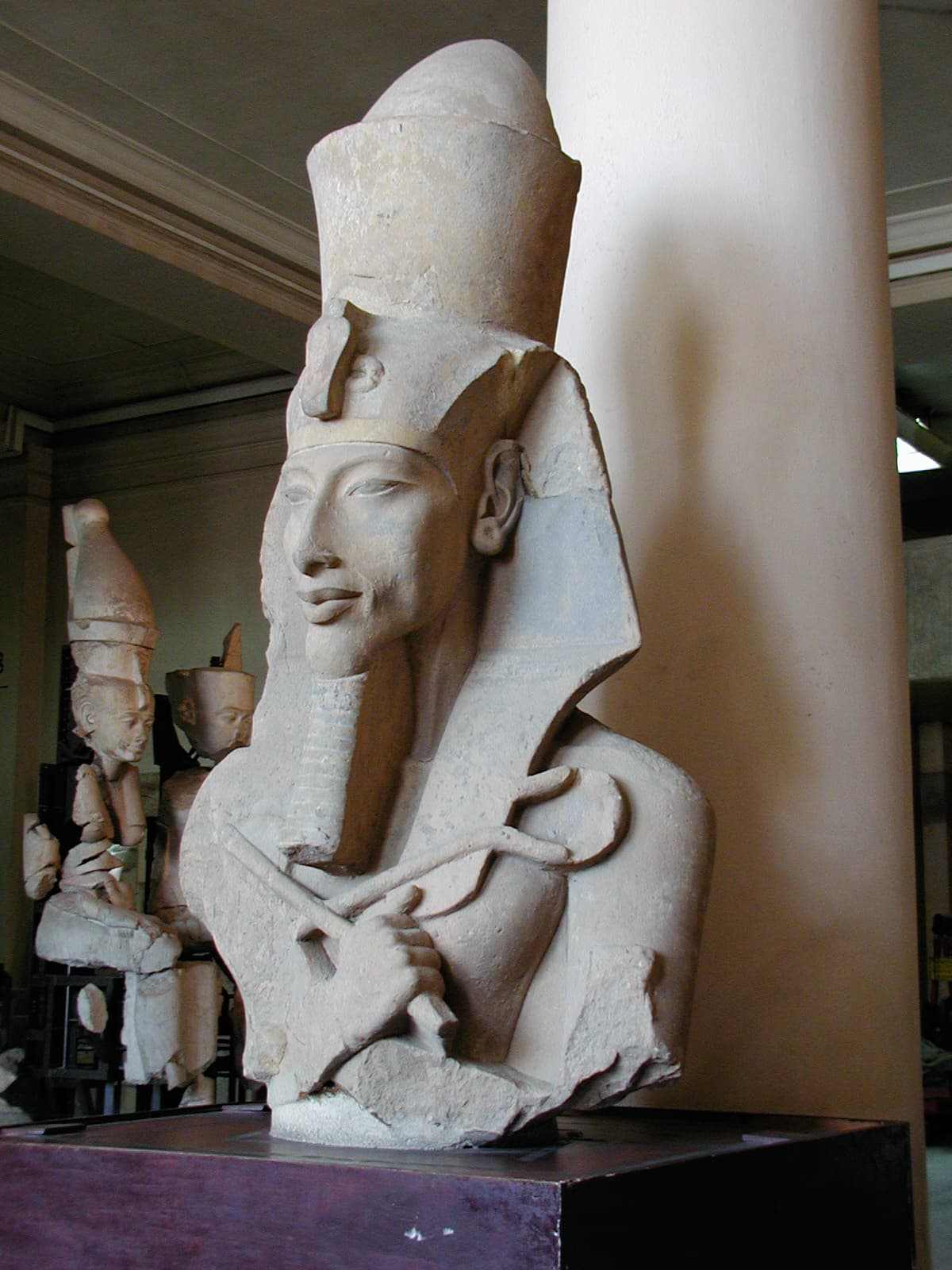
In the fifth year of his reign, the pharaoh Amenhotep IV abandoned the name of his birth, which honored the god Amun, and renamed himself Akhenaten.
In the fifth year of his reign, the tenth ruler of Egypt’s Eighteenth Dynasty did something unprecedented in the annals of the Nile: he abandoned his birth name. He had spent his youth and his first years on the throne as Amenhotep IV—a name that translated to "Amun is satisfied"—honoring the great state god of Thebes whose wealthy priesthoods effectively managed the kingdom’s vast resources. By emerging from this chrysalis as Akhenaten, meaning "Effective for the Aten," the young pharaoh signaled a radical break not just with his ancestors, but with the very cosmological order of Egypt. This was not a mere shift in administrative preference; it was an existential earthquake. For millennia, the spiritual life of Egypt had been defined by a crowded, comforting pantheon of animal-headed deities, local cults, and hidden gods. Akhenaten sought to sweep them all aside, replacing them with a single, blinding focus: the Aten, the physical disc of the sun, whose lifegiving rays ended in tiny, human-like hands reaching down to touch the royal family.
To understand the scale of this rupture, one must look to the world Akhenaten inherited around 1353 or 1351 BCE. He was born Prince Amenhotep, a younger son of the magnificent Pharaoh Amenhotep III and his formidable principal wife, Tiye. He was never meant to rule. His elder brother, Crown Prince Thutmose, had been groomed for the throne, even serving as the High Priest of Ptah in Memphis. But Thutmose died young, perhaps around the thirtieth year of their father’s reign, thrusting the younger prince into the line of succession. Scholars still debate the environment of his youth; some believe he was raised in the northern city of Memphis, where the nearby Heliopolitan cult of the sun god Ra may have planted the seeds of his later obsession, while others note that solar worship was already so pervasive that he could have absorbed it anywhere in the kingdom. There are even whispers among historians that he may have briefly filled his deceased brother’s role as priest of Ptah—the patron deity of craftsmen—which might explain the highly unusual, fluid, and expressive artistic sensibilities he would later unleash upon Egypt.
The transition of power from father to son remains shrouded in historical fog. For decades, archaeologists have argued over whether Akhenaten shared a long coregency with Amenhotep III, with some suggesting they ruled together for up to twelve years, while others insist on a brief overlap of no more than two years, or none at all. When a joint inscription bearing both their names was discovered on the walls of the Luxor tomb of the vizier Amenhotep-Huy, some heralded it as definitive proof of a shared eight-year reign. Yet, skeptics argue the tomb simply straddled the transition, a monument built by a courtier wishing to honor both the dying king and the rising sun. What is certain is that when the young Amenhotep IV first took the crown, he did so traditionally. His earliest inscriptions show him paying homage to the old gods—Atum, Osiris, Anubis, Nekhbet, Hathor, and the Eye of Ra. There was no grand manifesto at his coronation, no hint of the storm to come.
Then came the fifth year, and with it, a revolution from above. Akhenaten did not simply rename himself; he chose to leave Thebes entirely, abandoning the temples of Amun and the powerful, entrenched priests who controlled them. He led his court to a virgin site in Middle Egypt, a desert bay hemmed in by cliffs that he named Akhetaten—"the Horizon of the Aten"—known today as Amarna. Here, he built a utopian capital from scratch, featuring vast, roofless temples designed to let the sun’s rays fall directly onto thousands of offering tables. In this new city, the pharaoh and his beautiful Great Royal Wife, Nefertiti, functioned as the sole intermediaries between humanity and the supreme solar deity. The traditional, polytheistic religion of Egypt was dismantled. The temples of Amun were closed, their assets seized, and the name of Amun was systematically hacked off monuments across the empire. Whether this policy represented true monotheism, or rather monolatry, syncretism, or henotheism, remains a battleground for modern Egyptologists. To the common Egyptian, however, the practical result was the same: the ancient, diverse heavens had been emptied, replaced by a single, burning disc.
This theological purge was accompanied by an astonishing artistic renaissance. For centuries, Egyptian art had relied on highly idealized, rigid proportions. Under Akhenaten’s patronage, the human form was suddenly depicted with a shocking, almost grotesque fluidness. Royal portraits showed the pharaoh with an elongated skull, a hanging jaw, a spindly neck, pronounced breasts, and a soft, swollen belly. So startling were these depictions that early modern observers wondered if the pharaoh suffered from a physical deformity. Today, scholars view this "Amarna style" as a deliberate theological statement—an embrace of the natural, generative warmth of the Aten, which broke down old boundaries to reveal a different kind of truth. This artistic intimacy extended to private life. For the first time, relief carvings depicted the pharaoh and Nefertiti in moments of tender domesticity, playing with their six daughters: Meritaten, Meketaten, Ankhesenpaaten, Neferneferuaten Tasherit, Neferneferure, and Setepenre.
Yet behind the sun-drenched domestic scenes of Amarna lay a darker, more complicated dynastic reality. The desire for a male heir seems to have driven the pharaoh to expand his household and perhaps cross ancient taboos. He took a secondary wife named Kiya—who some believe was actually Tadukhipa, a Mitanni princess who had previously been married to his father—and foreign brides from Babylon and Enišasi. He is also rumored by some historians to have taken his own eldest daughters, Meritaten and Meketaten, as consorts in a desperate bid to father a son. When his second daughter, Meketaten, died at the tender age of ten or twelve, early excavators interpreted her tomb’s reliefs—which showed an infant and grieving parents—as evidence that she died in childbirth, potentially pregnant by her own father. More recent analyses suggest the child represented her departing soul, but the rumors of father-daughter incest persist, fueled by inscriptions that list grandchildren with names like Meritaten-tasherit ("the younger") alongside the pharaoh.
When Akhenaten died in his seventeenth regnal year, around 1336 BCE, his solar revolution collapsed almost immediately. The fragile ecosystem of Atenism had been entirely dependent on the living presence of the king; without him, the sun disc was just a silent light in the sky. Within a few years, the court abandoned the glittering white city of Akhetaten, leaving its palaces and open-air temples to be reclaimed by the desert sands. The pharaoh's young successor and likely son, Tutankhaten, was pressured by the restored priesthood to change his name to Tutankhamun, formally signaling the return of the old god Amun and the restoration of the traditional pantheon.
In the decades that followed, the memory of Akhenaten was treated with systematic fury. Later pharaohs of new dynasties, seeking to legitimize their own rule, sought to erase the Amarna period from the fabric of time. Akhenaten's temples were dismantled, his stones reused as filler for other monuments, his statues smashed, and his name omitted from the official king lists. In state archives, if he had to be referred to at all, he was called "the enemy of Akhetaten," "the enemy," or simply "that criminal." His mummy was moved, possibly ending up in the mysterious, cluttered tomb KV55 in the Valley of the Kings, where modern genetic testing identified the occupant as Tutankhamun’s father, though controversial debates still rage over whether the bones belong to Akhenaten or his shadowy co-regist and successor, Smenkhkare.
For over three thousand years, the heretic pharaoh was successfully erased from human memory. When Flinders Petrie and other archeologists began excavating the ruins of Amarna in the late nineteenth century, they did not just find a city; they unearthed a forgotten intellectual rebellion. Akhenaten emerged from the dust as a deeply polarizing figure—hailed by some as "the first individual in history" and "the greatest idealist," and dismissed by others as a fanatical, destructive madman. Ultimately, his legacy is not found in the survival of his religion, which died with him, but in the profound question his reign left behind: whether a single ruler, armed with absolute power, could rewrite the spiritual DNA of a civilization by sheer force of will.
Connected to
- spouse · spouse ofNefertiti1370 BCE
- child · father ofTutankhamun1343 BCE
+ 12 further connections to entries not yet ingested