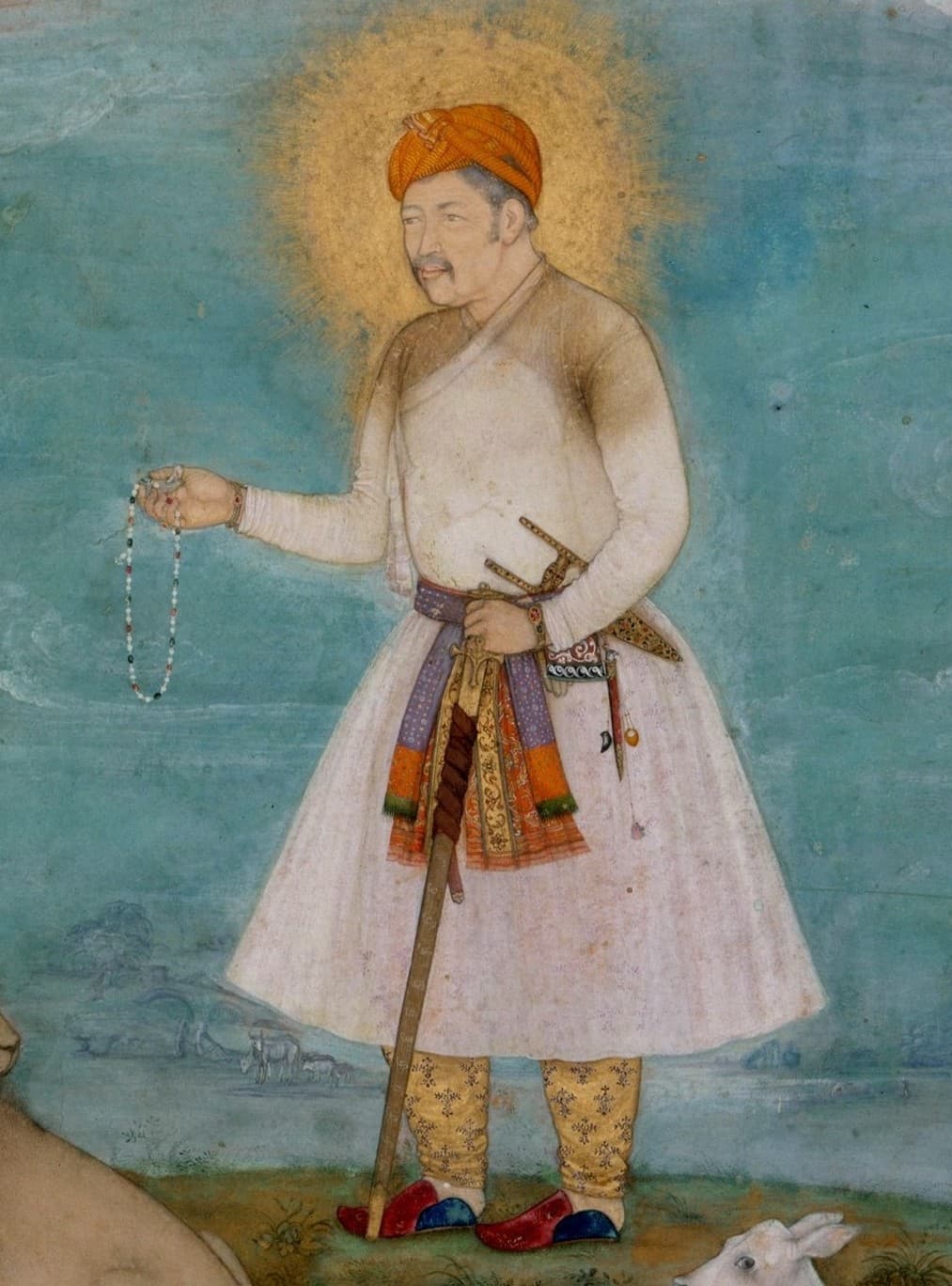
Born in the desert refuge of a Hindu Rajput fortress while his exiled father fled military defeat, Jalal-ud-Din Muhammad Akbar spent his childhood in Kabul learning to hunt, run, and fight rather than read or write.
In the year 1575, within the newly built, rose-red sandstone walls of his imperial capital at Fatehpur Sikri, the Mughal emperor Jalal-ud-Din Muhammad Akbar ordered the construction of a unique hall. He named it the Ibadat Khana, the "House of Worship." Thirsty for intellectual engagement and deeply unsatisfied by the rigid, often acrimonious dogmatism of his court’s orthodox Sunni theologians, the thirty-three-year-old sovereign designed this chamber as a crucible for the spirit. Initially, the gatherings were restricted to representatives of different Muslim schools—Sunnis, Shias, Ismailis, and Sufis—who met on Thursday nights to debate the finer points of law and theology. Yet these early assemblies, far from yielding spiritual clarity, quickly degenerated into petulant shouting matches, with highly placed clerics insulting and denouncing one another as heretics. Disillusioned by this spectacle of sectarian hostility, Akbar took a radical step that scandalized the traditionalist ulema: he opened the doors of the Ibadat Khana to the world. Into this high-vaulted space he invited Hindu pandits, Jain monks, Zoroastrian priests from Gujarat, Jesuit missionaries from Portuguese-controlled Goa, Jews, and even materialist skeptics.
The scene inside the Ibadat Khana during these nights was unlike anything the medieval world had witnessed, offering a striking window into the mind of a ruler who occupied the absolute pinnacle of early modern power. Illuminated by flickering torches, the emperor sat at the center of a architectural layout designed to foster debate, his broad shoulders and bright, flashing eyes commanding the room. To one side stood the Jesuit fathers Antoni de Montserrat and his companions, clutching their Latin texts and arguing for the divinity of Christ; to another, the white-clad Jain scholar Hiravijaya Suri, who had traveled on foot from Gujarat, urged the absolute sanctity of all living things and the virtues of vegetarianism. Nearby, Zoroastrian mobeds explained the sacred mysteries of fire and the sun as symbols of the divine, while Hindu pandits debated the monistic philosophy of Vedanta with Sufi mystics, who in turn found deep echoes of their own pantheistic beliefs in the ancient Sanskrit teachings. Akbar listened to them all with a remarkable, retentive memory. Though he was believed to be dyslexic and never learned to read or write, he spent his evenings having the world's great literature read aloud to him, and he navigated these complex theological waters with astonishing agility. When the Jesuit fathers launched into fierce diatribes against the Prophet Muhammad, sending shockwaves of indignation through the Muslim jurists in attendance, Akbar did not execute them for blasphemy; instead, he commanded his scribes to record their arguments, insisting that the pursuit of truth required an atmosphere free from the immediate threat of the sword.
From the archives
Akbar handing the imperial crown to his grandson, the future Shah Jahan. From the Padshahnama, 17th century.
Public domain · via Wikimedia Commons
Theological debate at the Ibadat Khana, Fatehpur Sikri. From Akbarnama, c. 1605.
Public domain · via Wikimedia Commons
The Diwan-i-Khas at Fatehpur Sikri, Akbar's imperial capital. The throne column suggests a fifth point of the universe.
This dramatic intellectual experiment was not an isolated eccentricities of a wealthy monarch, but the logical culmination of a life shaped by exile, military genius, and the immense practical challenge of governing a heterogeneous empire. Born on 15 October 1542 at the Rajput fortress of Amarkot in modern-day Sindh, Akbar entered a world of precarious fortunes. His father, the second Mughal emperor Humayun, had been driven from his throne and forced into a perilous westward flight by the Afghan commander Sher Shah Suri. In these desperate circumstances, Humayun married the fourteen-year-old Persian girl Hamida Banu Begum, who gave birth to Akbar in the safety of a Hindu refuge provided by the Rajput ruler Rana Prasad. Raised largely in Kabul by his paternal uncles and aunts while his parents sought Safavid military aid, the young prince spent his youth learning to hunt, run, ride, and fight rather than studying classic texts. He was a creature of physical action and raw survival. When Humayun finally reconquered Delhi in 1555 with Persian support, the triumph was short-lived; a few months later, the emperor fell down his library stairs and died.
The fourteen-year-old Akbar was thrust onto the throne on 14 February 1556, in the middle of a campaign in the Punjab. His guardian and regent, the brilliant Turkoman general Bairam Khan, performed the coronation on a hastily erected brick platform in Kalanaur and kept the emperor's death a secret until the fragile state could be secured. The Mughal grip on India was extraordinarily weak. To the south and east, the forces of the Sur dynasty rallied under Hemu, a Hindu general who had marched on Delhi, expelled the Mughal garrisons, and proclaimed himself sovereign. Against the advice of most of his chieftains, Bairam Khan chose to fight. At the Second Battle of Panipat on 5 November 1556, the outnumbered Mughal army clashed with Hemu's forces. A stray arrow blinded Hemu, throwing his army into panic and sealing a decisive victory for the young Shahanshah. Delhi and Agra were secured, but the lesson was burned into Akbar’s consciousness: the Mughal state in India could not survive as a transient military occupation. It had to put down deep, indigenous roots.
As Akbar reached his late teens, the tutelage of Bairam Khan grew increasingly suffocating. The regent was brilliant but autocratic and severe, frequently executing rivals and alienating the nobility. In the spring of 1560, encouraged by his foster mother Maham Anga, the eighteen-year-old Akbar asserted his independence. He dismissed Bairam Khan, ordering him to undertake the Hajj to Mecca. Though the proud general was briefly goaded into a rebellion in the Punjab, Akbar quickly defeated his former guardian, pardoned him with characteristic magnanimity, and sent him on his way with a generous pension, though Bairam was tragically assassinated by an Afghan vendetta en route. Akbar was now the sole master of his destiny, and he immediately embarked on a relentless series of military campaigns that would transform the small kingdom of Punjab and Delhi into a colossal empire spanning from the Bay of Bengal to the Hindu Kush.
The military machine that Akbar forged was characterized by daring innovation and a willingness to integrate foreign technologies. He recognized early on that the future of warfare lay in gunpowder, and he actively sought the expertise of Portuguese and Ottoman specialists to procure advanced firearms, matchlocks, and compact artillery. His vizier, Abul Fazl, would later boast that with the exception of the Ottoman Empire, no state possessed a more formidable array of guns to secure its authority. Yet Akbar’s genius lay in how he combined these European-style firearms with traditional Central Asian horse-archery and the devastating shock-power of war elephants. During his campaigns in Central India, Akbar personally rode into battle, displaying a physical courage that contemporary chroniclers compared to Alexander of Macedon. He would plunge his horse into swollen, roaring rivers during the monsoon season to surprise his enemies and think nothing of riding far ahead of his vanguard.
His pacification of Malwa in 1560 and 1561, though initially marred by the horrific cruelties of his foster brother Adham Khan, demonstrated Akbar’s growing intolerance for undisciplined brutality. When Adham Khan kept the spoils of victory and slaughtered the surrendered garrison—including women, children, and Muslim holy men—Akbar rode out in person to relieve him of command. When Adham later murdered a rival minister in the palace at Agra, an enraged Akbar personally confronted him, struck him down, and had him thrown headfirst from a high palace terrace into the courtyard below. Finding the man still groaning, the emperor ordered him dragged back up and thrown a second time to ensure his death. It was a terrifying demonstration of royal authority that made one thing clear: the old, chaotic Central Asian tribal politics of the early Mughals were over. Power was now centralized in the person of the Shahanshah.
Nowhere was this combination of devastating force and sophisticated diplomacy more evident than in Akbar's campaign against the Rajputs, the prestigious warrior clans who dominated the strategically crucial hills of Rajputana flanking the Indo-Gangetic plains. The Sisodia clan of Mewar, headed by Udai Singh II, represented the pinnacle of Hindu ritual status and resistance. To secure his empire's western flank and open the trade routes to the ports of Gujarat, Akbar besieged the great mountain fortress of Chittorgarh in late 1567. For four grueling months, the Mughals hammered the walls, until they finally breached the defenses in February 1568. The fall of Chittor was a brutal affair. Akbar, still operating under a more orthodox Islamic framework at this early stage of his life, proclaimed the victory as a triumph of Islam over infidels. He ordered the massacre of the remaining thirty thousand non-combatant defenders within the fort and displayed their heads on towers to break the spirit of Rajput resistance.
Yet, having demonstrated the horrific consequences of defiance, Akbar pivoted to a policy of extraordinary conciliation. He understood that the Rajputs were the finest warriors in India and that the empire would be far stronger with them as allies than as subjects. Unlike his predecessors, who treated conquered Hindu rulers with humiliation and forced their daughters into harems as a sign of subjugation, Akbar revolutionized imperial matrimonial diplomacy. When he married Mariam-uz-Zamani (historically known as Jodha Bai), the daughter of Raja Bharmal of the Kacchwaha Rajput state of Amer, in 1562, he allowed her to remain a practicing Hindu within the imperial palace. Her male relatives, including Bhagwant Das and Man Singh, were not forced to convert; instead, they were elevated to the highest civil and military ranks of the Mughal administration, dining and campaigning alongside Muslim amirs. Akbar made it clear that Rajput amirs were valued partners in the empire. He did not insist on marriage as a prerequisite for alliance; when Surjan Hada of Ranthambore surrendered his fortress on the condition that none of his daughters enter the imperial harem, Akbar readily accepted, appointing him to high command in the state. Through this policy of religious respect and political inclusion, the Rajputs became the iron pillars of the Mughal army, leading imperial forces in conquests as far afield as Kabul and Bengal.
With Rajputana secured, Akbar turned his attention to the wealthy, maritime province of Gujarat, which he annexed in 1572 after a lightning-fast campaign, giving the landlocked Mughal state its first direct access to global sea trade. When a subsequent rebellion threatened to undo this conquest, Akbar rode from Fatehpur Sikri to Ahmedabad—a grueling six-week journey of several hundred miles—in just eleven days, catching the rebels completely off guard and crushing them on 2 September 1573. He followed this with the conquest of Bengal in 1574, defeating the Afghan ruler Daud Khan and permanently ending the Sur dynasty's aspirations. By the late 1580s and 1590s, Akbar’s armies had conquered Kashmir, Sindh, Baluchistan, and the prized fortress of Kandahar from the Safavids, before pushing south into the Deccan plateau to annex Berar, Ahmadnagar, and Khandesh. By the dawn of the seventeenth century, Akbar’s empire stretched from the borders of Persia to the Bay of Bengal, and from the Himalayas to central India, creating a stable, unified political entity of unprecedented scale.
This massive empire was held together by administrative reforms that were as revolutionary as Akbar’s military conquests. Under the guidance of his brilliant revenue minister, Raja Todar Mal, the empire abandoned the chaotic, corruption-prone tax systems of the past in favor of the dahsala or zabti system. This highly organized administration divided the land into assessment circles based on local productivity and crop types. Cultivated fields were meticulously measured, and the state's tax was calculated as one-third of the average yield over the previous ten years, to be paid in cash rather than crops. This stabilized the state’s finances, protected the peasantry from arbitrary exactions, and encouraged the cultivation of high-value cash crops. To govern this vast realm, Akbar created the mansabdari system, a highly centralized military and civil bureaucracy. Every official was assigned a numerical rank (mansab) that determined their salary, status, and the number of cavalry they were required to supply to the imperial army. Ranks were not hereditary; they were granted, raised, or revoked solely at the pleasure of the emperor based on merit, effectively preventing the rise of independent, regional feudal lords.
This rigorous, rationalized state machinery went hand-in-hand with a profound cultural and intellectual transformation. Under Akbar's patronage, the Mughal court became a shimmering beacon of the Indo-Persian culture, where Persian administrative traditions fused seamlessly with local Sanskrit, Rajput, and vernacular Indian styles. The imperial workshops produced magnificent illustrated manuscripts, such as the Akbarnama, written by his close friend and vizier Abul Fazl, which recorded the reign in vivid, elegant prose and dynamic, naturalistic paintings. Akbar established a translation bureau that rendered great Sanskrit epics, including the Mahabharata and the Ramayana, into Persian, allowing his Muslim courtiers to study and appreciate the philosophical depth of Hindu tradition. He abolished the hated jizya tax on non-Muslims and the tax on Hindu pilgrims, declaring that a just ruler must view all his subjects with a single, protective eye, regardless of their path to the divine.
This philosophical evolution reached its peak in the years following the closure of the Ibadat Khana debates in 1582. Realizing that the formal theological systems of the world’s great religions were too deeply entrenched in their own mutual exclusions to ever find common ground, Akbar sought to articulate a universal framework that transcended them all. This gave rise to what his court chroniclers called sulh-e-kul, or "universal peace," a political and spiritual philosophy that placed the king at the center of a diverse cosmos as the ultimate arbiter of harmony. To manifest this ideal, Akbar promulgated a discipleship system that later European historians termed the Din-i Ilahi, or "Divine Faith."
The nature of the Din-i Ilahi remains one of the most hotly contested subjects among historians of South Asia. During Akbar's lifetime, orthodox critics like the historian Abdul Qadir Badayuni accused the emperor of completely abandoning Islam to set himself up as a prophet or a god. Modern Pakistani historians, such as Ishtiaq Hussain Qureshi, have echoed this view, arguing that Akbar's radical religious policies severely weakened the political dominance of Islam in India and compromised the distinct identity of the subcontinent’s Muslims. Conversely, modern scholars such as M. Athar Ali have argued that Din-i Ilahi was never a formal religion with a holy book, a priesthood, or a defined dogma. Instead, it was an elite, ethical order of discipleship designed to bind a diverse multi-ethnic and multi-religious nobility directly to the emperor through shared values of tolerance, self-control, and devotion to the state. The virtues of this code were universal: generosity, piety, the cleansing of the mind, and the avoidance of meat-eating, with a particular emphasis on the sun and fire as brilliant manifestations of the divine light.
Akbar’s final years were shadowed by deep personal tragedy. His younger sons, Murad and Daniyal, died in their youth due to severe alcoholism, a common affliction among the Timurid elite. His eldest son and heir, Prince Salim (the future emperor Jahangir), grew impatient for power and rose in rebellion against his father, even arranging the murder of Akbar’s beloved friend and intellectual partner, Abul Fazl, in 1602. Though Akbar ultimately pardoned Salim to ensure the continuity of the dynasty, the betrayal broke his spirit. On 3 October 1605, the emperor fell ill with a severe attack of dysentery. He passed away on 27 October 1605, leaving behind an empire of unimaginable wealth, stability, and cultural brilliance.
He was buried in a magnificent, multi-tiered sandstone and marble mausoleum at Sikandra, near Agra, a structure that elegantly synthesized Islamic, Buddhist, and Hindu architectural styles. Yet his true monument was the enduring idea of India as a pluralistic civilization. By attempting to weave the disparate religious, linguistic, and political threads of the subcontinent into a single, cohesive imperial tapestry, Akbar did not merely conquer an empire; he imagined a nation. In an era when Europe was tearing itself apart in bloody wars of religion, this illiterate Timurid prince on the plains of Hindustan posed a question that still echoes across the modern world: can a state be built not on the forced conformity of its citizens, but on the deliberate, celebrated harmony of their differences?