Event · 550 BCE – 330 BCE · Persian Empires
Achaemenid Empire
- Also known as
- Achaemenes Ông-tiâu
- Achaemenid Persia
- Achaemenid Persian Empire
- Achaemenidae
- Achaemeniden
- Achaemenidiese Ryk
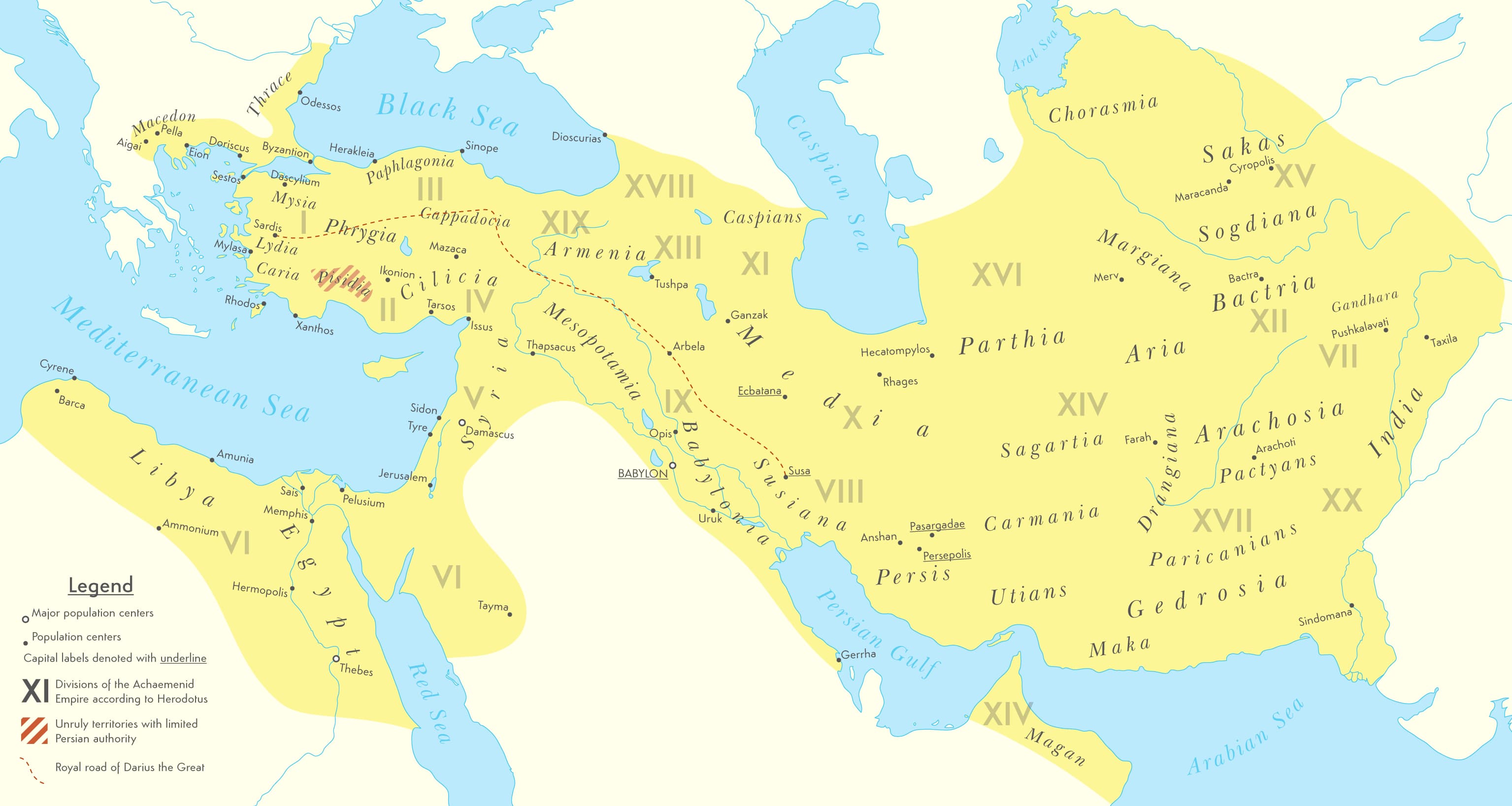
Before it was a colossus, the realm that would become the Achaemenid Empire began with the Parsa, a nomadic people of the seventh century BCE moving through the southwestern highlands of the Iranian plateau.
The world’s first global empire did not begin with a grand theory of statecraft, but with a sudden, violent shift in the geopolitics of the Iranian plateau. In 550 BCE, a regional ruler named Cyrus, sovereign of the ancient Elamite city of Anshan and leader of the nomadic Parsa people, turned his spears against his own overlord and grandfather, Astyages of the Median Empire. Capturing the Median capital of Ecbatana, Cyrus did not merely replace one king with another; he inherited a sprawling network of tributaries and structural rivalries that forced his hand outward. To the west lay Croesus of Lydia, legendary for his gold, who saw the transition of power in Ecbatana as an opportunity to expand. Cyrus’s counteroffensive did not just repel the Lydians; it swallowed them. By 546 BCE, the Lydian capital of Sardis had fallen, and Persian reach touched the Aegean Sea. Turn by turn, the dominoes of the ancient Near East fell. In 539 BCE, Cyrus marched on the Neo-Babylonian Empire. Defeating the Babylonian forces at Opis, he entered the legendary metropolis of Babylon without a siege, claiming the ancient throne not as a foreign destroyer, but as a savior chosen by their own god, Marduk, to restore order.
By the time Cyrus’s heirs completed their initial push, the Achaemenid Empire—named for its shadowy ancestral progenitor, Achaemenes—stretched from the Balkans and Cyrenaica in the west to the Indus Valley in the east. It was an unprecedented geopolitical canvas containing some 5.5 million square kilometers of mountains, deserts, fertile river valleys, and ancient cities. To govern an entity of this scale, which bound together Egyptians, Babylonians, Jews, Phoenicians, Lydians, Greeks, and Central Asian nomads, the Achaemenids had to invent an entirely new language of empire. The core of this system was the satrapy. The empire was divided into provinces ruled by satraps, governors who held vast civil and military authority but remained tethered to the center through a sophisticated administrative network. To bridge the massive distances between these satrapies, the state constructed infrastructure of astonishing efficiency. The most famous artery was the Royal Road, which connected Susa to Sardis, allowing royal messengers to traverse nearly three thousand kilometers in a matter of days using a system of fresh horses and riders stationed at regular intervals. Alongside this physical network ran a linguistic one: while Old Persian remained the language of the court, Imperial Aramaic was adopted as the official administrative script, allowing a scribe in Memphis to communicate seamlessly with a bureaucrat in Bactria.
What truly distinguished the Achaemenid system, however, was its calculated policy of cultural and religious integration, a strategy pioneered by Cyrus and immortalized in his clay cylinder. Rather than imposing the Persian pantheon or the cult of their own supreme deity upon conquered populations, the Achaemenid kings chose to rule as legitimate patrons of local traditions. In Babylon, Cyrus presented himself as the restorer of Marduk’s neglected cult; in Judah, he was remembered as the divinely inspired liberator who ended the Babylonian Captivity, financed the rebuilding of the Jerusalem Temple, and returned the sacred vessels stolen by Nebuchadnezzar. When Cyrus's son, Cambyses II, invaded Egypt in 525 BCE, defeating Pharaoh Psamtik III at the Battle of Pelusium, he did not seek to erase Egyptian identity. Though later Greek historians like Herodotus painted Cambyses as a madman who desecrated temples and slaughtered the sacred Apis bull, contemporary Egyptian records reveal a far more pragmatic reality. Epitaphs show that Cambyses participated in the traditional funeral rites of the Apis bull, styling himself as a proper Pharaoh and honoring the ancient local cults to legitimize his rule over the Nile.
Connected to
- containsBabylon3k BCE
- had as citizenCambyses II559 BCE
- had as citizenCyrus the Great600 BCE
- had as citizenDarius I550 BCE
- followed byMacedonia