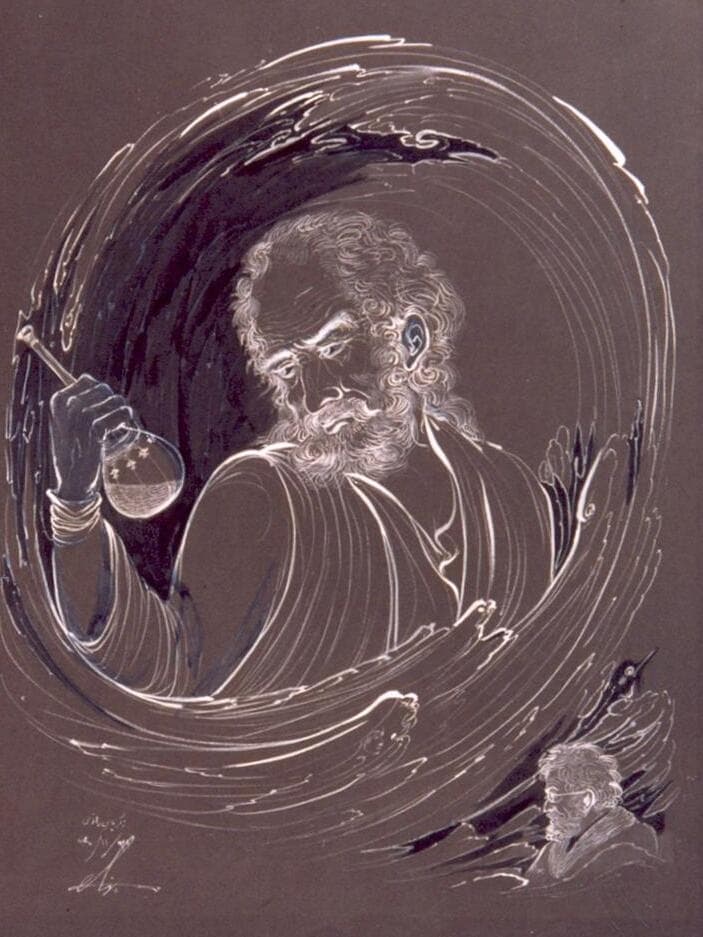
To walk through the wards of the great hospitals of Baghdad and Ray in the late ninth century was to encounter a physician who refused to see poverty as a barrier to healing.
On a humid morning in tenth-century Baghdad, several pieces of fresh meat hung from wooden posts scattered across the city’s various quarters. Passersby along the Tigris might have assumed it was the work of a mad butcher or a bizarre street ritual. In truth, it was a public experiment in atmospheric purity. The designer of this trial was Abu Bakr al-Razi, a physician of formidable intellect and clinical skepticism, who had been commissioned by the Abbasid Caliph Al-Muktafi to select the site for a grand new hospital, destined to be the largest in the Islamic world. Rather than relying on royal whim or astrological alignment, al-Razi chose the location where the meat took the longest to rot, reasoning that the air there was the cleanest and most conducive to healing.
This empirical impulse defined the life and legacy of al-Razi, known to the Latin West as Rhazes. Born in 864 or 865 CE in the ancient city of Ray—a bustling node on the Great Silk Road just south of the Alborz mountain range in modern-day Iran—he was a native Persian speaker who wrote in Arabic, the lingua franca of medieval scholarship. Ray was a place where East met West, a melting pot of merchants, ideas, and manuscripts. Al-Razi’s intellectual journey began there, but it matured in Baghdad, the heart of the Islamic Golden Age. Over his sixty years, he would author more than two hundred manuscripts spanning logic, astronomy, grammar, alchemy, and philosophy. Yet it was in the wards of the bimaristan (hospital) that he established himself as arguably the most original clinical observer of the medieval world, an early champion of experimental medicine whose work eventually crossed the Mediterranean to shape European medical education for centuries.
Al-Razi’s clinical method was built on a radical premise: authority, even that of the revered ancient Greek physician Galen, must yield to direct observation. In his posthumously compiled masterwork, Al-Hawi (The Comprehensive Book on Medicine)—a massive twenty-three-volume collection of his working notebooks—al-Razi repeatedly challenged classical orthodoxy. Where Galen offered theoretical descriptions of urinary ailments based on only three observed cases, al-Razi countered with data gleaned from hundreds of cases he had personally treated in the hospitals of Baghdad and Ray. When he sought to understand the efficacy of blood-letting for treating meningitis, he did not merely consult ancient texts; he set up a control group, comparing the outcomes of patients who underwent the procedure against those who did not.
This systematic observation allowed al-Razi to unlock some of the most persistent medical mysteries of his era. Along with the scholar Thabit ibn Qurra, he was the first to clinically distinguish between smallpox and measles. In his treatise (), al-Razi described the subtle differences in their presentation, a crucial diagnostic breakthrough given that ancient Greek medicine had no concept of smallpox. Translated first into Syriac, then into Greek at the request of a Byzantine emperor, and eventually into Latin, the work introduced Europe to a precise terminology for these eruptive fevers, using the Greek term to bridge the linguistic gap.
+ 8 further connections to entries not yet ingested
Within the hospital walls, al-Razi was as much a teacher as he was a healer. In the tradition of the Abbasid academies, he sat as a shaikh, surrounded by concentric circles of students. When a patient approached with a query, the students in the outermost, first circle would attempt an answer. If the problem eluded them, it was passed to the more experienced second circle, and so on, until it finally reached al-Razi himself. His educational philosophy was rigorous; he urged his pupils to continuously read medical books and expose themselves to new information, warning that even the most educated physicians could not cure every disease. Yet he was equally quick to defend his profession against charlatans and itinerant fake doctors who preyed on the desperate with false promises of instant cures. He maintained that a doctor's true aim was to do good, even to one’s enemies, bound by an oath to never compose "mortiferous remedies."
This ethical compass translated into a deep compassion for those at the margins of society. Al-Razi believed that high-quality medical care should not be the exclusive preserve of the wealthy. While he served as the chief physician to governors and caliphs—and wrote his famous Kitab al-Mansuri (Book for al-Mansur) for the governor of Ray, Mansur ibn Ishaq—he also authored a pioneering home medical manual specifically for the impoverished and the traveler. Entitled For One Who Has No Physician to Attend Him (Man la Yahduruhu Al-Tabib), this thirty-six-chapter book was a guide to self-treatment using cheap, easily accessible ingredients.
In its pages, al-Razi democratized medicine. He prescribed a mixture of rose oil and vinegar applied to a linen cloth for a feverish headache, and a laxative drink made of macerated violet flowers, pears, and sugar. For the melancholic, he recommended remedies containing poppy juice or clover dodder, and for eye ailments, a tablet of myrrh, saffron, frankincense, and yellow arsenic dissolved in coriander water. He sought to empower ordinary citizens to treat their own ailments using items found in any modest kitchen, marketplace, or military camp. Conversely, he occasionally expressed a dry, humorous pity for those physicians tasked with treating princes and noblewomen, noting that such elite patients rarely possessed the discipline to obey a doctor’s dietary restrictions or treatment plans, making them the most difficult of cases.
The end of al-Razi's life was shadowed by physical decay. In his final years, spent in his native Ray, he suffered from cataracts that eventually led to total blindness. Characteristically, he approached his own affliction with clinical rigor. When an traveling physician offered to cure his blindness with a topical ointment, al-Razi stopped him with a test, asking the man how many anatomical layers the eye contained. When the practitioner could not answer, al-Razi dismissed him, declaring, "My eyes will not be treated by one who does not know the basics of its anatomy."
Historians of his era offered competing explanations for his blindness. Ibn Juljul wrote that it was the result of a physical blow to the head delivered by his patron, Mansur ibn Ishaq, after al-Razi failed to provide physical proof for his theories on alchemy. Others, like Abulfaraj, blamed a monotonous diet consisting entirely of beans. Whatever the cause, al-Razi accepted his looming mortality with composure. When a former pupil traveled from Tabaristan to care for him, al-Razi thanked him for his kindness but sent him back home, stating that his final days were at hand. He died in Ray in 925 CE at sixty years of age.
The legacy of this Persian physician, whom the polymath al-Biruni considered his mentor and commemorated with a detailed biography and bibliography, far outlived the Abbasid Caliphate. Translated into Latin in 1279 by Faraj ben Salim, a Sicilian-Jewish physician working for Charles of Anjou, al-Razi’s writings became foundational texts in medieval European universities. Sections of his Al-Mansuri on surgery and therapeutics remained core medical curricula in the West for generations, and a fourteenth-century catalog from Peterborough Abbey in England lists him as a part author of ten different medical texts. By treating the human body as an observable landscape rather than a theoretical construct, al-Razi did not merely compile the medical knowledge of his era—he refashioned medicine into an experimental science.